
NUS's See4D Turns Phone Clips Into Walkable 4D Scenes Without Camera Data
A new framework converts casual handheld videos into free-viewpoint 4D scenes without camera poses, beating pose-conditioned baselines on reconstruction and video quality benchmarks.
 Pro
Takeaways
- See4D generates 4D scenes from single handheld videos without any camera pose annotations, via a trajectory-to-camera formulation.
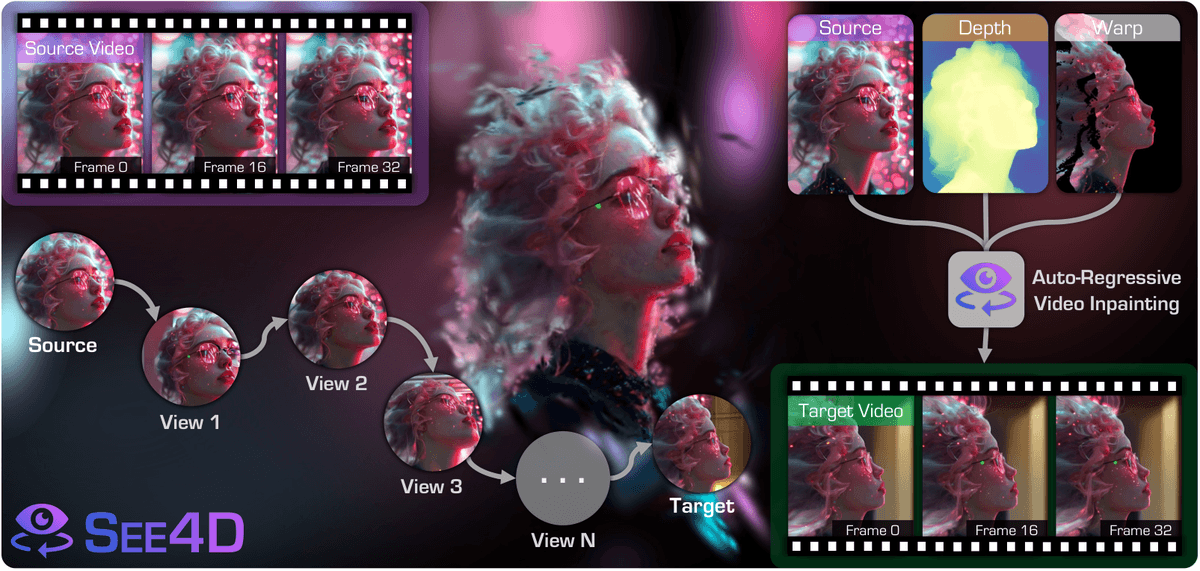
- Method renders input into a bank of fixed virtual cameras, then uses a view-conditional video inpainting diffusion model.
- Three innovations: realistic warp synthesis, noise-adaptive conditioning tied to mask density, and a spatial-temporal transformer backbone.
- Dual auto-regressive inference: spatial spline hops across virtual cameras, temporal sliding window with overlapping clean frames.
- Beats TrajectoryCrafter and ReCamMaster on iPhone 4D reconstruction (PSNR 14.56) and wins 5/6 VBench metrics.
- Demo videos and paper available at the project page; trained on SynCamMaster and ReCamMaster.
Turning a single handheld phone clip into a free-viewpoint 4D scene, where you can wander around actors and objects while time keeps moving, has been one of the messier problems in generative vision. Most working solutions demand precise per-frame camera poses that are painful to collect on in-the-wild footage. A team from NUS, HKU, CUHK, Tsinghua, Shanghai AI Lab, Horizon Robotics, and NTU is proposing a way around that with See4D, a pose-free framework that reframes the problem as inpainting videos rendered into fixed virtual cameras.
Why pose annotations keep breaking 4D pipelines
Video-to-4D research has split into two camps. The first conditions models on explicit poses, assuming each frame is paired with a precise external pose in a specific coordinate system, which is hard to obtain for the dynamic hand-held videos common on online platforms. The second uses a warp-then-inpaint trick: estimate monocular depth, project pixels into a target view, then let a diffusion model hallucinate the missing regions.
Warp-then-inpaint sidesteps pose labels but comes with its own baggage. Most of these systems are optimized for trajectory-to-trajectory synthesis, generating a novel video from an entirely different camera path while preserving synchronized scene dynamics. This dual-trajectory formulation is under-constrained, which complicates training and makes inference less stable. Generated viewpoints tend to hug the input path, and reconstruction quality is sensitive to per-frame depth accuracy. In other words, camera motion and scene dynamics get tangled together inside the model.
Fixed virtual cameras instead of predicted trajectories
See4D takes what the authors call a trajectory-to-camera formulation. Rather than predicting a new camera path, the system renders the input into a bank of synchronized, fixed virtual cameras. A view-conditional video inpainting model learns a geometry prior by denoising realistically synthesized warped images and filling occluded regions across virtual viewpoints, eliminating the need for explicit 3D annotations.
The pipeline works in latent space using a standard latent diffusion backbone. Depth is estimated per frame, pixels are lifted into 3D, and each frame is warped toward a target virtual pose using the intrinsics and a relative transform. That produces a partially filled image plus a visibility mask marking depth clashes and off-screen projections. The diffusion model then denoises the target latent while conditioned on the warped image, the mask, and the clean source latent.

Three tricks that make it work on dynamic footage
Prior warp-conditioned models were tuned for static scenes and fell apart under motion. See4D introduces three components to fix that:
- Realistic warp synthesis. During training, target frames get forward-projected to a random nearby pose and back-projected with jitter, imitating the tearing, stretching, and disocclusion patterns produced by noisy monocular depth at inference time. The foreground-centric rotation produces realistic disocclusions around moving objects, whereas arbitrary global rotations tend to introduce largely unstructured noise.
- Noise-adaptive conditioning. The warp latent gets perturbed with more noise than the target latent, and the blend between them is modulated by the density of the visibility mask. Reliable warps transmit more signal, sparse or noisy ones are suppressed, so the network cannot overfit to bad geometric cues.
- Spatial-temporal backbone. Each 2D transformer block is upgraded with sinusoidal frame-time embeddings and attention across neighboring frames, forcing cross-view and cross-frame coherence without a heavyweight video diffusion model.
Two auto-regressive loops at inference
Even with a solid inpainter, a single warp from source to a distant target camera produces too much tearing and occlusion. See4D handles this with a dual recursion. Spatially, it spline-interpolates a chain of virtual cameras between source and target and hops through them one small step at a time. At each step it warps, inpaints, re-estimates depth, and scale-aligns it before the next hop. Temporally, a sliding window scheme prepends the last few clean latent frames from the previous window to the next batch of noisy frames, acting as a temporal anchor that eliminates seams between diffusion runs.
The numbers
The team trained on two synthetic multi-view datasets, SynCamMaster with 34K clips from 3.4K scenes filmed by ten static cameras, and ReCamMaster with 13.6K scenes captured by nine moving and one fixed camera, yielding 136K clips for a combined 170K temporally aligned videos. Training used 512x512 resolution, 16-frame sequences, and ran on eight NVIDIA A800-80GB GPUs for about 48 hours starting from See3D weights.
On the iPhone dataset for 4D reconstruction, See4D posts an average PSNR of 14.56 versus 14.24 for the previous best diffusion baseline, TrajectoryCrafter, with corresponding gains on SSIM (0.442 vs 0.417) and LPIPS (0.492 vs 0.519). Pose-conditioned ReCamMaster lands at PSNR 12.02, and the Shape-of-Motion reconstruction pipeline reaches 11.28.

On a set of 200 in-the-wild WebVid clips evaluated with the VBench protocol, See4D wins five of six metrics including subject consistency (92.18), background consistency (94.63), and aesthetic quality (41.35), coming second only on motion smoothness. Ablations show every component matters: removing the spatial-temporal transformer collapses PSNR from 14.56 to 10.66, and dropping the noise-adaptive condition drops it to 13.47.
Where this actually helps
The authors demonstrate the pipeline on four downstream applications that map naturally onto the trajectory-to-camera framing:
- Robotic manipulation. Generating a panoramic overview of a workbench from a single wrist-camera clip for grasp planning.
- Autonomous driving. Augmenting a single dash-cam feed with virtual side and rear views that preserve static infrastructure and moving traffic.
- Interactive gaming. Turning single in-game captures into multi-angle fly-through replays.
- Cinematic post-production. Producing stabilized off-axis takes from handheld footage with filled occlusions.
The limitations are the usual ones for this class of methods. Reconstruction quality still depends on the underlying monocular depth estimator, and the model was trained on synthetic multi-view data, which means the domain gap for very unusual in-the-wild footage remains an open question. The paper does not include code links yet, but the authors maintain a project page with demo videos, and the paper itself is on arXiv with full methodology and appendix results.
The broader takeaway is architectural: by refusing to predict a camera trajectory and instead committing to a fixed bank of virtual cameras, the model gets to decouple two problems that have been fighting each other for years, camera control and scene dynamics. That decoupling shows up cleanly in the benchmarks, and it opens a path to 4D content pipelines that do not need a calibrated capture rig or a COLMAP preprocessing step to work.