
NUS's ImagiNav Trains Robots to Navigate Using 30 Minutes of iPhone Footage
A new modular navigation framework lets robots learn from smartphone walking videos instead of expensive robot demonstrations, achieving zero-shot transfer to humanoid platforms.
 Pro
Takeaways
- ImagiNav decouples visual planning from robot control by having a video model imagine future frames of task completion.
- Three-stage pipeline: Gemini 3.0 Flash reasoner, LoRA-finetuned LTX-Video-2B planner, VGGT for pose extraction.
- Trained on only 33 minutes of handheld iPhone footage instead of costly robot demonstrations or simulation data.
- Zero-shot transfer to Unitree H1 humanoid in VLN-PE benchmark with 36% success rate.
- Action-Conditioned Mixture-of-Experts routes left and right turns to separate specialists to fix spatial ambiguity.
- Real-data variant beats sim-trained equivalent on FVD (65 vs 73) and Motion Fidelity (0.72 vs 0.67).
Teaching robots to follow instructions like "walk down the hallway and turn left at the vending machine" usually means one of two painful choices: collect thousands of hours of expensive robot demonstrations, or train in simulators that never quite match the messy reality of the physical world. A team from the National University of Singapore and A*STAR is proposing a third path with ImagiNav, a framework that turns any egocentric walking video into training data for a navigation policy, without ever touching a robot.
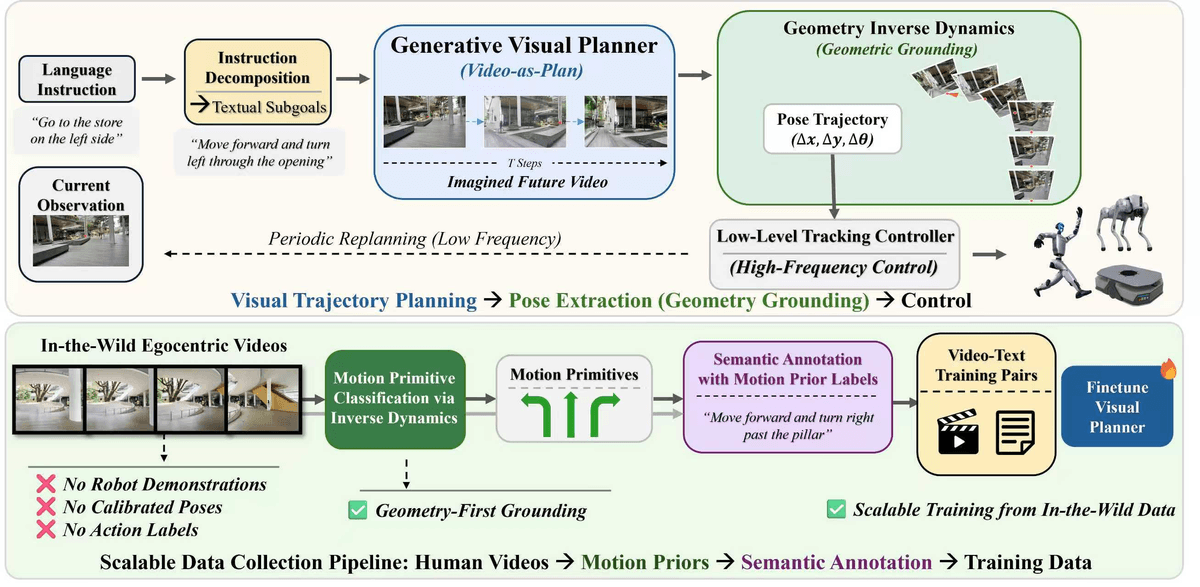
The core idea flips the usual pipeline on its head. Instead of learning a direct mapping from pixels to motor commands, ImagiNav treats a video generation model as the planner. Given a language instruction and the robot's current view, it imagines the future first-person video of completing the task, then extracts a trajectory from that imagined footage using geometric pose estimation. While robot kinematics vary across platforms, the visual outcome of what the agent expects to see while progressing toward a goal is largely embodiment-invariant.
Why simulation keeps hitting a wall
Vision-Language Navigation (VLN) is the task of getting a robot to follow natural language directions in unfamiliar environments. The dominant recipe has been end-to-end policies trained on synthetic data, but rendered indoor scenes never quite capture the visual richness or the physical dynamics of the real world. Collecting robot demonstrations at scale is prohibitively expensive, while the massively abundant alternative, web-scale egocentric video, comes with a catch: clips lack the action labels required to train conventional policies.
ImagiNav sidesteps this by never predicting actions during training. The video model learns to produce plausible future visual sequences conditioned on text, and geometry does the rest at inference time.
How the three-stage hierarchy works
The framework runs as a chain of three foundation models, each doing something they're already good at:
- Semantic reasoner: Gemini 3.0 Flash handles high-level task decomposition, breaking a natural language instruction into a textual subgoal describing the expected future motion.
- Visual imagination: A LoRA-finetuned LTX-Video-2B latent diffusion model synthesizes a 480x256 video of 121 frames at 24 Hz, showing what the robot should see as it executes the subgoal.
- Inverse dynamics: VGGT, a geometric foundation model, extracts relative camera poses from the generated video, and the IDM decodes the synthesized frames into relative ego-motion waypoints that a simple proportional controller then tracks.
One clever detail addresses a chronic weakness of video generators: telling left from right. The authors bifurcate their training data and finetune two specialists, one biased toward left turns and one toward right, then route between them based on the subgoal. They call this an Action-Conditioned Mixture-of-Experts (AC-MoE) strategy that dispatches the generation task to specialized experts, yielding precise motion dynamics.

A data pipeline that skips the robot
Because the planner operates in visual space, the training data doesn't need pose annotations or action labels. The team collected videos by walking around with an iPhone in shopping malls and university campuses. Clips are sampled from approximately 33 minutes of raw footage and labeled using an IDM-guided procedure, yielding 2,558 clips of 121 frames each after geometric mirroring augmentation to reduce class imbalance.
The auto-labeling itself uses a geometry-first trick to avoid a common failure mode. Directly relying on VLMs for annotation introduces spatial hallucination errors, particularly in directional reasoning. The authors adopt a geometry-first, semantics-second supervision pipeline: extract motion primitives from pose estimation first, then prompt an LLM to write captions consistent with the recovered motion. They also map navigation verbs to camera movement terminology, replacing "move" with "dolly" and "turn" with "pan" to align with the pretraining distribution of the video model.
What the numbers show
Evaluation happens on VLN-PE, a physically realistic benchmark built on NVIDIA Isaac Sim, using a simulated Unitree H1 humanoid. Even though ImagiNav-Real was trained purely on handheld human videos and has almost no exposure to residential indoor scenes, it transfers.
| Method | Data | Success Rate | SPL |
|---|---|---|---|
| InternVLA-N1 (in-domain) | ~1000h sim | 0.53 | 0.44 |
| NavDP (zero-shot) | ~101h sim | 0.32 | 0.31 |
| ImagiNav-Sim | ~0.5h sim | 0.39 | 0.37 |
| ImagiNav-Real | ~0.5h real | 0.36 | 0.35 |
The striking result is that ImagiNav-Real, with 30 minutes of iPhone footage, matches a diffusion policy trained on 100+ hours of simulation data. On the video generation metrics, real-data training also wins: the Real-Finetuned model achieves an FVD of 65.39 versus 72.72 for Sim-Finetuned, and Motion Fidelity of 0.72 versus 0.67. Simulation gives slightly better in-domain layout priors, but the kinematics are unnatural. As the paper puts it, while in-domain simulation data provides better visual layout priors, real-world human data offers superior motion dynamics.

What breaks, and what's next
The approach is not ready for production robots. The team is candid about three limitations:
- Inference latency. The high computational cost of video generation currently restricts the system to a low-frequency control regime, limiting reactivity to sudden dynamic hazards.
- Geometric hallucinations. Operating purely in RGB space can produce visually plausible but physically unsafe trajectories. A dedicated safety scorer or depth grounding could help.
- MoE overhead. Managing separate left and right turn experts is a preliminary fix for spatial reasoning, not a clean solution.
Future directions include distilling the heavy generative model into a lightweight, real-time policy, integrating explicit depth modalities into the generation process, and merging the specialized experts into a single unified model.
Riding the coattails of consumer video AI
The bigger claim here is architectural. If video generation quality keeps improving at its current pace, then any advance in models like LTX-Video or Wan translates directly into better robot planners without retraining on new demonstrations. The same logic applies to geometric foundation models: as VGGT improves, the inverse dynamics stage improves for free. Data collection collapses from teleoperated robot rigs to someone walking around with a phone. That's a very different scaling curve than the one embodied AI has been on, and it hints at a route where generalist navigation models could ride the coattails of consumer video generation research rather than requiring their own dedicated data-gathering infrastructure. The project page is available at j1dan.github.io/ImagiNav for demos and updates.