
NUS Reveals SNNs Only Beat Quantized Networks Under Extremely Rare Conditions
A rigorous analytical framework shows SNNs only beat quantized neural nets under tight conditions: spike rates below ~6% and short time windows
 Pro
Takeaways
- SNNs only beat equivalent quantized ANNs when spike rate stays below ~6% and time windows are 5 timesteps or fewer.
- The paper introduces "QNN-SNN twins": pairing an SNN at T timesteps with a QNN at ⌈log₂(T+1)⌉ bits for a fair energy comparison.
- Data movement (memory access + on-chip routing) often dominates compute energy, and SNNs pay a hidden cost by accessing weights T×sᵣ times per neuron vs. once for QNNs.
- Real-workload tests on VGG16/ResNet/transformers confirm: at T=7, SNNs use 2.3× more energy than twin QNNs on GLUE benchmarks.
- An optimized SNN can nearly double smartwatch battery life vs. a QNN, but only under tight co-design constraints.
- No code released; the contribution is a first-principles analytical energy model for SNN vs. QNN hardware comparison.
Spiking Neural Networks (SNNs) have long been celebrated as the energy-efficient future of AI inference. The pitch is intuitive: instead of multiplying dense tensors like conventional networks, SNNs fire sparse binary spikes, skipping most computations and promising massive power savings on neuromorphic hardware. But a new paper from the National University of Singapore asks a harder question: are those savings real once you account for everything?
The answer is: sometimes, but only under conditions that most deployed SNNs don't currently meet.
The flawed benchmark that inflated SNN claims
Prevailing energy evaluations often oversimplify, focusing on computational aspects while neglecting critical overheads like comprehensive data movement and memory access. Such simplifications can lead to misleading conclusions regarding the true energy benefits of SNNs. The standard approach counts additions (used by SNNs) versus multiply-accumulate operations (used by conventional networks) and calls it a day. That ignores the elephant in the room: memory.
The deeper problem is that the comparison was never apples-to-apples. An SNN running over T timesteps was being compared against a full-precision ANN, which is like racing a bicycle against a car and declaring the bicycle wins on fuel efficiency without accounting for the trip taking ten times longer.
The QNN-SNN twin: a fair fight at last
The paper's first key contribution is establishing a principled equivalence. The authors establish a fair baseline by mapping rate-encoded SNNs with T timesteps to functionally equivalent QNNs with ⌈log₂(T+1)⌉ bits, ensuring both models have comparable representational capacities as well as similar hardware requirements, enabling meaningful energy comparisons.
The intuition is clean: an SNN running for T=7 timesteps can produce spike counts from 0 to 7, which is exactly 8 distinct output levels, representable in 3 bits. So the fair comparison is SNN at T=7 versus a 3-bit QNN. These "QNN-SNN twins" share the same architecture and weight precision, differing only in how they represent activations.
Once you fix the comparison this way, the energy model has three components:
- Compute energy: additions (SNN) vs. multiply-accumulate operations (QNN), scaled by sparsity
- Data movement energy: fetching weights and transferring activations across the chip's network-on-chip (NoC)
- Control energy: excluded from the analysis as it is architecture-specific
The critical insight is that data movement often dominates compute. Due to the poor scalability of memories (commonly known as the memory wall), the energy consumption of memory operations becomes even dominating over the energy spent by the computations themselves. And here SNNs have a hidden cost: because they process T timesteps, they access weights up to T × sᵣ times per neuron activation, where sᵣ is the spike rate. A QNN fetches each weight just once.
Where SNNs actually win
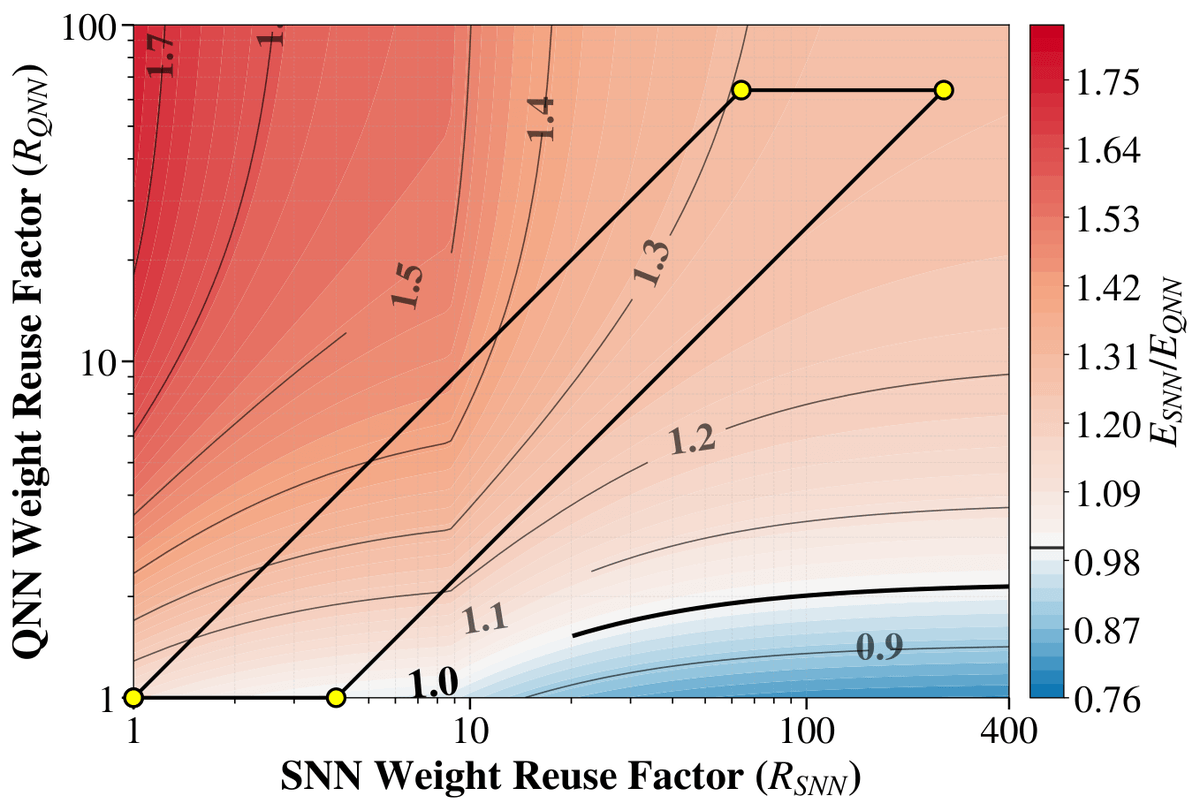
The analysis identifies specific operational regimes where SNNs genuinely offer superior energy efficiency. Under typical neuromorphic hardware conditions, SNNs with moderate time windows (T ∈ [5,10]) require an average spike rate below 6.4% to outperform equivalent QNNs.
The paper sweeps a wide parameter space to map out exactly where the crossover happens. The key variables are:
- Time window T: how many timesteps the SNN processes per inference
- Spike rate sᵣ: the fraction of neurons that fire at each timestep (the "density" of computation)
- QNN activation sparsity γ: how many zero activations the QNN has (e.g., from ReLU)
- Weight precision: 4-bit vs. 8-bit weights
- Hardware routing distance: how many chip-to-chip hops data must travel (k_hop)
The dominant finding: the SNN's energy scales with T × sᵣ, while the QNN's energy scales with ⌈log₂(T+1)⌉. Since a logarithm grows much slower than a linear product, longer time windows are disproportionately expensive for SNNs. A model at T=5 with sᵣ=5.7% is right at the break-even point. Push either number up and the QNN wins.
The memory wall hits SNNs harder than expected
The paper distinguishes between two types of data movement: dense transfers (cheap, amortized per bit) and sparse event-driven transfers (expensive, with per-packet overhead for routing metadata). Sparse activations are often transported as fine-grained, dynamically generated events over the on-chip interconnect, so the useful payload is accompanied by additional transaction overheads such as packet headers, routing and arbitration, buffer accesses, and control activity.
This creates a counterintuitive threshold. Under typical neuromorphic hardware settings, when the SNN spike rate exceeds roughly 12–17%, it becomes cheaper to broadcast data densely rather than event-driven. At that point, the SNN's supposed advantage from sparsity evaporates.
Routing distance (k_hop) matters too. The paper shows that as the average number of hops between cores increases, SNNs lose their edge faster. At k_hop ≈ 0.46 (close to what real neuromorphic chips achieve), SNNs without temporal weight reuse already reach parity with QNNs for a typical configuration of T=4, sᵣ=0.1.
Real model validation confirms the theory
The team validated the analytical model on actual workloads across CIFAR-10, CIFAR-100, ImageNet, and GLUE benchmarks using VGG16, ResNet-18, RepVGG, and transformer models. The accuracy gap between QNN-SNN twins was consistently small, keeping the energy comparison fair.
For VGG16 on CIFAR-10, the SNN is marginally better at T=3 (energy ratio 0.982), but becomes clearly worse at T=5 (ratio 1.400) and reaches 2.236× at T=7. On CIFAR-100, the SNN is already worse at T=3. For transformer workloads on GLUE, the energy ratio is approximately T / ⌈log₂(T+1)⌉, meaning an SNN at T=7 uses 2.3× more energy than its QNN twin, and at T=15, 3.76× more.
The smartwatch case: when SNNs genuinely shine
To make the findings concrete, the paper analyzes a smartwatch running continuous health monitoring. SNN energy efficiency is not a given, but requires a confluence of favorable algorithmic and hardware properties. At a high level, the design space for energy-efficient SNNs depends on achieving a low total number of spike events (a low T·s product), hardware optimized for low-cost sparse event processing, and a substantial MAC-to-ACC energy ratio.
Under the right conditions, an optimized SNN can nearly double battery life compared to a QNN. But that requires hitting all three criteria simultaneously: short time windows, extremely low spike rates, and hardware that efficiently handles sparse events.
What this means for SNN practitioners
The paper's conclusions are practical and specific. Under typical neuromorphic hardware conditions, SNNs with moderate time windows (T=5) require an average spike rate below 5.7% to outperform equivalent QNNs. Beyond that operating point, a well-optimized QNN is the more energy-efficient choice.
The key design rules that emerge:
- Keep time windows short:
T ≤ 5is the recommended ceiling for energy efficiency - Target spike rates below 6%: most published SNN architectures run at 10–30%, well above this threshold
- Use higher weight precision (8-bit over 4-bit) when possible: it raises the break-even spike rate, giving SNNs more headroom
- Minimize routing hops: chip mapping quality has a large effect on whether sparse event transmission is actually cheaper
- Consider temporal weight reuse: hardware that keeps weights resident across timesteps can make SNNs up to
T× more efficient on weight loading
The paper also flags a subtlety around "aggregated transmission" strategies, where spike trains are compressed into log₂(T)-bit counts before transmission. This approach eliminates the sparse-event overhead but also eliminates the ability to exploit timestep-level sparsity, making it functionally equivalent to a QNN in data movement cost.
The broader implication
This work doesn't say SNNs are bad. It says the conditions under which they're better are narrower than the field has assumed, and it gives you a quantitative tool to check whether your specific model and hardware combination actually lands in the winning zone. The analytical framework can be related to NeuroBench-style metrics without requiring full benchmark execution, with key quantities such as footprint, synaptic operations, and sparsity naturally derived from the model.
For edge AI on wearables, IoT sensors, and always-on devices, SNNs remain a compelling target, but only if the model is co-designed from the start to operate with both short time windows and extreme sparsity. Retrofitting a high-accuracy SNN that runs at T=32 and 20% spike rate onto neuromorphic hardware and expecting energy savings is, according to this analysis, wishful thinking. No code or model weights are released with this work, as it is an analytical study rather than a training framework.