
NUS Builds WikiDBGraph to Expose Federated Learning's Broken Benchmarks
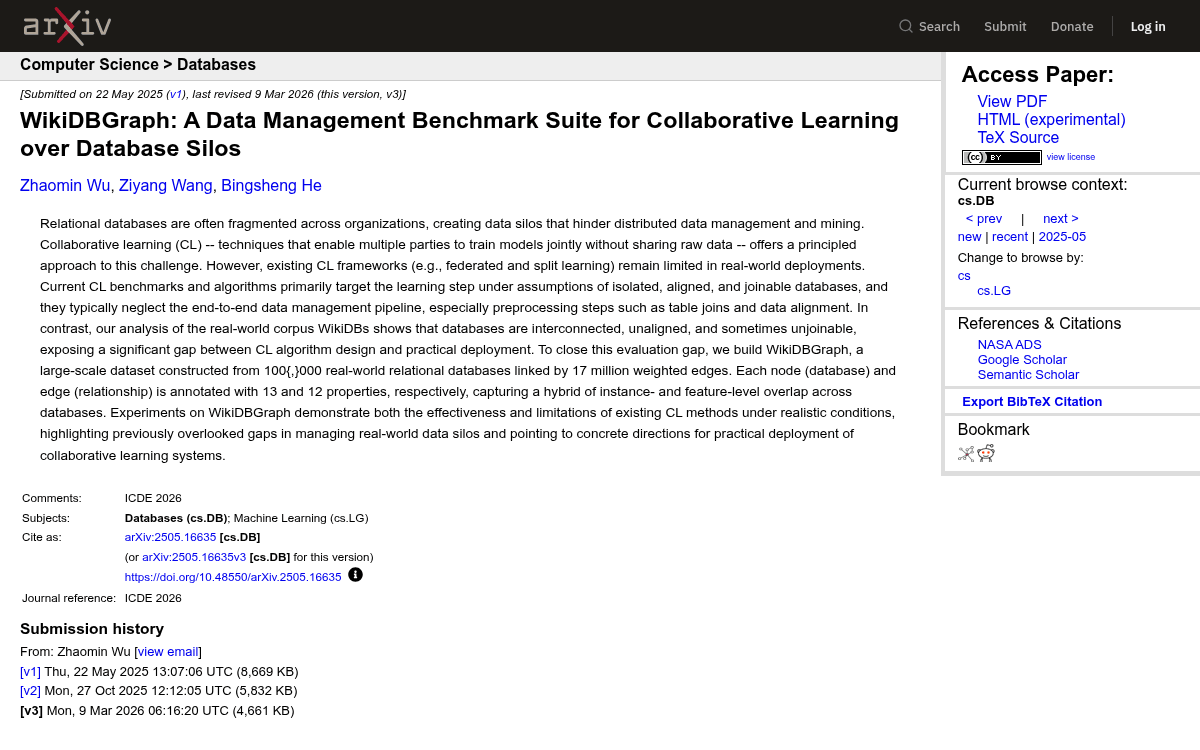
WikiDBGraph exposes a critical gap in federated learning benchmarks by mapping 100,000 real-world databases into a graph of 17 million edges, revealing that real data silos are interconnected, misaligned, and often unjoinable
 Pro
Takeaways
- WikiDBGraph is a new benchmark of 100,000 real-world relational databases linked by 17 million weighted edges, built to expose gaps in federated learning research.
- Analysis of real databases shows they are interconnected, unaligned, and often unjoinable -- the opposite of what most CL benchmarks assume.
- A contrastive learning model fine-tuned on BGE-M3 achieves AUC-ROC of 0.9967 for predicting database relatedness, uncovering millions of implicit connections.
- In automated end-to-end experiments, fewer than half of 1,207 tasks benefited from collaborative learning, with preprocessing quality identified as the main bottleneck.
- Manually curated case studies show CL does work well when alignment is correct, with FedAvg and SplitNN approaching centralized training performance.
- Dataset and code are publicly available: HuggingFace dataset (CC BY 4.0) and GitHub repo (Apache 2.0).
Federated learning has a dirty secret: its benchmarks are built on a fantasy. Nearly every major benchmark for collaborative learning -- the family of techniques that lets organizations train models together without sharing raw data -- assumes that each participant's database is neatly isolated, perfectly aligned with others, and small enough to join into a single table. A new paper from the National University of Singapore tears that assumption apart, and builds a dataset to prove it.
The result is WikiDBGraph, a large-scale graph of 100,000 real-world relational databases linked by 17 million weighted edges. It is the first benchmark designed to reflect what enterprise data silos actually look like -- messy, interconnected, and stubbornly resistant to the clean abstractions that most collaborative learning (CL) algorithms depend on.
The benchmark gap nobody was measuring
Collaborative learning (CL) is the umbrella term for techniques -- including federated learning, split learning, and transfer learning -- that allow multiple parties to train a shared model without exposing their raw data. The appeal is obvious: hospitals, banks, and government agencies all sit on valuable data they cannot legally or competitively share. CL promises to unlock that value.
Existing CL frameworks remain limited in real-world deployments. Current benchmarks and algorithms primarily target the learning step under assumptions of isolated, aligned, and joinable databases, and they typically neglect the end-to-end data management pipeline, especially preprocessing steps such as table joins and data alignment.
The standard workaround is to take a single large dataset and artificially split it across simulated clients. Many benchmarks are synthetic, formed by partitioning a centralized dataset to simulate distribution, and thus may not reflect natural heterogeneity. Others are built from real-world sources but assume perfect alignment into horizontal CL (disjoint samples, same features) or vertical CL (disjoint features, same samples), whereas practical collaboration often involves partial overlap in both. Moreover, most benchmarks model each client as a single table and implicitly treat all inter-client relationships as equally relevant, which is unrealistic for multi-table databases.
The authors analyzed WikiDBs, a corpus of 100,000 relational databases extracted from Wikidata, and found the opposite of what benchmarks assume. Real databases are:
- Interconnected, not isolated -- they form a graph where some databases are densely linked and others are peripheral
- Unaligned -- they rarely share the same columns or rows in a clean way; even when schemas look similar, column names are noisy and orderings differ
- Unjoinable -- the estimated row count from joining all tables in an average database is 9 x 10^16, making full joins computationally impossible
Building the graph
The core challenge was that WikiDBs, despite containing 100,000 databases, had almost no explicit connections between them. Only 8,816 correlated pairs were identifiable through a shared Wikidata topic ID, leaving over 90% of databases without any link. The team needed to infer the missing connections.
Their approach uses contrastive learning -- a technique where a model learns to pull similar items together and push dissimilar ones apart in a vector space. Each database is serialized into a compact text representation: its name, table names, column names, and three sample values per column. A pre-trained language model (BGE-M3) is then fine-tuned using InfoNCE loss, where pairs sharing the same Wikidata topic ID are treated as positives and random pairs as negatives.
The fine-tuned model achieves an AUC-ROC of 0.9967, compared to 0.9663 for the base model without fine-tuning. Crucially, the model discovers a massive tail of high-similarity database pairs that the original topic-ID labels missed entirely -- substantially expanding the network beyond what explicit metadata could provide.

Once embeddings are computed for all 100,000 databases, the team uses FAISS for efficient nearest-neighbor retrieval and connects databases whose cosine similarity exceeds a configurable threshold. The final graph contains up to 26.8 million edges at the lowest confidence threshold, with each node and edge annotated with rich metadata.
What the graph reveals
WikiDBGraph annotates every node (database) with 13 properties and every edge (relationship) with 12 properties, spanning structural, semantic, and statistical dimensions. Some key findings from the graph structure:
- Long-tailed connectivity: The degree distribution mirrors social networks -- a few hub databases connect to thousands of others, while most sit in small clusters or are isolated entirely
- Hybrid alignment is the norm: The average Jaccard overlap of column names across connected databases is only 0.36, and the average instance overlap ratio is 0.22 -- meaning most pairs are neither purely horizontal nor purely vertical, but somewhere in between
- Unjoinable at scale: The mean AllJoinSize (estimated rows from joining all tables in a database) is 9 x 10^16, rendering any CL method that requires a pre-joined table impractical
- Significant non-IID heterogeneity: 24.7% of database pairs fall into a high-heterogeneity regime, with 18.4% showing extreme label skew -- a distribution that existing synthetic benchmarks rarely capture

Do existing CL algorithms actually work?
The team ran an automated end-to-end pipeline on the top 2,000 most similar database pairs, selecting classification tasks, joining tables, aligning columns by string matching, and training a suite of CL algorithms including FedAvg, FedProx, FedOV, SplitNN, and SCAFFOLD. Of 2,000 pairs, 1,207 completed training successfully.
The results are sobering. Fewer than half of the tasks benefit from CL. The high rate of non-improvement indicates that the primary bottleneck lies in data preprocessing. The automated pipeline -- which uses simple string-based column alignment -- can miss semantic matches or, worse, join dissimilar columns. This produces a "garbage in, garbage out" effect where misaligned data actively hurts collaborative performance.
| Algorithm | Tasks Improved vs. Solo | Total Tasks | Improvement Rate |
|---|---|---|---|
| FedAvg | 566 | 1207 | 46.9% |
| FedProx | 576 | 1207 | 47.7% |
| FedOV | 559 | 1207 | 46.3% |
| SCAFFOLD | 405 | 1207 | 33.6% |
| Combined (centralized) | 565 | 1207 | 46.8% |
The manually curated case studies tell a different story. When the team hand-aligned two bioinformatics databases with near-identical schemas (feature overlap), FedAvg pushed accuracy from 0.29 (the weaker solo baseline) up to 0.62, while centralized training reached 0.90. For an instance-overlap pair (databases sharing the same gene IDs), SplitNN jumped from 0.41 solo accuracy to 0.65 -- close to the 0.68 centralized ceiling. The gap between automated and manual results points squarely at preprocessing quality, not the CL algorithms themselves.
Switching from string-based column alignment to semantic alignment using DeepJoin improved mean F1 by 0.06 to 0.09 across FedProx, FedOV, and FedAvg -- a meaningful gain that confirms the diagnosis.
The real bottleneck is data management, not model training
Current CL benchmarks and algorithms primarily target the learning step, and they typically neglect the end-to-end data management pipeline, especially preprocessing steps such as table joins and data alignment. WikiDBGraph makes this concrete: even when the right database pairs are identified, the pipeline for preparing them for joint training is broken.
The paper identifies three open research directions that WikiDBGraph is now equipped to drive:
- Schema matching at scale: Identifying which columns across two databases actually correspond to the same concept, without human labels
- Record linkage under noise: Matching rows across databases when identifiers are inconsistent or missing, in a way that feeds back into downstream task performance
- Graph-native CL algorithms: Methods that operate directly on relational database graphs -- tables connected by foreign keys -- rather than requiring a pre-joined flat table as input
WikiDBGraph identifies correlated databases that present superior performance in collaborative learning compared to using isolated databases, highlighting its utility for advancing federated learning, split learning, tabular foundation models, and the development of more collaborative learning methods. Both the code and the dataset are publicly available under Apache 2.0 and CC BY 4.0 licenses respectively, making it straightforward to plug WikiDBGraph into existing CL research pipelines.