
NUS Builds P-GSVC to Deliver 2.6 dB Sharper Video Streaming
P-GSVC organizes 2D Gaussian splats into base and enhancement layers, and a cyclic joint training scheme fixes the ugly artifacts that layer-wise training normally produces.
 Pro
Takeaways
- P-GSVC is the first layered progressive 2D Gaussian splatting framework unified for images and video, from NUS, accepted at MMSys 2026.
- Splats are organized into a base layer plus enhancement layers, enabling one bitstream to serve multiple quality and resolution levels.
- A cyclic joint training scheme supervises the full output and one intermediate level per step, fixing cross-layer gradient conflicts.
- Gains up to 2.6 dB PSNR on DIV-HR images and 1.9 dB on UVG video over sequential layer-wise training like LIG.
- Rendering hits about 1200 fps on an H100 for all three layers simultaneously, but encoding takes roughly 720 seconds per frame.
- Code is open source at github.com/LonganWANG-cs/PGSVC; built on the gsplat library.
Scalable video codecs like JPEG2000 and HEVC-SHVC have been quietly powering adaptive streaming for decades by splitting a bitstream into a coarse base layer and successive enhancement layers. A team from the National University of Singapore has now brought that same idea to 2D Gaussian splatting, the explicit primitive that has been eating into NeRF's territory for image and video representation. Their new framework, P-GSVC, is billed as the first layered progressive 2D Gaussian splatting framework that works uniformly for both images and video.
The headline number: the joint training strategy can gain up to 1.9 dB improvement in PSNR for video and 2.6 dB improvement in PSNR for image when compared to methods that perform sequential layer-wise training. That is a large jump for a codec paper, and it comes almost entirely from rethinking how the layers are optimized rather than from any new primitive.
Why splatting resists being sliced into layers
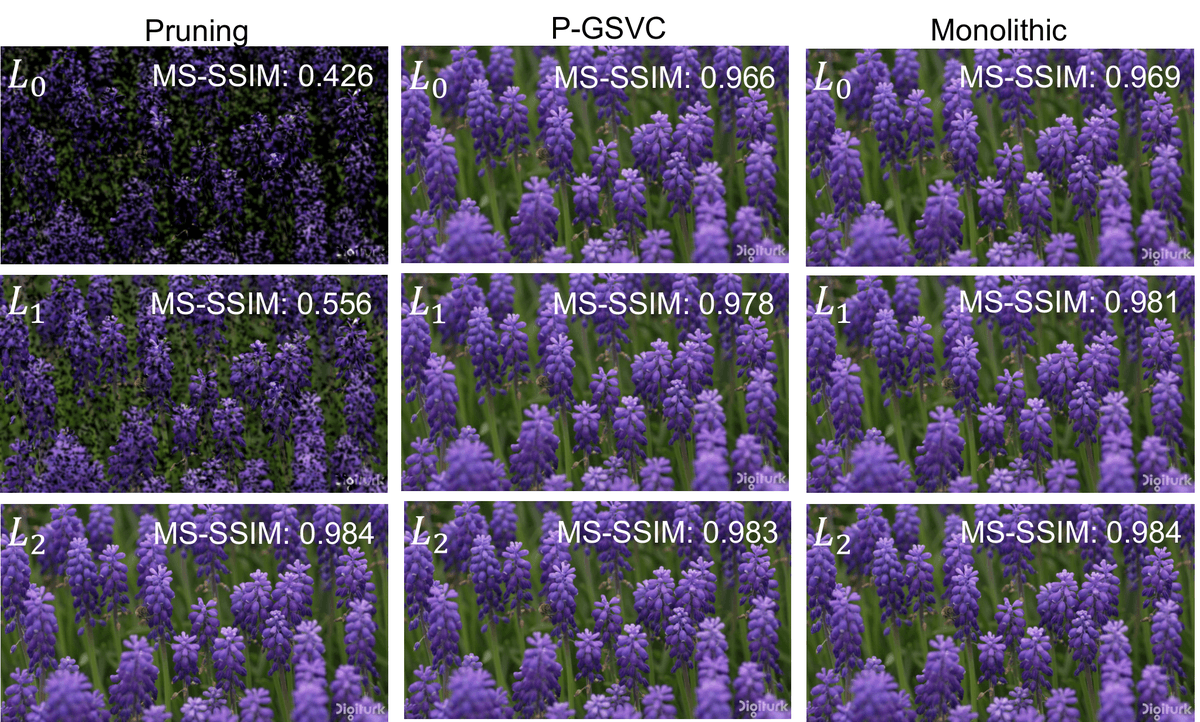
2D Gaussian splatting represents an image as a cloud of small Gaussian blobs, each carrying position, covariance, color and opacity. It renders fast and compresses well, but slicing that cloud into progressively decodable layers is deceptively hard. The obvious approach, ranking splats by their contribution and putting the important ones in the base layer, produces visible artifacts such as noticeable gaps in the reconstructed frames. The root cause is that splats are jointly trained to overfit the highest fidelity input by design, making them highly interdependent on each other, so removing any subset shreds the reconstruction.
The other obvious approach, borrowed from layered 3D Gaussian work like LapisGS, is to train layers one at a time and freeze the previous ones. Videos contain substantial temporal dynamics across frames, including motion, lighting changes, and occlusions. As GSVC uses Gaussian prediction for P-frames, these dynamics increase the interdependency of the Gaussian splats, not only across the layers but also across time. Freezing lower layers then forces higher layers to fight a losing gradient battle, and training gets stuck in a bad local minimum with only marginal gains at the top of the pyramid.
The fix: cyclic joint training
P-GSVC keeps the layered structure but changes how it is trained. Instead of freezing lower layers, every iteration supervises two reconstructions at once: the full-quality output using all layers, and an intermediate output using only up to layer i. The intermediate target is then cycled through the layers in a fixed order.

The authors flag two failure modes they had to design around:
- Cross-layer optimization conflict: base layers want coarse structure, enhancement layers want high-frequency detail, and locking them into separate objectives produces conflicting gradients. Joint supervision aligns their optimization trajectories.
- Progressive instability: if you pick the intermediate layer at random each step, the same layer sometimes gets picked repeatedly or is skipped for a stretch, which causes unstable gradients. Cyclic selection (
l_k ≡ k mod (L-1)) enforces a fixed periodic switch and smooths the loss curve.
Each 2D splat is compact, requiring only eight parameters, yielding a compact and efficient representation, and the whole pipeline is built on top of the gsplat library with CUDA rasterization. For video, P-GSVC inherits the machinery from the group's earlier GSVC work: P-frame prediction from the previous frame, contribution-based pruning, splat augmentation for dynamic content, and dynamic keyframe selection for scene cuts.
What the numbers say
Experiments cover the Kodak and DIV2K image datasets and the UVG 1080p video set, using three layers with splats distributed evenly across them. Against LIG, the state-of-the-art sequential layered 2DGS baseline, P-GSVC improves PSNR by approximately 1.9–2.1 dB on Kodak and 2.4–2.6 dB on DIV-HR, with consistent gains in MS-SSIM and LPIPS.
The more interesting comparison is against a Monolithic baseline that trains a separate full model per quality level and therefore is not scalable at all. That is the upper bound. Our P-GSVC employs a layered structure in which Gaussian parameters are shared across levels to achieve scalable video. The rate-distortion curves appear piecewise, yet the gaps between adjacent levels remain very small (around 0.2 dB), demonstrating the effectiveness of joint training. Under our default strategy of evenly distributing splats across layers, the quality remains below about 1.1 dB in PSNR across all layers under the same Gaussian budget. In plain terms: you get real scalability for a tax of about 1 dB versus training separate non-scalable models.
The Sequential baseline, by contrast, has a strong base layer but its enhancement layers barely improve things. The gap between its top level and the Monolithic top level exceeds 2.2 dB.
Where it works and where it doesn't
P-GSVC is aimed at adaptive delivery: video-on-demand pipelines that need to serve heterogeneous devices and fluctuating bandwidth from a single encoded stream. The rendering side is genuinely impressive. P-GSVC achieves real-time rendering, simultaneously reconstructing all three layers at a speed of about 1200 fps on an H100.
Encoding is the sore point. For a 600-frame YUV video (1920×1080, about 1.9 GB in raw format), encoding all three layers with P-GSVC produces an average total bitstream of about 45–100 MB per video under the per-frame Gaussian budgets of 12k–27k. The encoding time of our implementation of P-GSVC takes around 720 seconds per frame. Twelve minutes per frame is prohibitive for anything live, though the authors point out that over 90% of computation lies in iterative Gaussian optimization, which can be accelerated through parallelization on multiple GPUs. Rate-distortion is also still behind SHVC running on the well-tuned SHM-12.4 reference software, so this is not a drop-in replacement for standardized codecs yet.
Practical takeaways for anyone building on top of splatting-based media:
- If you already use 2DGS for image or video compression, swapping in cyclic joint training is a mostly free quality boost at intermediate quality levels.
- The base-plus-enhancement structure lets you serve one bitstream to phones, laptops and 4K displays, without maintaining a ladder of separate encodes.
- The explicit representation makes content editing and post-processing far easier than latent-space neural codecs, which the authors argue is one of the underrated wins over hierarchical VAE-style compressors.
- Expect to run this offline for now; the encoder is not real-time.
Code is available on the authors' GitHub repository, and the paper is scheduled to appear at MMSys 2026. It is an incremental but well-motivated step toward Gaussian splats becoming a serious alternative primitive for adaptive media delivery, sitting between classical layered codecs and the current wave of neural compressors.