
NUS and ByteDance's SFI Decodes 128K Tokens 14x Faster Without Retraining
Researchers from NUS and ByteDance introduce Slow-Fast Inference, a training-free method delivering up to 14.4x decoding throughput on long contexts.
 Pro
Takeaways
- NUS and ByteDance released Slow-Fast Inference, a training-free decoding accelerator for long-context LLMs.
- Method exploits within-sentence support stability, refreshing sparse memory only near semantic boundaries.
- Delivers 1.6x to 14.4x throughput gains on Qwen3 models from 0.6B to 235B parameters.
- Matches or improves full-KV quality on LongBench, GPQA, and MMLU while retaining only 15 to 20% of tokens.
- Closed-form reverse-KL Selector fuses dense-attention evidence with cache-aware priors, no training needed.
- Code available at github.com/LV-NUS/SFI, integrates with vLLM on existing checkpoints.
A team from the National University of Singapore and ByteDance has released a training-free decoding technique that dramatically accelerates long-context inference on existing model checkpoints, with no retraining required. Called Slow-Fast Inference (SFI), the method reports throughput gains ranging from roughly 1.6x on short contexts to 14.4x at 128K tokens, while keeping quality on par with the standard full-attention baseline.
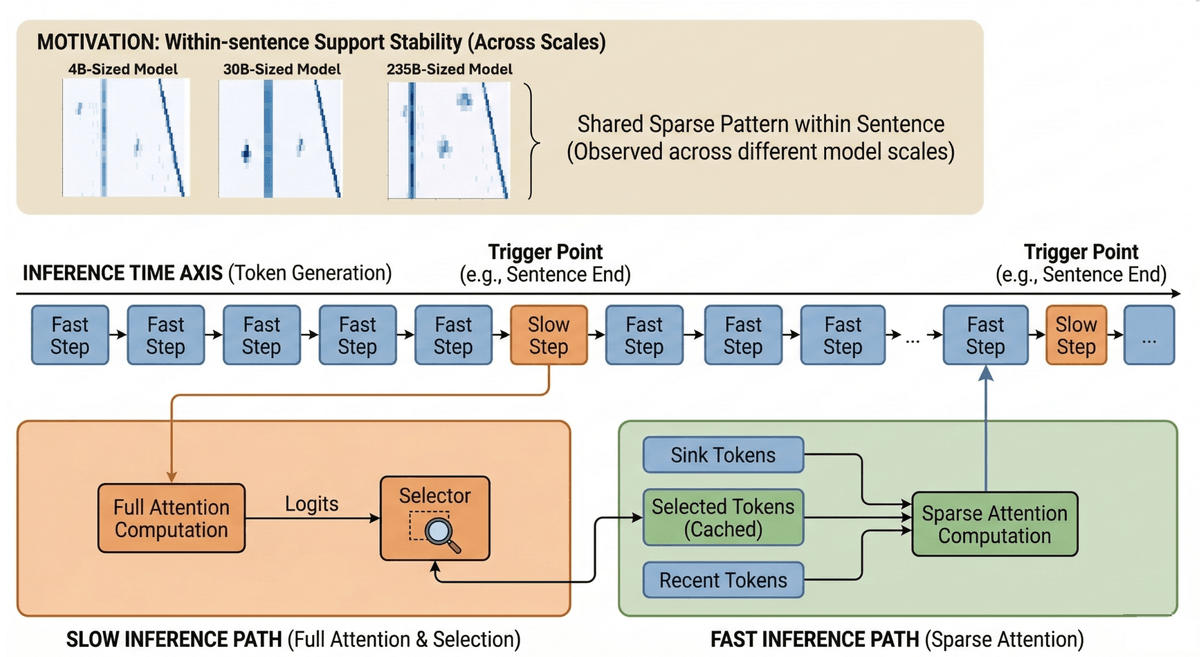
The idea starts with an observation about how attention actually behaves during generation. Within a sentence, and more generally within a short semantically coherent span, the model frequently assigns most attention mass to a largely overlapping subset of past positions, while larger support transitions are more likely to occur near semantic boundaries. The authors call this within-sentence support stability, and it suggests that reprocessing the entire history at every token is wasteful.

The bottleneck SFI actually attacks
KV caching already removes redundant projections, but it does not solve the real cost of long-context decoding. Each autoregressive decoding step still performs attention over the accessible history, incurring heavy compute and memory traffic as the context grows. This burden becomes acute in retrieval-heavy prompts, long chain-of-thought traces, and multi-agent runs where the active context accumulates tool outputs, plans, and prior reasoning.
SFI treats this not as a compression problem but as a scheduling problem. Instead of asking which tokens to keep, it asks a different question: when does the model actually need to look at everything again?
How the slow-fast schedule works
The framework splits decoding into two step types:
- Fast steps attend only to a compact sparse cache made of three parts: a handful of anchor tokens, a sliding window of recent tokens, and a selected memory of long-range positions carried forward across many steps.
- Slow steps run full dense attention over the entire history, then use the resulting attention logits to refresh which long-range tokens the following fast steps will attend to.
Slow steps fire on a simple, token-level trigger. The set of trigger token IDs is constructed offline via the tokenizer, so runtime detection operates directly on token IDs without string decoding. In the default setup, sentence-ending punctuation and newlines mark semantic boundaries where the attention support is most likely to shift, and a hard refresh budget forces a slow step at least every 64 tokens as a safety valve.
Turning dense attention into reusable sparse memory
The interesting technical piece is the Selector, which converts each slow step's full-attention logits into a Top-K index list for the next segment. It fuses two signals: fresh evidence from the current slow step, and a cache-aware prior that discourages logit inflation from unusually large key norms and over-concentration on very recent positions.
The fusion is formulated as a KL-divergence objective with a closed-form solution, so it adds no learned parameters. The fused score is simply a convex interpolation between current slow-step evidence and the cache-aware prior, yielding a continuous ranking signal that is both adaptive and regularized before the final Top-K discretization. The authors specifically choose reverse KL over forward KL because a geometric mixture would drop any token where either source is weak, whereas an arithmetic mixture is more forgiving in a setting where false negatives (evicting a useful token) hurt more than a few extra candidates.
Two additional refinements clean up the ranking: a soft non-maximum suppression that prevents one narrow region from dominating multiple slots, and a cross-head exclusivity term that softly discourages different attention heads from all claiming the same position.
Making sparse attention actually fast on a GPU
Algorithmic sparsity does not automatically translate into wall-clock gains. Naive scattered reads from a paged KV cache can leave a sparse kernel slower than dense attention. SFI reorganizes the sink and selected tokens into a contiguous compact buffer after each slow step, while reading the rapidly changing recent window directly from paged KV. A layer-wise asynchronous pipeline hides the selector and reorganization overhead behind the next layer's attention computation on a secondary CUDA stream.
At the kernel level alone, the sparse attention implementation reaches 10.67x speedup at 1.6% retention compared to dense attention at 16K KV length.
What the numbers look like end to end

The team evaluated SFI on Qwen3 checkpoints from 0.6B up to 235B-A22B on NVIDIA B200 GPUs under vLLM. For Qwen3-4B, the speedup increases from 1.91x at 8K to 14.36x at 128K. Similar scaling trends are observed for Qwen3-30B-A3B and Qwen3-235B-A22B. Absolute throughput degrades far more gracefully than the baseline: Qwen3-4B sustains about 1400 tok/s from 8K to 32K and still reaches 935 tok/s at 128K, whereas the full-KV baseline drops from 759 tok/s to 65 tok/s over the same range.
Quality is the other side of this trade. On LongBench-V1 and LongBench-V2, SFI matches or slightly beats the full-KV baseline across all three tested Qwen3 sizes, with the 4B model improving from 41.40 to 43.19 average. On long chain-of-thought benchmarks (GPQA, MMLU) using Qwen3 Thinking checkpoints, the numbers stay essentially identical to full attention. A head-to-head against training-free KV-cache compression baselines like SnapKV, PyramidKV, StreamingLLM, and H2O is particularly telling: all competing methods use a unified compression ratio of 0.5, whereas SFI retains only about 15 to 20% of tokens on average and still wins the overall LongBench-V2 score.
When to reach for it
SFI shines where the payoff is largest: very long prompts, long reasoning traces, and agentic loops where the context balloons with tool outputs and intermediate plans. The gains are smaller at short contexts, and the method inherits the standard caveats of sparse attention when semantic boundaries are unusual or when a task genuinely requires uniform attention over the entire history. The implementation is available on GitHub, and because it applies directly to existing checkpoints, it slots into inference stacks like vLLM without touching model weights.
The broader point in the paper is worth internalizing: the win did not come from a cleverer eviction rule or a tighter compression ratio. It came from decoupling two questions that most methods conflate, when to look at everything versus what to reuse in between, and letting the model's own attention logits answer the first before applying any selection heuristics to the second.