
NTU and UCL's FD-MVGCL Learns Graph Views Without Labels or Augmentation
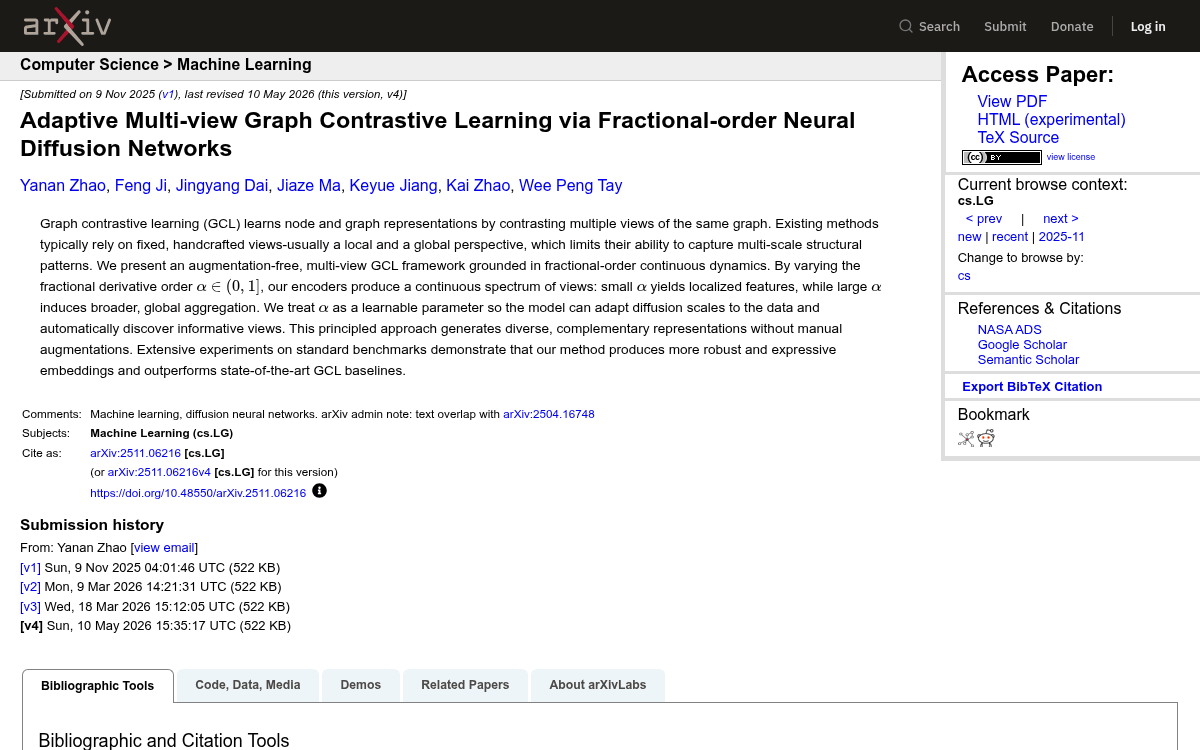
FD-MVGCL uses fractional-order differential equations to generate a learnable spectrum of graph views, beating 17 baselines without any data augmentation or negative samples
 Pro
Takeaways
- What: FD-MVGCL is an augmentation-free, negative-sample-free graph contrastive learning framework that uses fractional-order differential equations to generate a learnable spectrum of graph views.
- Core idea: A fractional order parameter α ∈ (0,1] controls diffusion scale — small α gives local views, large α gives global views — and α is learned from data via gradient descent.
- Key results: Achieves best average rank on heterophilic benchmarks (avg rank 1.40 vs. 4.38 for next best GraphACL) and ties for best on homophilic datasets across 16 total benchmarks.
- Robustness: Maintains ~92% accuracy on Photo under white-box PGD adversarial attacks at 15% perturbation, where most baselines collapse below 50%.
- First of its kind: The only GCL method that is simultaneously augmentation-free, negative-sample-free, adaptive, supports more than 2 views, and handles both homophilic and heterophilic graphs.
- Limitation: Higher GPU memory on large graphs due to FDE state caching; assumes static graph structure; no public code repository at time of writing. Paper on arXiv.
Graph contrastive learning has quietly become one of the most practical tools for learning from graph data without labels. The idea is simple: take the same graph, produce multiple "views" of it, and train an encoder to agree on what matters across those views. The catch is that producing good views is hard. Most methods either randomly corrupt the graph (drop edges, mask features) or apply a fixed pair of filters tuned by hand. Both approaches have a ceiling: you can only capture what your views were designed to see.
A team from Nanyang Technological University and University College London just published a paper proposing a fundamentally different approach. Their framework, called FD-MVGCL (Fractional Diffusion Multi-View Graph Contrastive Learning), replaces handcrafted views with a continuous spectrum of encoders governed by fractional-order differential equations. The result is a system that learns which views are actually informative for a given dataset, without any augmentation or negative samples.
Why the old way breaks down
Graph contrastive learning learns node and graph representations by contrasting multiple views of the same graph, but existing methods typically rely on fixed, handcrafted views, usually a local and a global perspective, which limits their ability to capture multi-scale structural patterns. Think of a citation network: some classification signals live in a node's immediate neighborhood, others only emerge when you zoom out to see community structure. A fixed two-view setup forces you to pick two zoom levels in advance and hope they cover what matters.
The problem compounds on heterophilic graphs, where connected nodes tend to belong to different classes, like social networks where people connect across communities. Graph contrastive learning has attracted significant research attention due to its self-supervised ability to learn robust node representations, but unfortunately most methods primarily focus on homophilic graphs, rendering them less effective for heterophilic graphs. Standard augmentations like edge-dropping actively hurt performance here because they destroy the very structural signals that matter.
There is also the question of negative samples. Augmentation-free methods obtain different views by applying distinct encoders or filters to the same graph, but many augmentation-free approaches still depend on negative samples for contrastive training. Negative sampling scales poorly and introduces its own design choices about what counts as a "different" graph.
Fractional calculus as a view generator
The key insight in FD-MVGCL is that fractional-order differential equations (FDEs) naturally produce a continuous spectrum of graph diffusion behaviors, and that spectrum can serve as a principled source of diverse views. To understand why, it helps to know what a fractional derivative actually does.
A standard (integer-order) derivative is local: it only looks at the immediate rate of change. A fractional derivative of order α ∈ (0,1] is defined via an integral over the function's entire history, giving it a "memory effect." When applied to graph diffusion, this memory controls how far information spreads across the graph:
- Small α (near 0): The walker waits a long time before moving, producing highly localized embeddings that capture fine-grained neighborhood structure.
- Large α (near 1): The walker moves frequently and explores widely, producing global embeddings that capture long-range dependencies and community structure.
- Intermediate α: A smooth blend of local and global signals, with the exact balance determined by the data.
Each view is generated by an FDE with its own fractional order α ∈ (0,1], providing continuous, learnable control over the diffusion scale. This yields diverse, complementary views without handcrafted filters or graph augmentations, and by learning the α values from data, the model removes the need for manual tuning or grid search.
The authors also prove formally that encoders with different α values produce provably distinct embeddings, and that the separation between views grows as the gap between their α values increases. This is the first formal analysis of this multi-scale distinguishability property in the context of contrastive learning.
How FD-MVGCL works, step by step
The full pipeline is straightforward to follow:
- Initialize K encoders with fractional orders uniformly sampled from (0.01, 1]. Each encoder is an FDE-based diffusion network (built on the GRAND architecture).
- Project features: Each encoder applies a linear transformation
Z_k = W_k Xto the raw node features, then runs fractional diffusion governed byD_t^α Y(t) = -L̄ Y(t)for diffusion time T. - Learn α via gradient descent: Both the weight matrices W_k and the fractional orders α_k are treated as learnable parameters and updated jointly via backprop.
- Prune redundant views: After each training phase, if any α values are too similar on a log scale, one is randomly retained and the others are pruned. The process repeats until all remaining α values are sufficiently distinct.
- Contrastive loss: Consecutive encoder pairs are aligned using a regularized cosine similarity loss. A penalty term discourages the dominant directions of two views from aligning, preventing view collapse without needing negative samples.
- Downstream inference: A weighted average of all K view embeddings is computed, with weights tuned on a validation set.
A minimal example of the core idea in code:
# Pseudocode: FD-MVGCL encoder forward pass
# alpha is a learnable scalar in (0, 1]
# A_norm: normalized adjacency, X: node features
def fde_encoder(X, A_norm, alpha, W, T, h):
    Z = X @ W                    # linear projection
    Y = Z.clone()
    history = [Y.clone()]        # FDE needs memory
    for step in range(int(T/h)):
        # Fractional diffusion step (simplified)
        memory_term = sum_history(history, alpha, h)
        dY = -A_norm @ Y + memory_term
        Y = Y + h * dY
        history.append(Y.clone())
    return F.relu(Y)
# Multiple encoders with different (learnable) alphas
views = [fde_encoder(X, A, alpha_k, W_k, T, h)
         for alpha_k, W_k in zip(alphas, weights)]
The two collapse problems it solves
Contrastive learning on graphs faces two failure modes that FD-MVGCL addresses directly:
- Dimension collapse: Embeddings collapse into a low-dimensional subspace, losing expressive power. FD-MVGCL mitigates this because small-α encoders produce less energy-concentrated embeddings, spreading signal across more dimensions. PCA analysis on Cora and Wisconsin confirms that small-α views have more spread-out principal components.
- View collapse: Two encoders converge to nearly identical representations, making the contrastive signal useless. The regularized loss adds a penalty on the inner product of the dominant directions of consecutive view pairs, keeping them geometrically distinct without requiring negative samples.
Benchmarks: where it wins and where it's competitive
FD-MVGCL was evaluated on 16 datasets spanning both homophilic graphs (Cora, Citeseer, Pubmed, Computer, Photo, Ogbn-arxiv) and heterophilic graphs (Wisconsin, Cornell, Texas, Actor, Squirrel, Chameleon, Crocodile, Roman-empire, Amazon-ratings, Arxiv-year). The evaluation protocol is standard linear probing: freeze the encoder, train a linear classifier on top, report test accuracy.
The gains are most dramatic on heterophilic graphs:
- Cornell: 72.70% vs. 66.24% for the next best (GraphECL) , a 6+ point jump
- Texas: 80.19% vs. 73.76% (GraphECL)
- Actor: 35.91% vs. 35.80% (GraphECL), narrowly best
- Crocodile: 68.41% vs. 66.17% (GraphACL)
On homophilic graphs, FD-MVGCL ties GraphACL for the best average rank (2.0), with top results on Cora (84.40%), Photo (94.27%), and Computer (90.38%). The adaptive view learning algorithm (AVLA) consistently outperforms fixed two-view, three-view, and five-view configurations, showing that learned α values are genuinely better than hand-picked ones.
Robustness under adversarial attack is a notable secondary result. Under black-box attacks (Random, PRBCD, Metattack, Nettack at 20% perturbation), FD-MVGCL maintains accuracy better than GraphACL, PolyGCL, and dedicated robust GCL methods on most datasets. Under white-box PGD attacks at 15% perturbation on Photo, it achieves 92.58% , matching clean performance , while most baselines collapse to under 50%.
What it's not great at
FD-MVGCL is not free of trade-offs. The FDE solvers maintain intermediate states across diffusion time steps, which increases GPU memory usage compared to simpler baselines. On large graphs like Roman-empire and Ogbn-arxiv, memory consumption is higher than GraphACL, though it avoids out-of-memory errors that plague PolyGCL and GraphECL on those datasets. Training time is also longer than single-encoder methods, though the authors show it remains competitive with multi-encoder baselines like PolyGCL.
The framework also currently assumes a static graph structure. Dynamic graphs with evolving edges and node sets are left as future work. And while the adaptive view learning algorithm removes the need to manually pick α values, it still requires tuning the similarity threshold δ that controls when two α values are considered redundant.
The real unlock: heterophilic self-supervised learning
The practical significance here goes beyond benchmark numbers. Heterophilic graphs are everywhere in real applications: fraud detection networks (fraudsters connect to legitimate accounts), protein interaction networks (interacting proteins often have different functions), and recommendation systems (users connect to items they consume, not items like themselves). Graph contrastive learning has attracted significant research attention due to its self-supervised ability to learn robust node representations, but most methods primarily focus on homophilic graphs, rendering them less effective for heterophilic graphs, where the complexity of node interactions poses considerable challenges to augmentation schemes, coding architectures, and contrastive designs.
FD-MVGCL is also the first GCL method to simultaneously check all five desirable properties in the comparison table: more than 2 views, augmentation-free, negative-sample-free, handles heterophily, and adaptive. No prior method achieves all five. The combination matters because each property addresses a real limitation: augmentations can corrupt meaningful structure, negative samples scale poorly, fixed views miss multi-scale patterns, and non-adaptive methods require expensive grid search per dataset.
No code repository was linked in the paper at time of writing, but the paper provides full algorithmic details, hyperparameter configurations for all 16 datasets, and theoretical proofs, making the method reproducible from the manuscript alone.