
NTT's RED Forces Vision Models to Actually Read Their Own Reasoning
A training-free decoding trick forces vision-language models to actually use their chain-of-thought rationales, boosting accuracy across benchmarks.
 Pro
Takeaways
- NTT researchers show vision-language models largely ignore chain-of-thought rationales during multimodal reasoning
- Rationale-Enhanced Decoding multiplies image-conditional and rationale-conditional token distributions at inference time
- Method derived as closed-form solution to a KL-constrained reward maximization objective
- Consistent gains across Gemma-3, Qwen2.5-VL, and Llama3-LLaVA-Next on seven benchmarks including MathVista and GQA
- Training-free plug-and-play strategy with code at github.com/yshinya6/red
- Scales better with larger models than standard CoT; main cost is doubled decode-time GPU memory
Chain-of-thought prompting is supposed to make vision-language models reason more carefully by first writing out intermediate steps before answering. A new paper from NTT researchers reveals an awkward truth: large vision-language models often ignore those rationales entirely, and the fix is a surprisingly simple change to how tokens are decoded.
The method, called Rationale-Enhanced Decoding (RED), works as a plug-and-play inference-time strategy with no retraining required. The code is available on GitHub, and the authors show consistent gains across Gemma-3, Qwen2.5-VL, and Llama3-LLaVA-Next backbones.
The rationale that nobody reads
The paper opens with two diagnostic experiments that expose the problem. The team measured attention contribution scores to quantify how much each input token type contributes to output predictions, and separately swapped correct rationales with irrelevant ones generated from unrelated image-query pairs.
The results were unflattering for standard multimodal CoT. When image, rationale, and query were all present in the context, image tokens dominated attention and rationale contribution was remarkably reduced. Even more damning, swapping the rationale for a nonsense one barely changed the answers. On GQA with Gemma-3-12B, CoT actually degraded performance compared to direct answering, and using an irrelevant rationale performed almost identically to using the correct one.
Meanwhile, when the image was removed and only the rationale was fed to the model, performance collapsed with irrelevant rationales, meaning the model can use rationale content when forced to, but ignores it when a picture is available.
Decoupling then remixing the distributions
RED's core idea splits the standard next-token distribution into two separate forward passes and combines them at the logit level. Instead of computing one probability conditioned on image, rationale, and query together, the model computes:
- An image-conditional distribution using only image and query
- A rationale-conditional distribution using only rationale and query
The two are then multiplied, with a hyperparameter lambda controlling the influence of the rationale-conditional probability, forming what the authors describe as a power-of-experts that emphasizes overlap between the two distributions.
In practice this is implemented as a weighted sum of log-softmax logits. Here is roughly what happens at each decoding step:
logits_img = model(image, query, prev_tokens)
logits_rat = model(rationale, query, prev_tokens)
combined = log_softmax(logits_img) + lam * log_softmax(logits_rat)
next_token = sample(softmax(combined))
The two forward passes run as a parallel batch, so latency stays reasonable. Average inference time per query with Gemma-3-12B was 3.01 seconds for baseline, 5.27 for standard CoT, and 5.05 for RED, meaning RED is actually slightly faster than CoT because each of its two contexts is shorter than the full image-plus-rationale context.
The theoretical hook
The paper frames this as a KL-constrained reward maximization, borrowing the same mathematical framework used in RLHF methods like DPO. The reward is the log-likelihood of the rationale-conditional distribution, and the reference policy is the image-conditional distribution. Solving this KL-constrained objective yields a closed-form optimal policy that turns out to be exactly the multiplied distribution RED uses, giving the heuristic a theoretical grounding rather than being pure engineering intuition.
Numbers that actually move
RED was tested on GQA, TextVQA, MME, SEED-I, LLaVA-Bench, MM-Vet, and MathVista across four LVLM backbones. The gains are consistent rather than cherry-picked:
- On Qwen2.5-VL-7B with SEED-I, CCoT alone gave a modest bump but CCoT + RED jumped by over 20 points
- MathVista accuracy on Qwen2.5-VL-7B rose from 64.7 to 70.6 with CoT + RED
- MME cognition scores on Gemma-3-4B nearly doubled from 370 to 645
- On the intervention analysis, feeding GPT-4-generated rationales to RED produced further gains, while random irrelevant rationales caused RED to degrade, confirming it actually grounds on rationale content
There is also a scalability story. Neither baseline direct decoding nor CCoT consistently improved with larger models in the Gemma-3 and Qwen2.5-VL families, but RED improved in proportion to model size, suggesting it can unlock capabilities that larger LVLMs already possess but fail to express through standard decoding.
Where it fits and where it hurts
The method is complementary to existing hallucination-mitigation decoders like VCD and LCD. Those methods modulate the image-conditional distribution to reduce object hallucination, and RED can consume that modulated distribution as one of its two inputs.
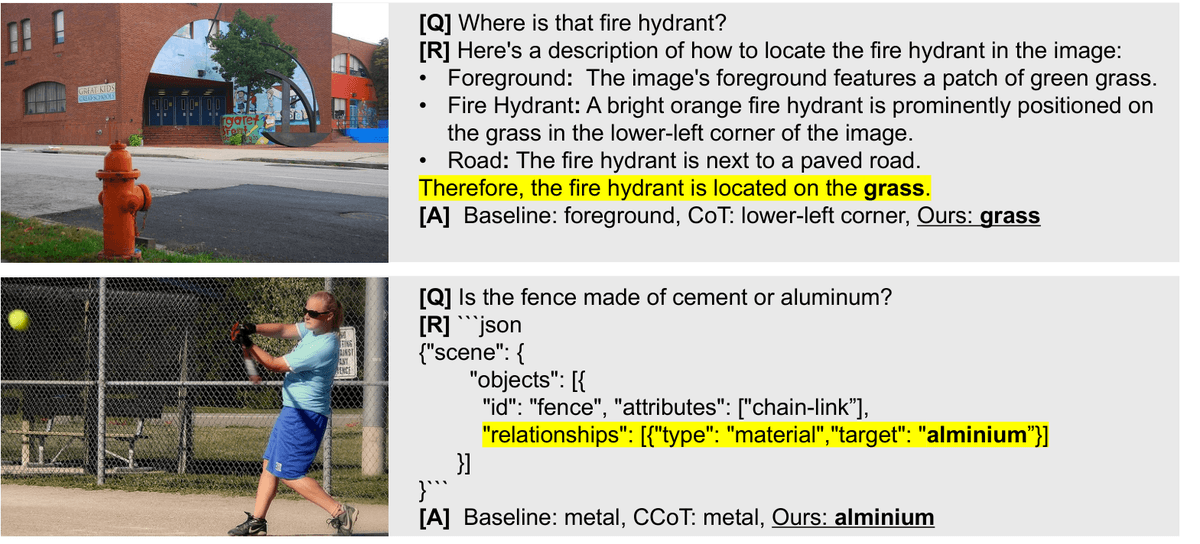
Detailed capability analysis on SEED-I showed an interesting effect: the format of the rationale determines which skills improve. Text rationales through CoT + RED boosted text understanding and spatial relations, while JSON scene graph rationales through CCoT + RED boosted instance attributes and localization. This means you can steer which capabilities get amplified by choosing the rationale format.
The main cost is memory. Running two forward passes in parallel roughly doubles GPU memory for the decode step, which the authors flag as a limitation for future work. Lambda also needs tuning per rationale type, though the paper reports stable behavior across a range of values.
For anyone building multimodal reasoning pipelines on top of open LVLMs, this is a cheap change to try before reaching for fine-tuning. It requires no data, no gradient updates, and no architecture changes, and it plugs into existing CoT and structured-rationale prompting schemes without modification.