
NTIRE 2026 Proves Single-Step Diffusion Now Restores Faces Without Sacrificing Identity
The Second Challenge on Real-World Face Restoration at NTIRE 2026 gathered 9 finalist teams and mapped how one-step diffusion is reshaping blind face restoration.
 Pro
Takeaways
- NTIRE 2026 Second Challenge on Real-World Face Restoration: 96 registrants, 9 valid finalists (paper).
- Evaluation: AdaFace identity gate then weighted CLIPIQA, MANIQA, MUSIQ, NIQE, Q-Align, and FID.
- Test set: 450 images from LFW, WIDER, CelebChild, WebPhoto, and CelebA.
- Top pipelines: MiPlusCV, CEVI-KLETech, HONORAICamera, YuFans, guaguagua.
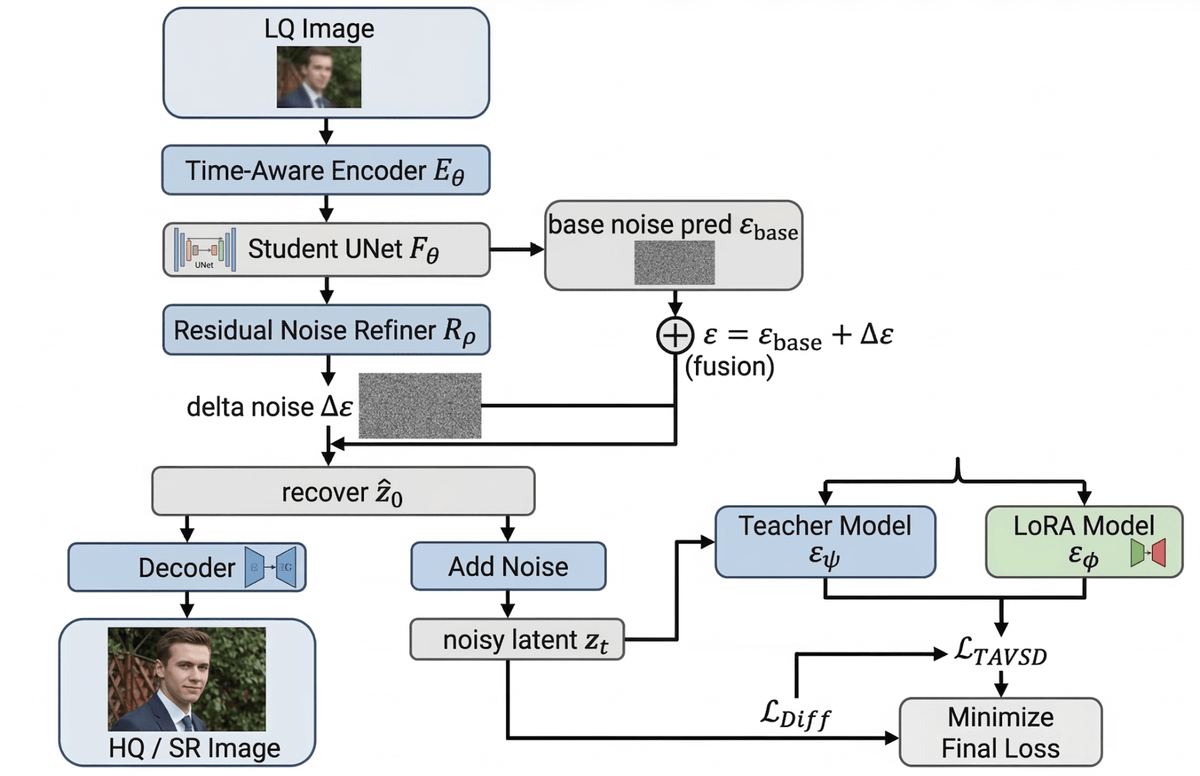
- Dominant trend: one-step distilled diffusion priors replacing multi-step sampling for face restoration.
- Code, checkpoints, and factsheets available at the challenge GitHub.
Blind face restoration has quietly shifted its center of gravity in the last year. A new review paper covering the Second Challenge on Real-World Face Restoration at NTIRE 2026 walks through nine finalist pipelines built to un-degrade real photos, and the takeaway is not any single winning model. One-step distilled diffusion, foundation-model adaptation, and metric-aware refinement have collectively displaced the multi-step generative pipelines that dominated the field a year ago.
The competition itself is straightforward but strict. It attracted 96 registrants, with 10 teams submitting valid models, and 9 achieving valid scores in the final ranking. Every submission had to first pass an AdaFace identity check before its perceptual quality was even scored, which forced participants to balance two goals that usually pull in opposite directions: hallucinating realistic detail while keeping the person recognizably themselves.
Why real-world face restoration is a nasty problem
Face restoration recovers a clean image from one mangled by blur, sensor noise, JPEG compression, or aging artifacts. The problem is fundamentally ill-posed because degradation deletes information, so the model has to invent plausible pixels. The task is to recover high-quality face images with rich high-frequency details from low-quality inputs while preserving facial identity to a reasonable degree. The challenge places no restrictions on computational resources such as model size or FLOPs, and judges purely on image quality and identity consistency.
Traditional approaches leaned on statistical priors, then CNN and GAN priors, then multi-step diffusion. Each jump improved realism but usually at the cost of inference speed, and often at the cost of identity drift, where the restored face looks great but no longer matches the input person.