
Notre Dame's VISAR Shows AI Writing Tools Can Sharpen Student Arguments
A classroom study of the VISAR writing tool shows structured planning scaffolds boost argument quality, while one-click draft regeneration actively damages it.
 Pro
Takeaways
- Classroom deployment of VISAR with 49 undergraduates ties specific AI interactions to argument quality outcomes.
- Argumentative Sparks strongly predicted better claims (β = 0.880) and evidence use across student essays.
- LLM Draft Regeneration significantly worsened claim articulation, warrants, and overall argument progression.
- Quiz scores rose from 5.79 to 7.50 after one week of use, with gains on counter-argumentation and evidence.
- Three engagement clusters emerged: brainstorm explorers, strategic scaffolders, and visual planners.
- Full paper on arXiv; original VISAR system paper.
Recent work has warned that AI writing assistants are quietly hollowing out student writing, letting learners skip the hard parts and hand the reasoning off to a language model. A new study from researchers at Notre Dame and the University of Michigan complicates that picture. When a writing tool is designed around planning and structural feedback instead of one-shot generation, students choose the effortful path, and their arguments get measurably better.
The paper reports an in-the-wild classroom deployment of VISAR, an AI argumentative writing assistant, across three sections of an undergraduate writing course with 49 students. Rather than proposing a new system, the authors use VISAR as a research probe to ask which specific AI interactions help students learn and which quietly undermine them.
The tool under the microscope
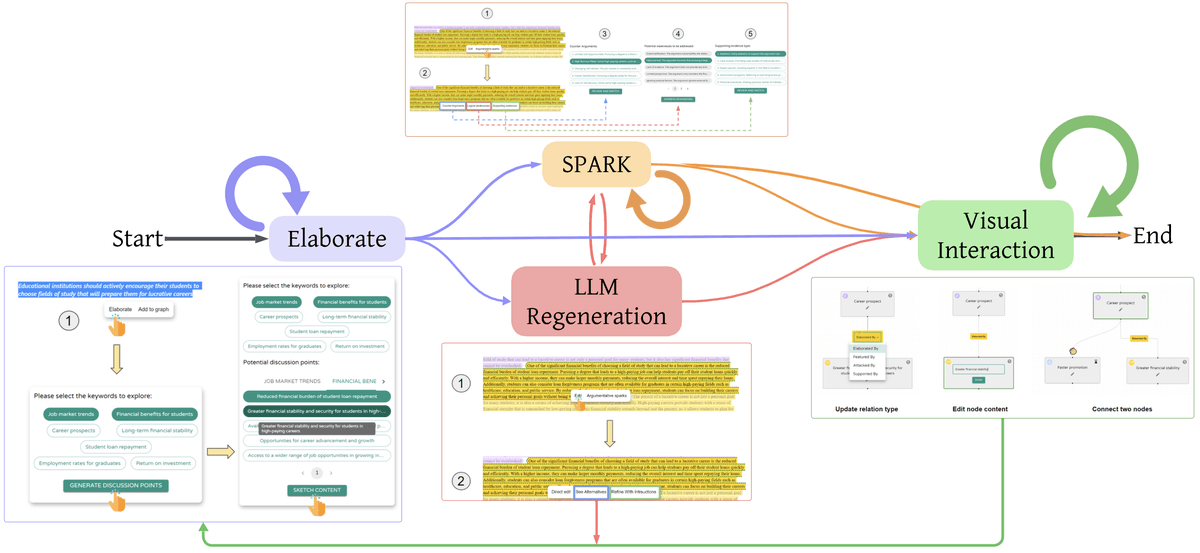
VISAR combines a node-and-edge canvas for laying out arguments with a text editor that stays synchronized with the visual plan. On top of that, it exposes four distinct AI features:
- Elaboration: hierarchical prompts that help expand a line of argument.
- Argumentative Sparks: targeted suggestions for evidence, counterarguments, and detection of logical weaknesses.
- LLM Draft Regeneration: intentionally low-fidelity draft text meant to be rewritten, not copied.
- Synchronized visual and text editing: changes in the argument map propagate into the draft and vice versa.
Students used VISAR for a week per section after already producing an initial draft of an open-topic argumentative essay. The team collected 1,543 interaction events across 66 writing sessions, along with essays, pre/post quizzes, surveys, and interviews with students and instructors.
Sparks help, regeneration hurts
The most striking result comes from regressions linking specific interaction types to five dimensions of argument quality, graded by an external writing expert on the Toulmin model. Different AI features had sharply different effects.
Higher use of Argumentative Sparks predicted stronger Claim Articulation (β = 0.880, p < .001), better Grounds (β = 0.435, p < .01), and improved Argument Progression across sections (β = 0.640, p < .001). Visual planning actions were separately tied to better Warrant and Causal Logic (β = 0.574) and stronger Counter-Consideration and Qualification (β = 0.792).
Draft Regeneration went the other way. Controlling for the other behaviors, students who leaned on regeneration produced significantly worse Claim Articulation (β = -0.896), Grounds (β = -0.321), Warrant (β = -0.471), and overall Progression (β = -0.681). Repeatedly regenerating drafts appears to substitute for the student's own reasoning work, weakening the explicit articulation of claims and coherence. Plain elaboration, meanwhile, showed no significant effect once the sharper scaffolds were accounted for.
Three ways students use the tool
A k-means clustering over the four interaction metrics surfaced three distinct engagement archetypes across the 66 sessions:

- Brainstorm-Oriented Explorers (N = 40): the largest group, using VISAR mainly for lightweight ideation via elaboration prompts.
- Strategic Scaffolders (N = 22): sustained use of the visual planner, sparks, and draft generation together in an integrated workflow.
- Visual Planners (N = 4): heavy focus on manipulating the argument map with little use of other features.
Interaction activity was heavily concentrated in the visual workspace, which accounted for 70.8% of all events. Sparks made up about 13% and regeneration only 6%. When the interface put planning and targeted feedback front and center, students spent most of their time there instead of asking the model to write for them.
Learning gains and emerging AI literacy
In the one section that ran a pre/post quiz on core writing concepts, mean scores rose from 5.79 to 7.50 out of 8 (p < .001), with the largest gains on evidence-based reasoning and counter-argumentation strategy. Students also reported improvements in the logical strength and structural organization of their essays.
The interviews surface something equally interesting: a form of situated AI literacy. Several students described spotting hallucinated citations, nonexistent authors, and broken URLs, then going to external sources to verify. They treated AI output as negotiable rather than authoritative. Instructors linked this behavior to the interface itself, arguing that a less conversational, more structural UI discourages the reflexive trust that chat-based systems tend to encourage. That framing sits in useful tension with recent studies on cognitive debt from essay writing with generic chatbots.
What this means for building writing tools
For anyone designing AI-assisted learning tools, the choice of affordances is doing more work than the choice of model. Features that force externalization, structure, and targeted critique produce better student writing and preserve reasoning. Features that generate finished-looking drafts on demand quietly degrade the same outcomes, even inside a well-designed system.
The authors are careful about the caveats. Deployments lasted one week, so the results speak to short-term uptake rather than durable habit formation. Visual maps also became unwieldy as arguments grew complex, pointing to future work on adaptive visualization and progressive disclosure. The tool itself is a research prototype rather than a shipping product, so the practical path for classroom use still runs through published prior work on VISAR's original design. As empirical evidence about which AI writing behaviors actually help learners, it is one of the cleaner signals to appear so far.