
Notre Dame's bfVAE Untangles AI's Hidden Data Without Ground-Truth Labels
A new framework unifies disentangled VAEs and delivers evaluation metrics that work without ground-truth generative factors, particularly for tabular data.
 Pro
Takeaways
- bfVAE unifies β-VAE and factor-VAE under one loss with tunable capacity, disentanglement, and reconstruction terms.
- FVH-LT probes latent-feature associations via decoder traversal, producing interpretable heatmaps without ground-truth factors.
- DBSR-LS uses dirty block sparse regression as a linear surrogate to identify shared and dimension-specific feature associations.
- Greedy alignment strategy (GAS) fixes label switching across independent runs, enabling stable result aggregation.
- LSSI provides a single scalar in [0,1] that summarizes latent separation and correlates with supervised metrics.
- Framework works especially well on tabular data where standard β-VAE bottlenecks discard signal. Read the paper.
Evaluating whether a variational autoencoder has actually learned a clean, disentangled latent space is one of those problems that sounds easy until you try to do it on real data. Most existing metrics assume you know the true generative factors behind your dataset, which is almost never the case outside of synthetic image benchmarks. A new paper from researchers at the University of Notre Dame proposes bfVAE, a unified framework that both consolidates several state-of-the-art disentanglement objectives and introduces evaluation tools that work without ground-truth labels.
The gap in current disentanglement research
Most existing work on disentangled VAE focuses on image data, with relatively limited attention to other data modalities, tabular data included. The authors' empirical work suggests current formulations, effective for images, can fail on tabular data. Worse, current disentanglement evaluation metrics are applicable only to synthetic data where ground-truth generative factors are known, and image-focused approaches lean on qualitative visual inspection, which does not translate to other data types.
There is also a reproducibility issue lurking underneath. Latent spaces are subject to label-switching, where indexing of latent factors changes across independent runs, further complicating the interpretability and reproducibility of the learned representations. Train the same VAE twice and latent dimension 3 in one run might correspond to dimension 7 in the next.
One loss function to rule several VAEs
bfVAE (the name comes from β-VAE and factor-VAE) unifies existing disentangled VAE formulations under a single objective with three terms: a reconstruction error, a capacity constraint controlled by hyperparameters β and C, and a disentanglement regularization term controlled by γ. Some existing VAE models are special cases of Eq. 1 by setting β, γ, and C at specific values: when γ = 0, C = 0, bfVAE reduces to β-VAE and when β = 1, C = 0, it reduces to factor-VAE; when γ = 0, C = 0, β = 1, it becomes the vanilla VAE.
The interesting insight is why standard β-VAE breaks on tabular data. Previous work on β-VAE for image data often adopts relatively large β; since C=0 in standard β-VAE, this can be viewed as placing strong pressure toward a low-capacity information bottleneck. Images are highly redundant, so aggressive compression is fine. Tabular data usually is not. Applying the same bottleneck setting may discard substantial signal, reduce the number of true informative LDs, and degrade reconstructed or synthetic data. The capacity parameter C lets you dial the bottleneck to the data.
Two ways to probe the latent space without labels
The evaluation toolkit is where the paper really contributes. There are two complementary techniques for mapping latent dimensions to input features:

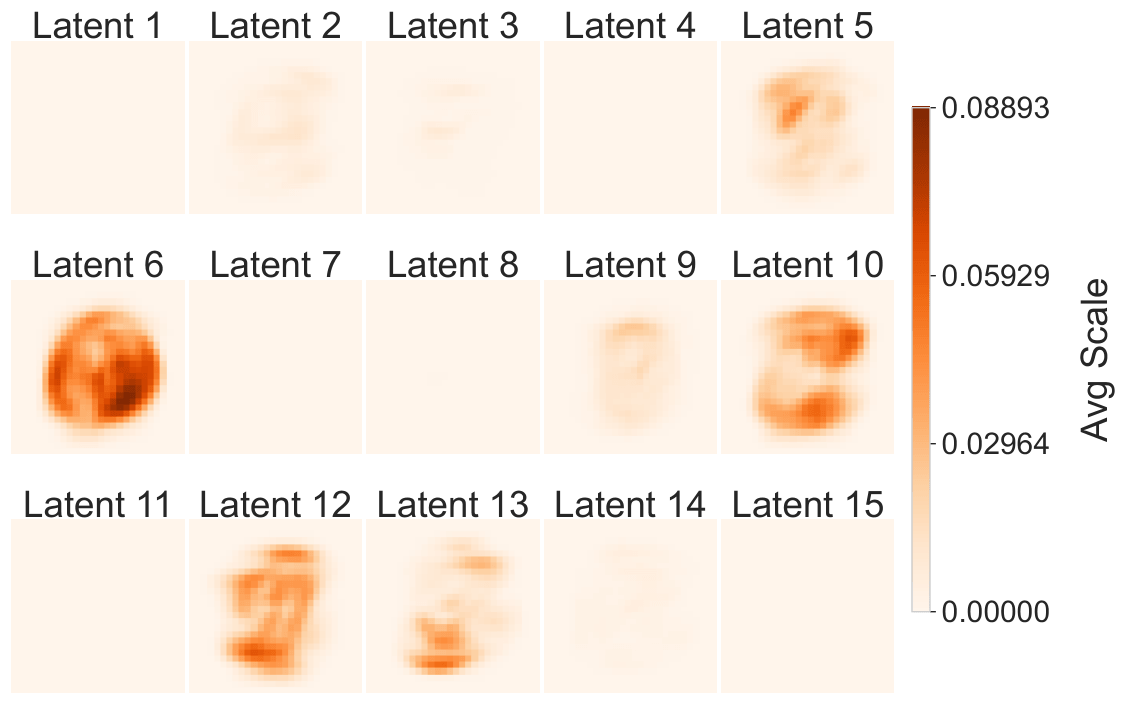
- FVH-LT (Feature Variance Heterogeneity via Latent Traversal): FVH-LT varies one LD at a time while holding the remaining LDs fixed, and measures the resulting changes in the outputs reconstructed by the decoder. The output is a heatmap showing which features respond to which latent dimensions.
- DBSR-LS (Dirty Block Sparse Regression in Latent Space): Treats each latent dimension as the output of a separate regression task and uses shared plus task-specific sparsity to identify feature-latent associations. DBSR-LS estimates LD-feature associations directly from learned latent space and is not decoder-mediated like FVH-LT; it may thus serve as a useful complementary approach when decoder-based LT is unstable.
To handle the label-switching problem across runs, the authors add a greedy alignment strategy (GAS) that clusters latent dimensions by informativeness, picks the run with the most informative dimensions as an anchor, and matches other runs against it via correlation. This lets you average results across many training runs without garbage aggregation.
Finally, there is the Latent Space Separation Index (LSSI), a scalar summary in [0, 1] that combines the association matrices with feature coverage and effective-dimension penalties. A 1 means each informative dimension owns a distinct block of features; a 0 means degenerate collapse.
Results across seven datasets
The team evaluated bfVAE against vanilla VAE, β-VAE, factor-VAE, and two DIP-VAE variants across synthetic factor-analysis data, RNA-seq, wine quality, FIFA 2018 match statistics, MNIST, and CelebA.

On the synthetic FA15 dataset (4 true factors, 15 features), bfVAE hit an LSSI of 0.891 with a reconstruction L2 error of 0.75, compared to factor-VAE's 0.807 LSSI at 2.13 error and β-VAE's 0.366 LSSI at 0.64 error. In other words, competitors either compress well but tangle their factors, or disentangle at the cost of reconstruction quality. On MNIST, bfVAE achieved an LSSI of 0.184 versus 0.089 for factor-VAE, along with the lowest reconstruction error. LSSI also tracked closely with the classical Higgins et al. (2017) and Kim and Mnih (2018) supervised metrics on synthetic data, supporting its use as a label-free proxy.
The RNA-seq numbers reveal an honest limitation: LSSI scores stayed low across all methods (bfVAE topped out at 0.081). The authors attribute this to genuine biological overlap. Genes are co-regulated in modules and pathway programs may overlap, and a single gene may participate in multiple biological processes. Clean block structure is not always the right assumption.
When it is worth using
The framework is most useful when you need interpretable latent factors on data that lacks natural visual inspection: tabular datasets, gene expression, sensor readings, or anywhere you want to know which input features drive which latent axis. The authors recommend FVH-LT as the default because DBSR-LS scales poorly with feature count. For high-dimensional data of large p, we recommend FVH-LT as the default procedure and using DBSR-LS selectively, for example on preselected features or domain-defined feature groups.
The main caveats: LSSI is described by the authors as a non-causal proxy, so it will not tell you whether the recovered dimensions correspond to true causal factors. DBSR-LS is also limited to linear surrogate relationships between features and latents, which will miss nonlinear structure. The paper does not currently ship a public code release alongside the arxiv preprint, so practitioners will need to reimplement from the algorithm pseudocode, which is included in detail.