
Northwestern's POSYDON Surrogate Cuts Binary Star Simulation Costs 10,000x
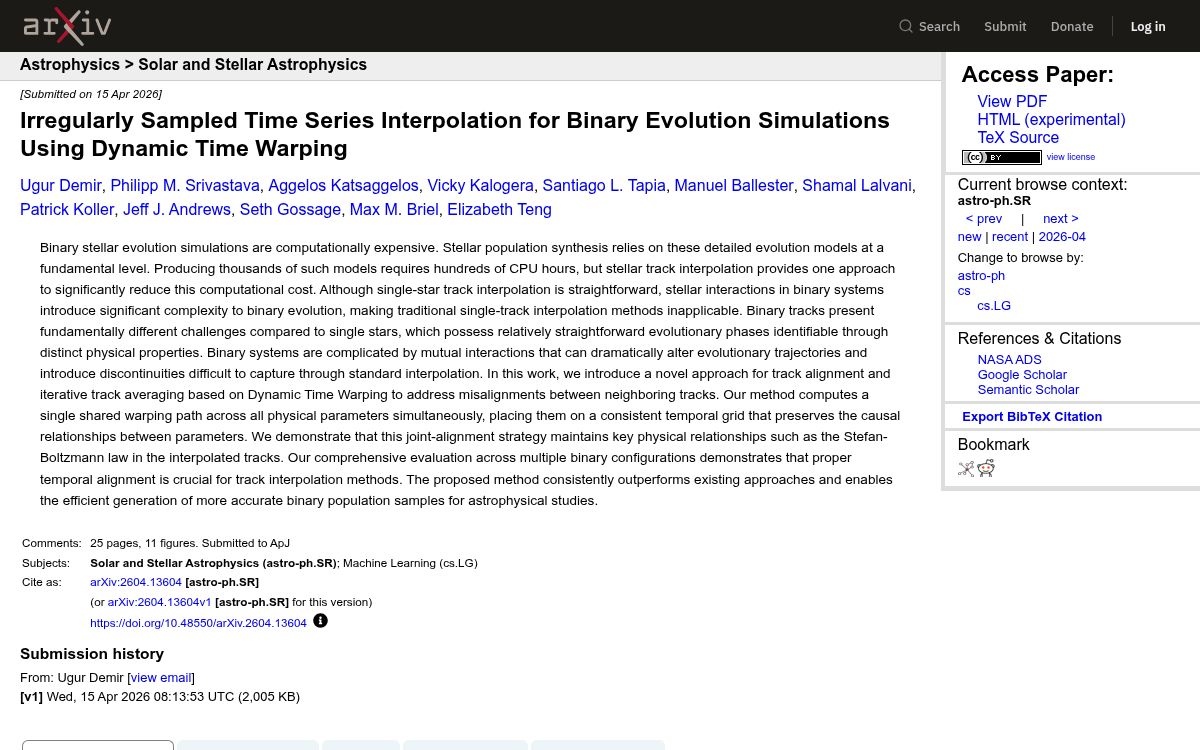
Researchers at Northwestern and collaborators propose a Dynamic Time Warping interpolation scheme for POSYDON binary star grids that preserves physical laws while cutting simulation cost.
Takeaways
- New interpolation method for POSYDON binary star grids using Dynamic Time Warping alignment plus barycentric KNN averaging.
- A shared warping path across all parameters keeps luminosity, radius, and temperature on one consistent age grid.
- Authors prove the Stefan-Boltzmann law is preserved exactly in log space under joint alignment.
- Beats the prior Change Point baseline on nearly all parameters across three POSYDON grids.
- Roughly 0.01 seconds per binary vs tens of CPU hours for a full MESA simulation.
- Paper on arXiv; targeted at statistical population synthesis, not individual-system fidelity.
A team from Northwestern's CIERA institute, the University of Geneva, and collaborators has published a method for interpolating between pre-computed binary stellar evolution tracks. The work targets a specific bottleneck: producing large synthetic populations of binary stars without re-running the underlying physics simulator for every new configuration.
At the center sits Dynamic Time Warping, a classical algorithm for aligning two sequences that unfold at different rates. Applied here to POSYDON binary grids, it produces interpolated tracks that look right and also obey physical laws like the Stefan-Boltzmann relation, something a prior change-point method fails to do reliably.
Why binary stars break normal interpolation
Binary stellar evolution is modeled through numerical integration of coupled differential equations, and running a population of these simulations is punishing. Parameter studies and synthetic populations can eat hundreds of CPU hours. POSYDON, one of the leading codes in this space, already uses advanced methods to interpolate between large, densely spaced grids of simulated binaries, but full track-in-time interpolation for binary systems has remained an open problem.
The reason is structural. Single stars have clean, well-understood evolutionary phases that work as alignment anchors. Binaries do not. Mass transfer between the two stars is treated approximately in one-dimensional stellar evolution models, and while the code can identify when transfer begins and ends, the process itself is not precisely defined. MESA, the underlying solver, uses adaptive time stepping, so every track has a different length and irregular sampling, while mass transfer events introduce sharp morphological discontinuities that naive interpolation smears out.