
Northwestern's DS²-Instruct Builds Domain AI Training Data From a Single Description
Northwestern researchers built a zero-shot pipeline that manufactures domain-specific instruction data without seed examples, corpora, or human annotation.
 Pro
Takeaways
- DS²-Instruct generates domain-specific instruction data from only a task description, no seeds or corpora needed. Paper
- Three-stage pipeline: bi-directional keyword expansion, Bloom's Taxonomy instruction generation, self-consistency filtering.
- Fine-tuning Llama-3.1-8B on generated data lifts average score from 14.3% to 42.8% across seven benchmarks.
- Produces 5,706 unique verb-noun pairs on finance data versus 505 for Self-Instruct, with far less repetition.
- Gains shrink as base model size grows, making the method most useful for 7B-class specialists.
- Code available on GitHub; limitations include static knowledge bases and English-only evaluation.
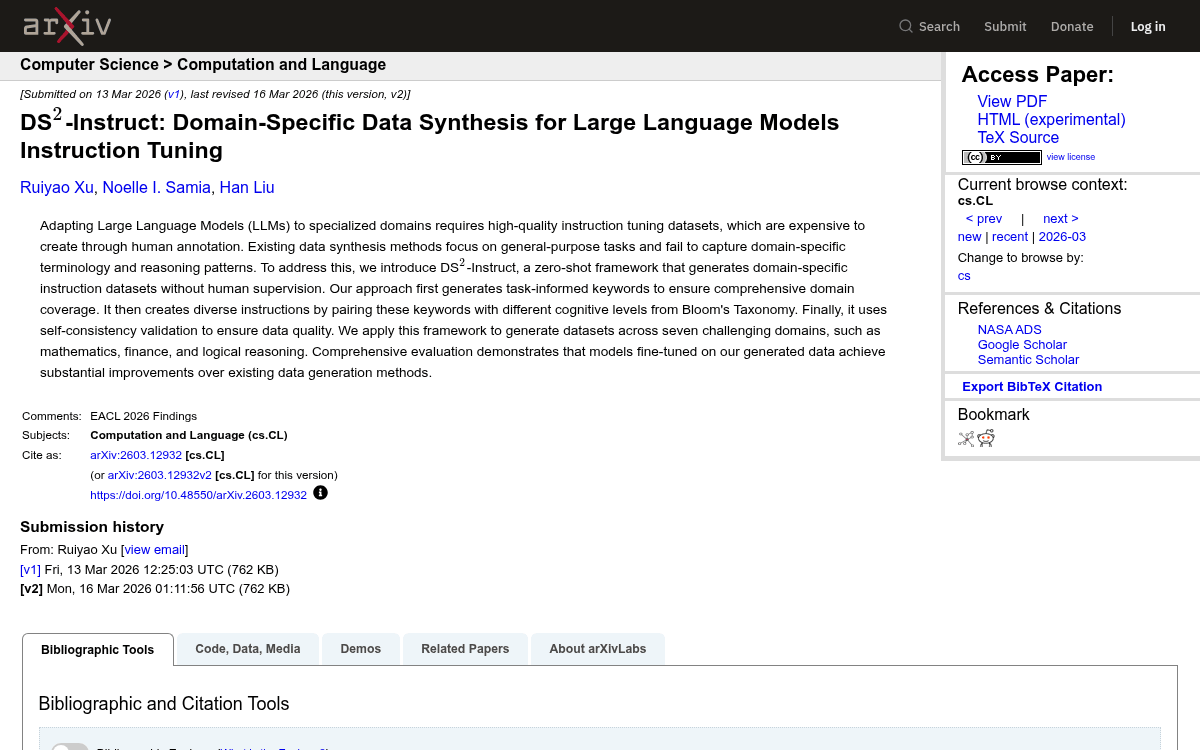
Fine-tuning a general model into a specialist usually requires two expensive things: domain experts who write seed prompts, and a pile of proprietary documents to mine questions from. A team at Northwestern University is proposing a way around both. Their framework, DS²-Instruct, generates instruction-tuning datasets for specialized fields starting from nothing but a task description.
The pitch is straightforward. Existing data synthesis methods focus on general-purpose tasks and fail to capture domain-specific terminology and reasoning patterns. DS²-Instruct closes that gap with a three-stage pipeline that builds a domain vocabulary, forces variety through an educational framework, and filters the output using the model's own agreement with itself.
Why domain data is hard to fake
Most synthetic data recipes today fall into two camps. One expands a small set of human-written seed prompts (Self-Instruct, Alpaca style). The other extracts questions from unannotated domain documents. Both fail in specialized settings: domain-specific corpora are often proprietary, expensive, or simply unavailable, and seed-based approaches require human experts to write examples for in-context learning prompts. A legal chatbot or a medical assistant needs vocabulary and reasoning patterns that a generalist LLM will not stumble into on its own.

How the pipeline works
The system takes a single task description and runs it through three stages, using Qwen2.5-72B-Instruct as the generator.
- Task-informed keyword generation. Starting from 50 seed keywords derived from the task description, the model runs bi-directional expansion that iteratively generates both prerequisite foundational concepts and advanced specialized topics. It then augments the pool with terms pulled from BM25 retrieval over ArXiv, Wikipedia, FreeLaw, StackExchange, and GitHub subsets of the Pile.
- Cognitive-level instruction generation. Rather than letting the LLM default to shallow recall prompts, the framework pairs each keyword with one of the six levels of Bloom's Taxonomy, an educational hierarchy running from Remember and Understand up through Analyze, Evaluate, and Create. Single keywords cover all six levels; paired keywords are combined at the four relational levels to force multi-concept reasoning.
- Self-consistency filtering. For each candidate instruction, the generator produces five independent responses at temperature 0.7. Instructions where the majority answer fails a 3/5 agreement threshold get discarded, and the winning answer becomes the training label. The assumption: it is less likely to consistently generate the same incorrect answer across multiple attempts.

The numbers
The authors generated 6,000 instruction-response pairs per task and fine-tuned Qwen2.5-7B, Llama-3.1-8B, and Mistral-7B with LoRA (rank 8, alpha 16). Evaluation spanned seven benchmarks: CFA, PubMedQA, MedQA, GPQA, LogiQA, GSM8K, and MATH.
The gains are largest on weaker base models. For Mistral, which exhibits the lowest zero-shot performance, DS²-Instruct improves the average score to 37.83%. On Llama3, the method raises the average from 14.34% in the zero-shot setting to 42.83%, substantially exceeding prior instruction-generation approaches. On the already-strong Qwen2.5-7B, the average climbs from 48.92 to 54.95, still beating Self-Instruct, InstructMix, and Explore-Instruct on nearly every benchmark.
Diversity metrics tell a similar story. On the CFA finance dataset, DS²-Instruct produced 5,706 unique verb-noun pairs versus 505 for Self-Instruct, with far lower repetition. Human review of 500 sampled pairs found valid instructions in the 92-97% range and domain-appropriate content above 90%.
What the ablations reveal
Each component earns its keep. Removing bi-directional expansion drops performance across the board. Retrieval augmentation from Wikipedia adds a further jump. Skipping Bloom's Taxonomy collapses the framework into ordinary keyword prompting and hurts reasoning scores. Disabling self-consistency filtering degrades quality on every domain tested.
There is also a scaling caveat worth noting. Performance gains diminish as model size increases, suggesting that larger models may rely less heavily on domain-specific instruction data and can better leverage their inherent reasoning capabilities. The method is most valuable when adapting small or mid-sized models.
Where it fits and where it does not
DS²-Instruct is genuinely useful when you need to spin up a domain assistant and you have neither a corpus nor human annotators. Finance, medicine, law, and internal enterprise domains are natural fits. The code is released on GitHub, and the whole pipeline runs off a single task description.
The limitations the authors flag are real. The keyword expansion leans on static knowledge bases like Wikipedia, which biases coverage toward well-documented topics and may miss emerging subfields. Output quality inherits any blind spots from the generator LLM, so a weak generator on a rare domain will produce weak data. Evaluation is English-only. And self-consistency filtering can reinforce confident-but-wrong answers when the base model has a systematic misconception, since majority voting cannot detect errors the model always makes.
For teams choosing between paying annotators, scraping proprietary documents, or running a synthetic pipeline, the tradeoff has shifted. Task descriptions are cheap. If the target domain is well-represented in a general LLM's pretraining, DS²-Instruct suggests you can bootstrap a fine-tuning dataset without touching either of the traditional bottlenecks.