
Northwestern Finds Humans Beat 32 AI Detectors on Real-World Deepfakes
A large study of 200 humans versus 95 state-of-the-art detectors finds AI collapses to chance on phone-recorded video while people stay accurate.
 Pro
Takeaways
- Humans beat 95 state-of-the-art deepfake detectors on both a curated benchmark and phone-recorded video.
- On the new CharadesDF dataset, AI detectors dropped to 0.537 accuracy while humans stayed at 0.784.
- Humans miss high-quality fakes; AI wrongly flags real videos, so their errors are statistically independent.
- Hybrid human-AI ensembles hit 0.941 accuracy on DF40 and eliminated catastrophic failures on both datasets.
- AI detectors lean on low-level color and scaling statistics; humans use face-level perceptual cues.
- Dunning-Kruger appears in both populations, and demographics do not predict human detection skill.
A US federal judge asked a research team to fake him chopping wood. He sent in a real clip, they swapped his face onto two consenting volunteers, and then ran the results past state-of-the-art deepfake detectors. Every automated system missed them. The footage had the sort of things you get in real life: a moving camera, the subject's face partly occluded by an axe swing, no tidy frontal close-ups. That failure is the seed of a new study from Northwestern that pits humans against machines on deepfake detection under realistic conditions, and the humans win by a wide margin.
Where the benchmarks quietly lied to us
Deepfake detection is typically framed as a pure machine learning problem, and detectors are typically evaluated on curated benchmarks like FaceForensics++, Celeb-DF, and more recently DF40. These benchmarks feature well-lit subjects in frontal poses with consistently visible faces, conditions that diverge substantially from authentic user-generated content where camera movement, occlusion, and awkward angles are the norm. The paper argues this gap matters enormously for the actual use cases: legal proceedings, protest footage, and any video shot on a phone.
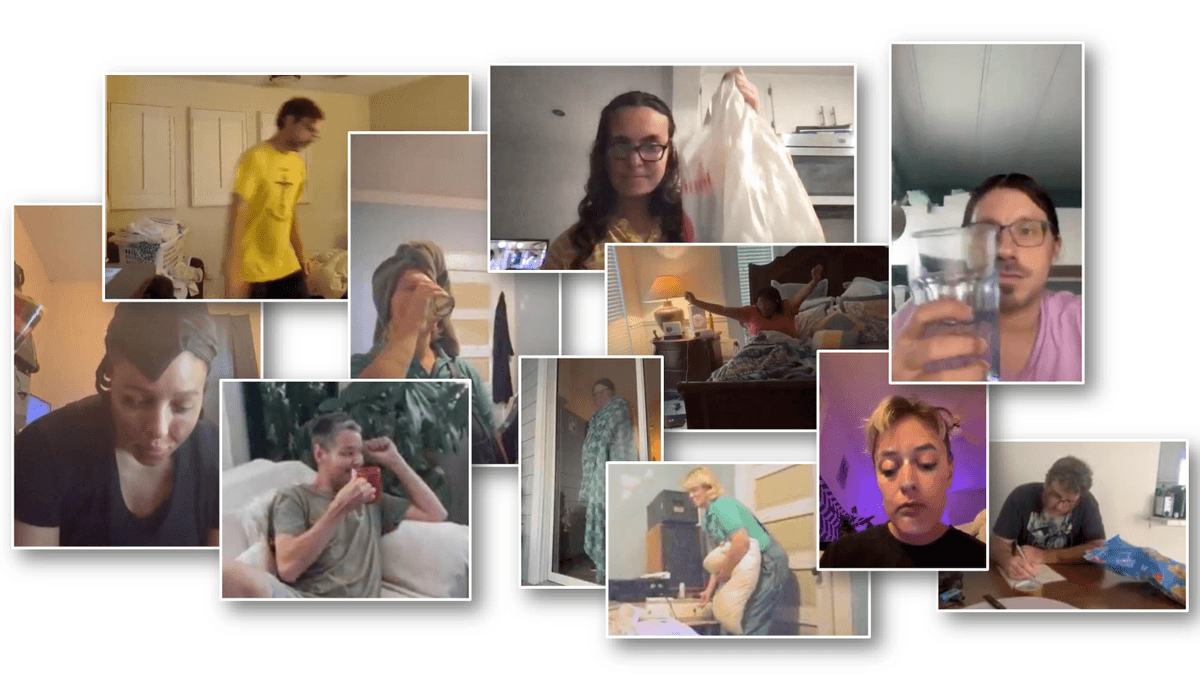
To probe that gap, the authors built CharadesDF, a new dataset of home recordings. They recruited 100 Prolific participants to record five short videos each following scripted activities sourced from the Charades dataset, things like drinking from a mug, moving around a room while speaking, or presenting in front of a microphone. Each participant also submitted a clean reference photo, which was then used to generate face swaps with FaceFusion v3.2.0 using five different swapping models ranging from the default HyperSwap to older, lower-quality blends. The result: 500 authentic phone videos paired with 500 deepfakes made the way a non-technical user would actually make them.
The head-to-head
The evaluation is unusually comprehensive. The authors trained 32 state-of-the-art detection architectures on three training datasets (FaceForensics++, CelebDF-v2, and the DF40 training split), yielding 96 detector variants, one of which was excluded due to architectural incompatibility. The lineup spans frequency-based methods, attention mechanisms, reconstruction models, contrastive learners, vision transformers, video-level temporal models, and CLIP-based foundation model adaptations. On the human side, 200 participants (100 per dataset) rated 60 randomly sampled videos each on a 5-point Likert scale.
On the polished DF40 benchmark, humans hit a mean accuracy of 0.743 versus 0.610 for AI detectors. On CharadesDF, the gap explodes. Humans held steady at 0.784 while AI detectors collapsed to near-chance performance at 0.537, with detectors narrowly concentrated around 50% and reduced variance suggesting that varied architectural approaches converged to similar failure modes when confronted with realistic recording conditions. Every architectural bet, whether frequency artifacts, attention over faces, or temporal transformers, essentially stopped working when the video looked like something your cousin filmed.
Humans and machines fail in opposite directions
The most useful finding is not that humans win, but how they lose. When the authors looked at catastrophic failures (predictions where the probability error exceeded 0.7), the two groups almost never failed on the same video. The phi coefficient measuring association between human and AI failures was near zero on both datasets, and no videos caused catastrophic failures in both groups simultaneously.
The error types are also mirror images:
- When only humans failed catastrophically, they predominantly classified deepfakes as real (74% of the time on DF40, 100% on CharadesDF), suggesting vulnerability to high-quality face manipulations.
- AI-only failures predominantly misclassified real videos as deepfakes, potentially due to over-reliance on compression artifacts present in both authentic and manipulated content.
That complementarity is what makes ensembling actually work here. It is not just averaging noise, it is stitching together two systems that make different kinds of mistakes.
Ensembles that erase confident errors
The authors used quality-weighted voting with a leave-one-out procedure to prevent circularity, then combined human and AI group predictions with equal weighting to prevent the larger group of AI detectors from swamping human input. The results:
| Judge | DF40 Accuracy | DF40 CFR | CharadesDF Accuracy | CharadesDF CFR |
|---|---|---|---|---|
| Individual human | 0.743 | 19.0% | 0.784 | 17.1% |
| Individual AI | 0.610 | 27.9% | 0.537 | 31.7% |
| Human ensemble | 0.890 | 1.9% | 0.928 | 1.0% |
| AI ensemble | 0.869 | 0.1% | 0.607 | 0.9% |
| Hybrid ensemble | 0.941 | 0.0% | 0.924 | 0.0% |
Individual judges were confidently wrong in 17 to 32 percent of cases; ensembles reduced this to under 2 percent, with hybrid ensembles eliminating such errors entirely. AI ensembles do improve on DF40, but on CharadesDF they still only reach 0.607, meaning stacking more models does not fix the distribution-shift problem. The hybrid does.
What each side is actually looking at
The regression analysis on 20 quality features is where the mechanism starts to show. Face size (bounding box area ratio) was the strongest predictor for both groups, but everything else diverges:
- Inter-ocular distance showed a strong negative association with AI accuracy that survived FDR correction in both datasets, with an especially large effect in the CharadesDF AI ensemble, while showing no significant effects for humans, suggesting that AI detectors are specifically susceptible to artifacts associated with face scaling.
- Color balance showed significant positive associations with AI detection accuracy in both datasets but not human accuracy, indicating that AI detectors leverage low-level color statistics that humans do not consciously process.
- Exaggerated expression negatively predicted human accuracy in CharadesDF while positively predicting AI ensemble accuracy, suggesting that exaggerated expressions may introduce visual complexity that impairs human judgment while providing exploitable patterns for AI detectors.
In plain terms: current detectors have learned to be low-level statistics detectors. They read compression fingerprints and color moments. Humans read faces.
Confidence, calibration, and Dunning-Kruger in silicon
The confidence analysis is a small side story with its own bite. Human confidence was substantially higher on correct predictions than incorrect ones, indicating genuine metacognitive awareness, while AI detectors showed much weaker confidence discrimination, meaning their confidence scores are less informative about prediction-level accuracy. Both groups shared an asymmetric miscalibration: overconfident when calling a video real, underconfident when calling it fake.
More striking, the Dunning-Kruger effect showed up in both populations. Poor performers overestimated their ability while top performers trended toward underconfidence, and the effect was more pronounced in AI detectors than humans. The worst DF40 detectors were overconfident by +0.163 while the best were underconfident by -0.096. That has real implications: you cannot use a detector's own score as a reliable filter, particularly on out-of-distribution content.
Who is actually good at this?
Not who you would guess. Age, gender, self-reported tech savviness, social media usage frequency, and even self-reported familiarity with deepfakes did not significantly predict performance. The one signal that survived correction was counterintuitive: more educated CharadesDF participants performed slightly worse, and that did not replicate on DF40. Self-reported detection confidence had zero correlation with actual accuracy. Awareness of deepfakes is not the same as being able to spot them.
What is (and is not) available
The paper says the CharadesDF dataset (500 authentic recordings plus 500 corresponding deepfakes) will be released for non-commercial academic use upon publication, along with code for quality feature extraction, ensemble aggregation, and statistical analyses. The AI detectors were trained inside the DeepfakeBench framework, quality assessment used CLIB-FIQA, and the activity prompts came from the original Charades dataset. Nothing is downloadable yet, but the reproducibility stack is fully identified.
The takeaway for anyone building or deploying deepfake defenses is uncomfortable. Stacking more clever ML architectures does not close the gap on real-world video, because they are all learning similar low-level statistical shortcuts that break under distribution shift. The most robust system in the paper is a two-stage pipeline: use AI detectors for initial screening, then route uncertain or high-stakes cases to human reviewers whose failure modes are orthogonal to the model's. It is less glamorous than an end-to-end classifier, but it is the only configuration that hit zero catastrophic failures on phone-shot video.