
Northwest University Says World Models Are Quietly Replacing Digital Twins in 6G
A new survey maps the shift from static, physics-based digital twins to learned, agent-centric world models running on 6G edge networks.
 Pro
Takeaways
- New survey maps the shift from centralized digital twins to agent-centric world models for edge intelligence.
- Target application is 6G edge general intelligence: autonomous, on-device agents that plan by imagining.
- Four paradigm shifts: abstraction over replication, learned over rule-based, imagination over replay, agent over system.
- Core components covered: perception, latent state, dynamics learning, imagination-based planning, and memory.
- Wireless use cases: ISAC, semantic communication, air-ground networks, and UAV low-altitude networks.
- Open problems: reliability, scalability, interoperability, and privacy of shared edge world models.
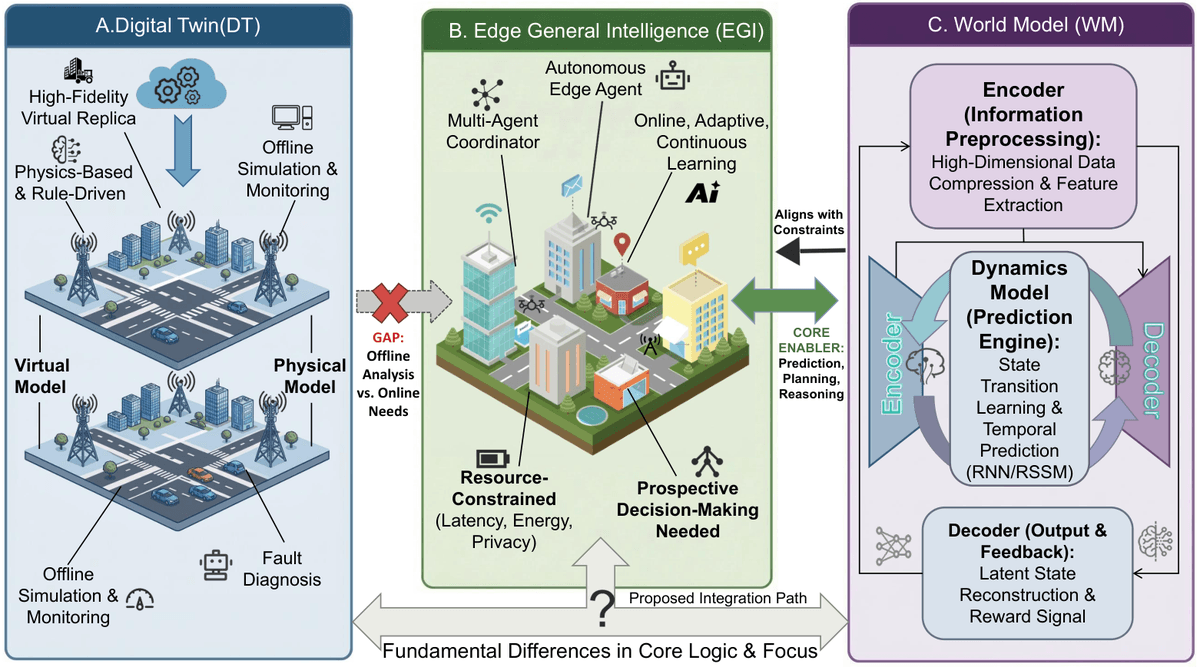
Digital twins have been the go-to abstraction for modeling physical systems for years. As 6G research pushes intelligence out to the network edge, where drones, vehicles, and sensors have to make decisions in milliseconds, the classical digital twin is starting to look heavy, slow, and too dependent on hand-crafted physics. A new survey from a team at Northwest University and Nanyang Technological University argues that the field is quietly transitioning to something more brain-like: world models, learned simulators that an agent carries around in its head.
The paper frames this as the foundation for what the authors call edge general intelligence (EGI): autonomous agents at the edge that can imagine future states, plan, and adapt without constantly phoning home to a centralized replica.
Why the classical twin runs out of road
Traditional digital twins provide high-fidelity representations of physical systems and support monitoring, analysis, and offline optimization, but in highly dynamic edge environments they hit hard limits in autonomy, adaptability, and scale. They are typically physics-based, centralized, and system-centric. You build one giant replica of a factory or a cell tower, stream telemetry into it, and use it for dashboards or offline what-if analysis.
That approach breaks down when the "system" is a swarm of drones bouncing between base stations, or a fleet of vehicles negotiating a busy intersection. Each agent needs its own predictive model, updated in real time, small enough to run on constrained hardware, and expressive enough to reason about actions it has not tried yet.