
Northeastern's Den-TP Cuts Self-Driving Training Time 45% While Beating Dense Traffic
A new curation framework cuts trajectory prediction datasets in half while boosting accuracy on the rare, high-agent scenes that matter most for safety.
 Pro
Takeaways
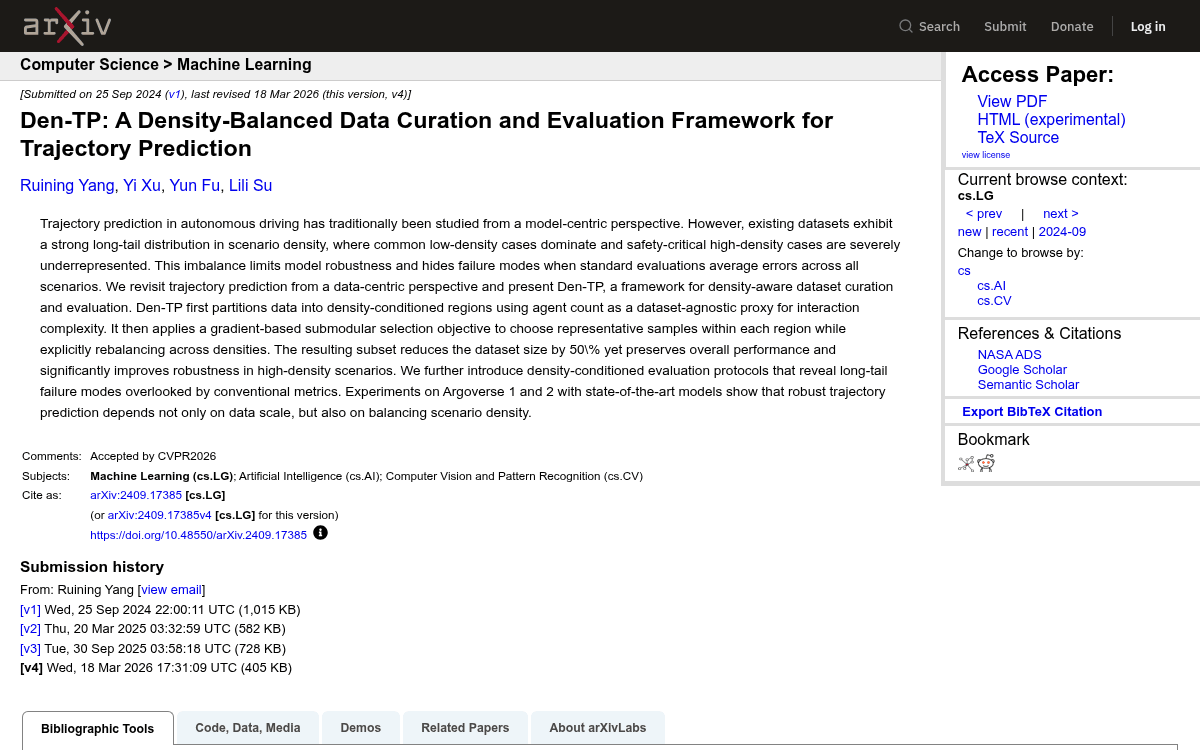
- Den-TP curates trajectory datasets by scenario density, keeping 50% of samples while matching or beating full-dataset accuracy.
- Uses gradient-based submodular selection plus biased sampling to protect rare high-agent scenes from being pruned away.
- On Argoverse 1 and 2, cuts missing rate by over 8% in scenes with more than 80 agents versus random selection.
- Curated subsets transfer across HiVT, HPNet, QCNet, and DeMo backbones without re-running the selection process.
- Introduces density-conditioned evaluation that exposes failure modes hidden by conventional aggregate minADE and minFDE.
- Cuts HPNet training time by roughly 45%, saving over 100 hours while preserving prediction quality.
Self-driving trajectory prediction has a data problem that most benchmarks quietly ignore. The scenes that really test a model, dense intersections with dozens of interacting agents, are a tiny sliver of training sets, so aggregate error metrics look great even when models struggle exactly where safety matters. A new paper from Northeastern University proposes a fix by rethinking curation and evaluation around scenario density.
The framework, called Den-TP, throws away half of a driving dataset and still matches or beats models trained on everything, with the biggest gains coming in the crowded scenes that conventional evaluation dilutes.
The long tail hiding inside Argoverse
Across Argoverse 1, Argoverse 2, and other driving datasets, low-density scenarios dominate the samples, while complex high-density interactions are severely underrepresented. On Argoverse 1, scenes with more than 60 agents account for fewer than 2.5% of samples, yet these are the moments where small prediction errors most directly threaten safety.

The consequence shows up clearly in the numbers. The minimum Average Displacement Error curve rises monotonically with density, while aggregate metrics are pulled down by abundant easy scenes, masking errors in rare high-agent situations. The leaderboard number you see for a state-of-the-art model is largely a measurement of how it handles freeway cruising.