
Northeastern's CMMR-VLN Gives Robot Navigators Memory, Tripling Real-World Success
CMMR-VLN gives LLM navigation agents a structured memory and reflection loop, boosting success rates by up to 53% over prior methods on the R2R benchmark
 Pro
Takeaways
- CMMR-VLN gives LLM navigation agents a structured episodic memory, letting them recall and apply past navigation experiences during new runs.
- The system achieves a 52% success rate on the R2R unseen benchmark, up from 34% (NavGPT), 43% (MapGPT), and 43% (DiscussNav).
- On a real TurtleBot 4 Lite robot, CMMR-VLN triples NavGPT's success rate and outperforms all baselines by 50%+.
- Key innovation: retrieved memories are converted into explicit navigation rules given priority in the prompt -- treating them as ordinary context kills the gains.
- A reflection module after each episode stores full successful paths and only the first mistake from failures, keeping memory lean and actionable.
- No code released yet; the paper is available on arXiv and uses GPT-4o as the backbone LLM.
Getting a robot to follow a natural language instruction like "go down the hallway, turn left at the bookshelf, and wait by the couch" is harder than it sounds. Vision-and-Language Navigation (VLN) is the research field tackling exactly this: teaching agents to interpret spoken or written directions and execute them in real, photo-realistic environments. LLMs have recently become the backbone of choice for these agents, replacing older sequence-to-sequence models with something that can reason in open-ended language. But there is a persistent gap: even GPT-4-powered agents forget everything between episodes. They cannot recall that last time they were at this intersection, turning left led them astray. Every run starts from scratch.
A new paper from Northeastern University proposes CMMR-VLN (Continual Multimodal Memory Retrieval for VLN), a framework that gives LLM navigation agents something closer to episodic memory -- the kind humans use when navigating a familiar building. The result is a training-free system that outperforms every comparable LLM-based baseline on the standard R2R benchmark, and triples the success rate of the weakest baseline on a real physical robot.
Why LLM Navigators Keep Getting Lost
Recent VLN studies introduce LLMs to leverage their strong abilities to enhance instruction understanding and improve generalization in unfamiliar environments. Systems like NavGPT, a purely LLM-based instruction-following navigation agent, performs zero-shot sequential action prediction for VLN. At each step, NavGPT takes textual descriptions of visual observations, navigation history, and future explorable directions as inputs to reason the agent's current status and make decisions. DiscussNav leverages dialogue-style interactions with LLM experts to enable decision-making, while MapGPT introduces an online-updated, language-formalized map to support long-range planning and adaptive behaviors.
The problem is that unlike experienced human navigators who can instinctively recall relevant prior experiences in similar scenarios, deliberately use them to avoid suboptimal paths, and gradually become experts in certain navigation routes through accumulated experience, LLM-based VLN often lacks the ability to identify and apply relevant prior knowledge during navigation. Despite these advances, current VLN agents still struggle to adapt to realistic, commonsense-rich environments and often lack interpretability and structured reasoning in decision-making. The core issue is not reasoning ability -- GPT-4 is a capable reasoner. The issue is that it has no memory of what worked and what did not in this specific environment.
A Memory That Learns From Mistakes
CMMR-VLN is built around three interlocking modules: a Multimodal Experience Memory (MEM), a Retrieval-Augmented Generation Pipeline (RAGP), and a Reflection Module. Together they mimic how a human navigator builds up a mental map of a space over repeated traversals.

Here is how the system works, step by step:
- Build the memory index. Before any navigation begins, the system scans the environment. For every viewpoint, the system stores the panoramic SkyBox image and its associated viewpoint ID within memory units. A fine-tuned Detic model detects salient landmarks from the panoramic images and stores the salient landmark texts in the same units. Both the panoramic images and their associated salient landmark texts are encoded using a CLIP model, generating a hybrid image-text embedding for each viewpoint. These embeddings are indexed using FAISS.
- Retrieve at every step. At each decision point during navigation, the agent encodes the current candidate viewpoint images and the navigation instruction together using an instruction-aware attention module. This produces a single observation embedding that is then compared against the FAISS index via cosine similarity to find the most relevant past experience.
- Convert memory into a rule. The most relevant prior experience is transformed into an explicit navigation rule R that incorporates prior experience relevant to the current context. This rule R is then augmented into the prompt manager as a high-priority constraint, ensuring the LLM prioritizes it over other contextual information during decision-making. The full prompt fed to GPT-4o is: instruction + candidate images + navigation history + topological map + retrieved rule.
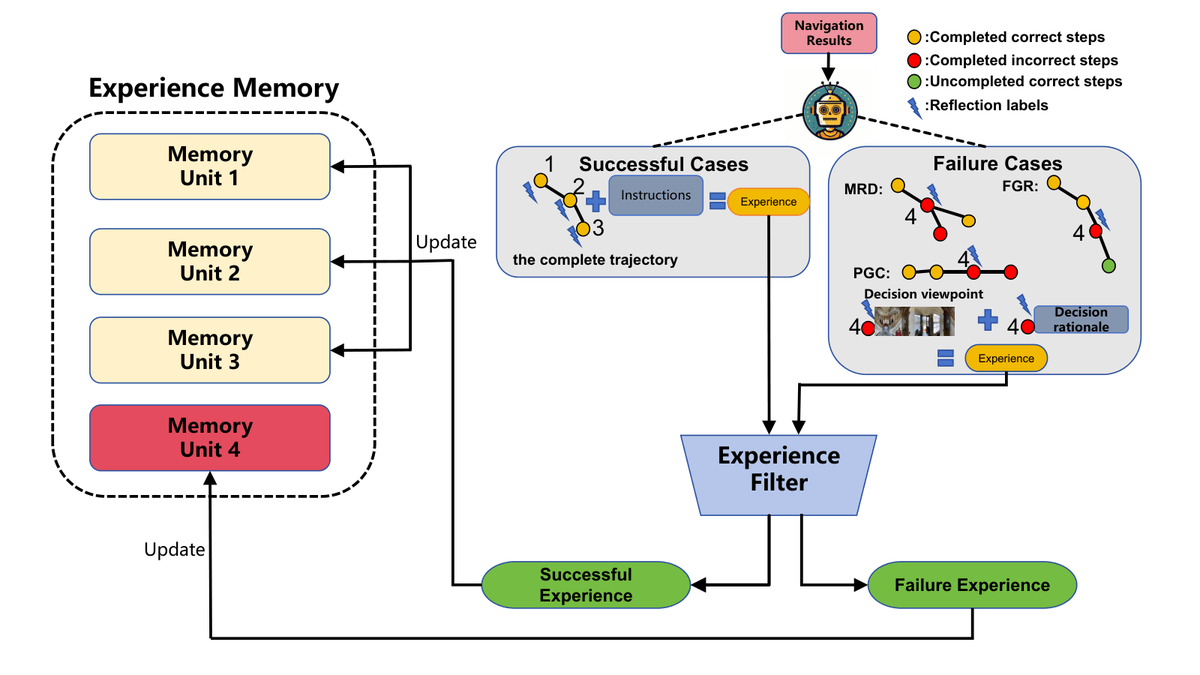
- Reflect and update after each episode. At the end of each navigation episode, a reflection is activated to evaluate the results and update the experience memory accordingly. The evaluation first determines whether the final position lies within the vicinity of the navigation target, classifying the episode as a success or failure.
The reflection step is where CMMR-VLN diverges most sharply from prior work. For successes, the full trajectory is stored against every viewpoint along the path. For failures, the system identifies the first wrong step and classifies it as one of three error types:
- Mid-route deviation (MRD) -- leaving the correct path before reaching the goal
- False goal recognition (FGR) -- stopping too early, thinking the destination has been reached
- Post-goal continuation (PGC) -- walking past the actual destination
Only the first mistake is stored, along with the panoramic image of that viewpoint. For successful experiences, if the memory already contains a similar successful route with better efficiency (shorter or more optimal), the new one is discarded. Otherwise, it replaces the less optimal version. This keeps the memory lean and avoids flooding the LLM with redundant context.
The Ablation That Tells the Real Story
The ablation study reveals something important about how retrieved experiences need to be presented. When the team removed the explicit rule framing and just concatenated retrieved experiences as ordinary context, performance dropped dramatically -- the CMMR-VLN without navigation rules performs significantly worse than the full system across all metrics, particularly with a drop of over 10 SPL points. Its performance is almost identical to that of MapGPT, suggesting that the LLM largely ignores them and falls back to standard contextual signals without explicit reasoning on how retrieved experiences guide decision-making.
Even more striking: replacing the reflection-based update mechanism with fixed scene-level textual descriptions of each viewpoint shows the lowest performance for all metrics. Qualitative inspection of the LLM's reasoning outputs reveals that scene descriptions distract the agent -- the LLM tends to overemphasize aligning the retrieved text with the current observations rather than focusing on navigation, often leading to irrational behaviors such as circling in place. The framing of retrieved knowledge as an authoritative rule, not just extra context, is what makes the system work.

Benchmark Numbers and Real-Robot Tests
Experiments are conducted in the Matterport3D simulator with the Room-to-Room (R2R) dataset, where each trajectory pairs a natural language instruction with a start and goal location in photo-realistic indoor environments. The validation unseen split contains 11 scenes and 783 trajectories -- environments the agent has never seen during any prior episode.
On the R2R validation unseen split, CMMR-VLN achieves a 52% success rate compared to NavGPT's 34%, MapGPT's 43%, and DiscussNav's 43%. SPL (Success weighted by Path Length -- a metric that penalizes inefficient routes) jumps to 51, versus 29, 34, and 40 for the three baselines respectively. Notably, DiscussNav relies on multiple LLMs as specialized experts, whereas CMMR-VLN employs a single LLM as a decision expert, reducing computational overhead while delivering superior performance.
The real-robot experiments used a TurtleBot 4 Lite with an RGB camera, navigating real indoor spaces with 20 natural language instructions. Real robot tests show that CMMR-VLN obtains SR improvements of 200%, 50%, and 50% over NavGPT, MapGPT, and DiscussNav, respectively. The NavGPT can generally follow human instructions to navigate in real environments, but its single-round reasoning limits its ability to complete long-horizon or abstract tasks. The MapGPT benefits from semantic topological maps in simulated discrete environments, yet struggles to fully exploit them in real-world continuous environments where region connectivity is more complex.
Where It Falls Short
The authors are candid about the system's limitations. The effectiveness of CMMR-VLN still depends on the quality and scope of stored experiences in memory. In a brand-new environment with zero prior episodes, the memory is empty and the system degrades to a standard LLM navigator. The gains compound over time -- which means cold-start performance in truly novel spaces remains a challenge. The paper also does not compare against fine-tuned VLN models, which still hold a significant performance edge over all zero-shot LLM-based approaches.
What This Unlocks
The practical implications are clearest for robotics deployments where the same agent operates repeatedly in the same building -- a hospital robot, a warehouse picker, a museum guide. Each run makes the next one better, without any retraining. The framework is also backbone-agnostic: swap GPT-4o for any multimodal LLM and the memory and reflection machinery stays the same.
No code or model weights have been released alongside the paper. The work is currently available as a preprint on arXiv, with experiments built on the Matterport3D simulator and the R2R dataset. The key insight -- that retrieved experiences need to be elevated to explicit rules rather than treated as soft context -- is simple enough to port into any RAG-based agent pipeline today.