
Northeastern Builds a Robot Planner That Proves Safety at 100% Success
A learned Fourier Neural Operator predicts safe reachable sets in real time, with a mathematical guarantee that the learned safe zone always stays inside the true one.
 Pro
Takeaways
- Northeastern researchers combine a Fourier Neural Operator with sampling-based planning for certified real-time safety.
- The FNO learns the Hamilton-Jacobi-Isaacs solution operator, generalizing across obstacle configurations without retraining.
- An epsilon-shifted sublevel set of the learned value function is proven to lie inside the true safe set.
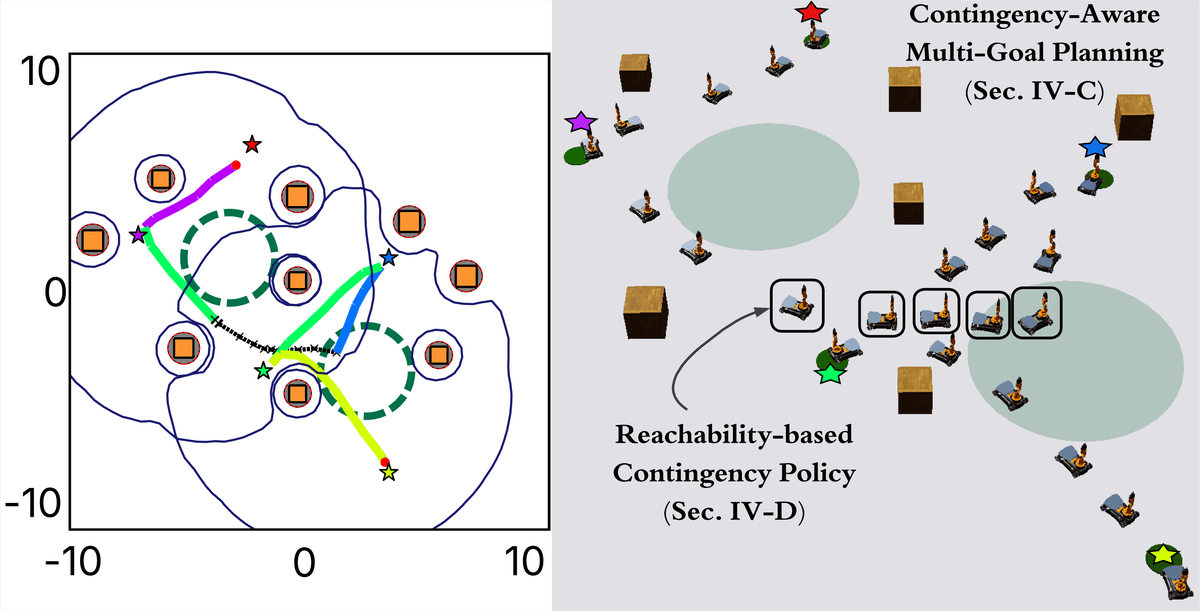
- A modified RRT-X planner enforces the reachability constraint and triggers a certified contingency fallback policy.
- Contingency success rates hit 100% for 1 obstacle and 95.6% for 7 obstacles across 500 trials each.
- Deployed on KUKA youBot in Webots simulation; scales to about 8 goals due to Held-Karp complexity.
Formal safety proofs for robots have a well-known problem: they are slow. Hamilton-Jacobi reachability, the standard method for proving a robot can always avoid crashing under worst-case disturbances, requires solving a partial differential equation over the entire state space. That works offline, but if the environment changes, you have to solve it again. A new framework from researchers at Northeastern University makes this both fast and provably safe by learning the PDE solver itself, then wrapping it in a planner that guarantees the robot always has an escape route.
The paper, Contingency-Aware Planning via Certified Neural Hamilton-Jacobi Reachability, integrates a learned reachability operator with a sampling-based multi-goal planner and demonstrates it on a KUKA youBot in Webots simulation.
Why reachability keeps getting stuck offline
Hamilton-Jacobi reachability provides formal safety guarantees for dynamical systems, but solving high-dimensional HJ partial differential equations limits its use in real-time planning. Prior learning-based approaches like DeepReach train a neural network to fit one specific PDE instance, so any change in dynamics, obstacles, or time horizon forces retraining. That is a dealbreaker for a robot that discovers obstacles as it moves.
A better target is the solution operator itself, a mapping from obstacle configurations to value functions, which lets new environments be handled at inference time. The closest prior work,