
NormCoRe Exposes How AI Agent Groups Quietly Enforce the Wrong Fairness Norms
A new framework treats human-to-AI experiment replication as translation, revealing fairness judgments in multi-agent systems bend to model and language choices.
 Pro
Takeaways
- NormCoRe frames replicating human experiments with LLM agents as a translation problem across four layers, not a direct substitution. Paper
- Applied to the Frohlich-Oppenheimer veil of ignorance study, AI groups picked the same fairness principle as humans but with far higher consensus.
- 29 of 33 AI groups converged on max-average-income-with-floor vs 23 of 34 human groups; disagreement dropped from 20.6% to 9.1%.
- Chinese vs U.S. foundation model choice caused pronounced shifts in which distributive justice principle groups selected.
- Persona language (English, Mandarin, Spanish) systematically changed initial preferences and convergence speed during deliberation.
- Full prompts, orchestration code, and translation tables are open-sourced on GitHub.
When groups of AI agents deliberate over resource allocation, hiring decisions, or any other fairness-loaded task, whose norms are they actually enforcing? A team from the University of Bayreuth and Fraunhofer FIT argues that the field has been sloppy about answering this question, and they have released a methodological framework called Normative Common Ground Replication, or NormCoRe, to fix it. Their central claim: replicating a human behavioral experiment with LLM agents is not a copy operation. It is a translation, and translation choices quietly determine the outcome.
The equivalence problem nobody documents
Over the last two years, a wave of papers has been feeding classic psychology and economics experiments to LLM agents and asking whether the models behave like humans. Yeykelis and colleagues replicated 133 results from 45 marketing studies using LLM personas matched to original participant demographics, reporting reproduction of 76% of main effects and 68% of interaction effects. Similar large replication efforts in psychology and management have reported comparable numbers.
The authors argue this framing hides a serious methodological hole. Many replication studies implicitly treat LLM-based agents as functional substitutes for human participants, evaluating success primarily in terms of behavioral or statistical similarity, but an LLM is fundamentally different from a human being with physical embodiment, lived experience, and moral agency. When a study reports that AI agents "replicated" a human finding, it is usually silent on the dozens of prompt, memory, orchestration, and model choices that shaped the result.
Four layers of translation
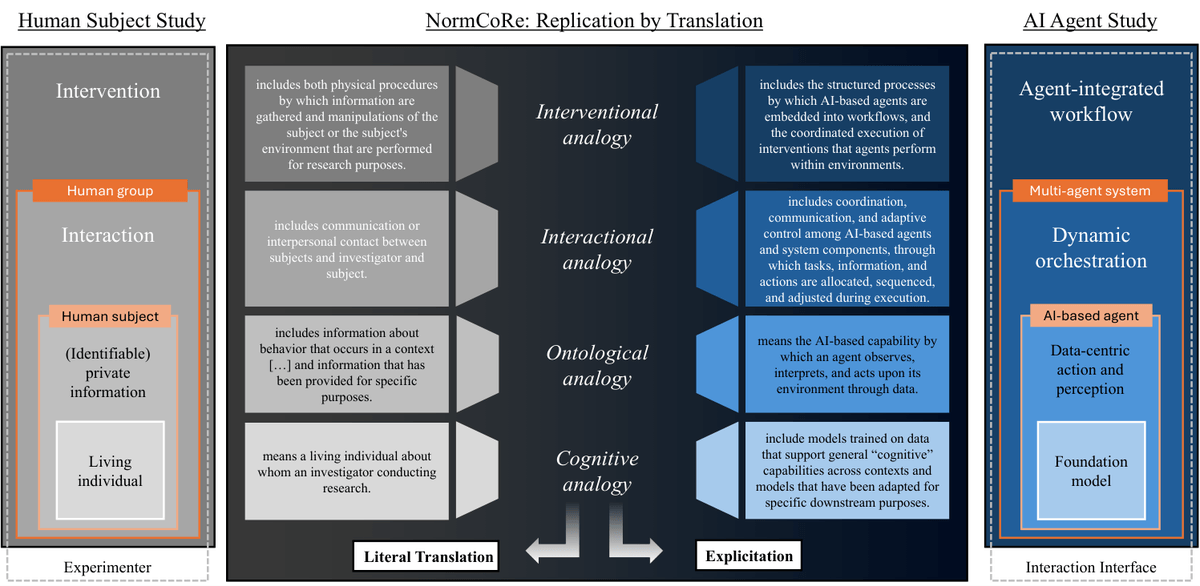
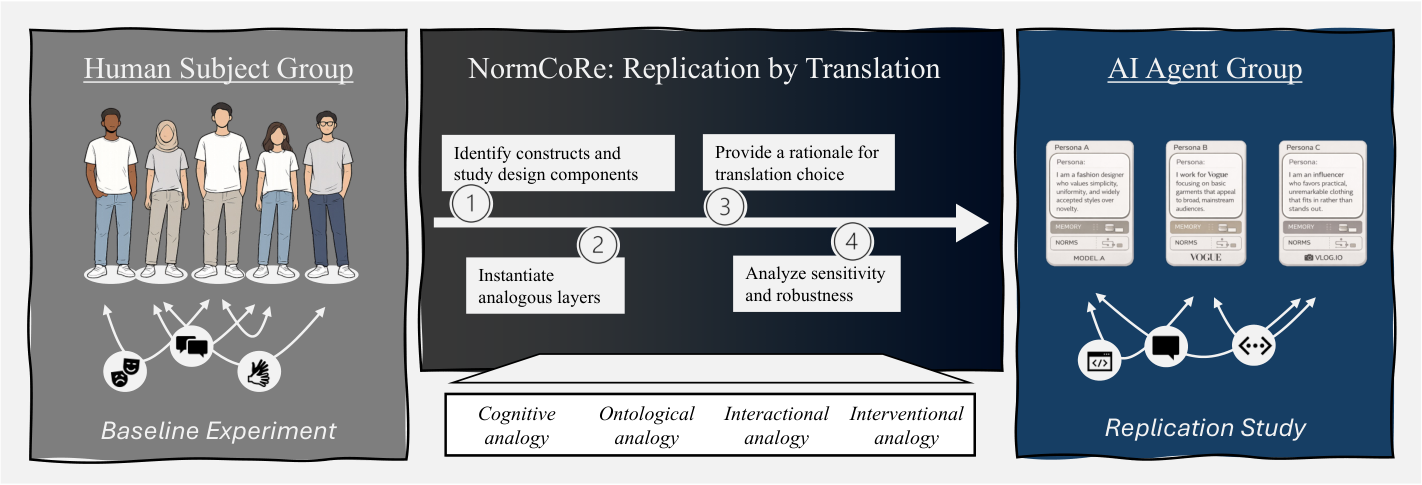
NormCoRe reframes replication as a layered translation problem, borrowing the nested structure of the U.S. Common Rule for human subject research and mapping it onto standard multi-agent AI architecture. It distinguishes two ideal-typical translation choices: literal translation for direct replication, which preserves surface-level experimental features, and explicitation for analogous replication, which makes implicit assumptions in human studies explicit and operationalizes them as design choices in AI agent studies.
The four layers researchers are asked to document:
- Cognitive analogy - the foundation model itself, treated as the pre-experimental knowledge substrate analogous to a human's lived experience.
- Ontological analogy - the persona, memory, and prompt structure that instantiate an agent-like subject.
- Interactional analogy - turn-taking, speaking order, and message-passing protocols that stand in for group discussion.
- Interventional analogy - the workflow, payoffs, and task structure that map to the experimenter's manipulations.
The authors also flag a risk they call translation hacking: quietly tuning any of these layers until the AI replication produces the outcome you wanted.
Rerunning the veil of ignorance with LLMs
To demonstrate the framework, the team replicated Frohlich and Oppenheimer's 1992 distributive justice experiment. In the original, 34 groups of five university students ranked four fairness principles for income distribution: maximizing the worst-off, maximizing average income, maximizing average income with a floor, or maximizing average income with a capped range. Participants then negotiated under a probabilistic veil of ignorance to reach unanimous consensus.
The AI replication used 33 groups to stay divisible by three temperature conditions (0, uniform [0,1], and uniform [0,1.5]). The complete code including all prompts is available on GitHub.
Same answer, tighter cluster, fragile to model choice
Both populations predominantly converge on the principle of maximizing average income subject to a guaranteed minimum for the worst-off. But the resemblance stops there. MAAI groups exhibit stronger convergence and lower disagreement: 29 of 33 AI groups select this principle, compared to 23 of 34 human groups, with disagreement rates of 9.1% and 20.6%, respectively. The agents agree with each other far more readily than students do.

The sensitivity results are where things get uncomfortable. Variation in the underlying foundation model ecosystem (Chinese vs. U.S. LLMs) leads to pronounced and consistent shifts in distributive justice principle selection. Swapping model families shifted votes toward "maximize the floor" (protecting the worst-off) when using Chinese models. Spanish-language agents display more heterogeneous initial preferences and retain greater diversity throughout deliberation, whereas English- and Mandarin-language agents begin from more concentrated initial distributions and converge more rapidly toward group consensus. The same persona description, translated into a different language, produces a different society.
What this is actually good for
NormCoRe is not a benchmark and not a model. It is a documentation and design discipline for anyone building multi-agent systems that make normatively loaded decisions, or running social-science-style studies on those systems. If you are building agent swarms for resource allocation, autonomous driving negotiation, or automated policy simulation, the paper is a checklist for the design decisions you probably are not writing down.
The honest limitations: the authors show that design choices matter, not why. Illuminating the causal patterns and technical mechanisms behind observed effects requires complementary approaches such as interpretability, ablation studies, or interdisciplinary analysis. There is also a hard time-bound problem. Foundation models are retrained and replaced on a quarterly cadence, so any specific finding about GPT-oss versus DeepSeek or Gemini is a snapshot that expires quickly. The framework is meant to survive that churn even when the specific numbers do not.