
NIH Benchmark BiomedSQL Exposes a 30-Point Gap Between AI and Expert Researchers
A new benchmark from NIH-CARD shows frontier models trail human experts by nearly 30 points when translating biomedical questions into SQL queries.
 Pro
Takeaways
- BiomedSQL is the first text-to-SQL benchmark testing scientific reasoning on real biomedical databases, released by NIH-CARD.
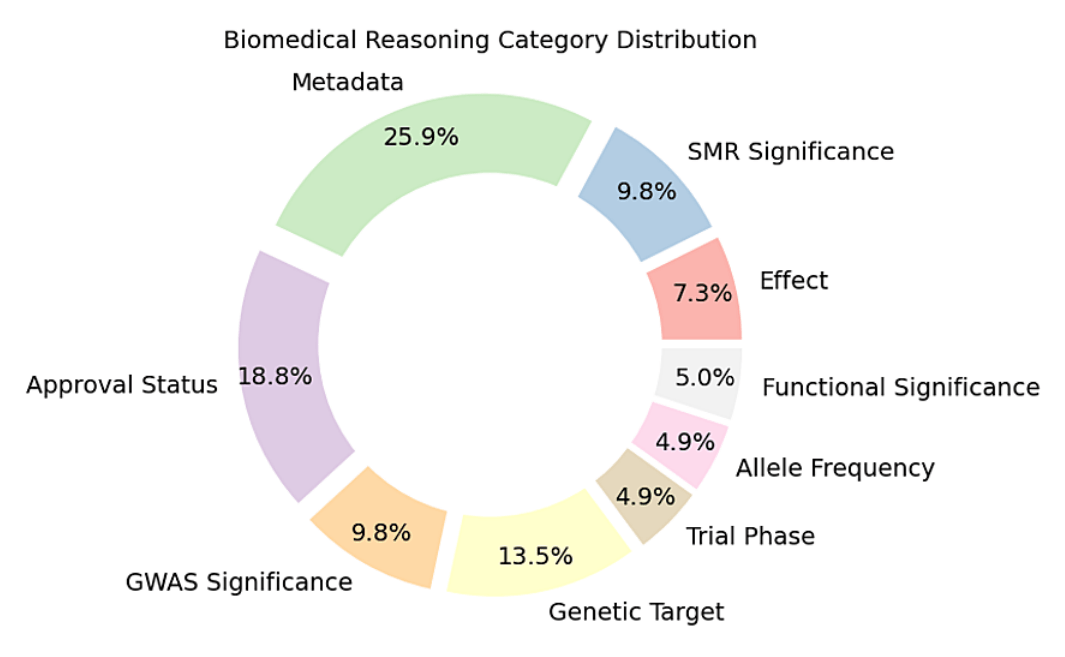
- Contains 68,000 question/SQL/answer triples over a 10-table BigQuery knowledge base built from OpenTargets, ChEMBL, and GWAS data.
- Gemini-3-Pro hits 58.1% execution accuracy; custom BMSQL agent reaches 62.6%; domain experts score 90%.
- Most common failures are incorrect table selection and missing statistical thresholds like p < 5e-8.
- Dataset available on HuggingFace; code and BMSQL agent open-source under PolyForm Noncommercial.
- Accepted at COLM 2026; paper on arXiv 2505.20321.
Ask a biomedical researcher "which SNPs are significantly associated with Alzheimer's?" and they will silently apply a p-value threshold of 5 x 10^-8, know which GWAS table to hit, and interpret effect directionality from a beta coefficient. Ask GPT-5.2 or Claude-4.5-Opus the same question against a real database, and the wheels tend to come off. A team from the NIH Center for Alzheimer's and Related Dementias just quantified that gap with BiomedSQL, the first text-to-SQL benchmark built specifically to probe scientific reasoning over biomedical knowledge bases.
Gemini-3-Pro achieves 58.1% execution accuracy on the benchmark, while a custom multi-step agent called BMSQL reaches 62.6%. Both sit well below the expert baseline of 90.0%, a 27-to-32-point gap on questions that trained analysts answer correctly nine times out of ten.

Why syntactic translation falls short
Existing text-to-SQL benchmarks like SPIDER and BIRD reward models for mapping question structure to SQL syntax. That works when the schema tells you everything you need. It breaks in biomedicine because domain-specific conventions such as genome-wide significance cutoffs, trial phase filtering, and effect-size interpretation are invisible from the schema alone.
A question like "which drugs target genes up-regulated in Parkinson's disease?" implicitly requires the model to know that "approved" is a function of clinical trial phase and indication rather than a single boolean flag, that up-regulation is inferred from beta coefficients in causal inference tables, and that these pieces live across separate resources that must be joined correctly.