
New Theory Formally Proves When AI Models Forget Old Skills During Training
New theoretical results pin down exactly when continual fine-tuning erases old skills, tying forgetting to the choice of KL direction and geometric overlap between tasks.
 Pro
Takeaways
- New arXiv theory paper quantifies forgetting during continual post-training of generative models.
- Splits forgetting into mass collapse of the old mode and silent drift of its mean.
- Proves forward-KL objectives drive old mixture weight to zero; reverse-KL converges to the true target.
- Under reverse-KL, drift decays exponentially with task separation via the Bhattacharyya coefficient.
- Replay reshapes the optimum under forward-KL but only controls variance under reverse-KL.
- Applies the framework to SDFT, TTT-Discover, and OAPL near-on-policy methods.
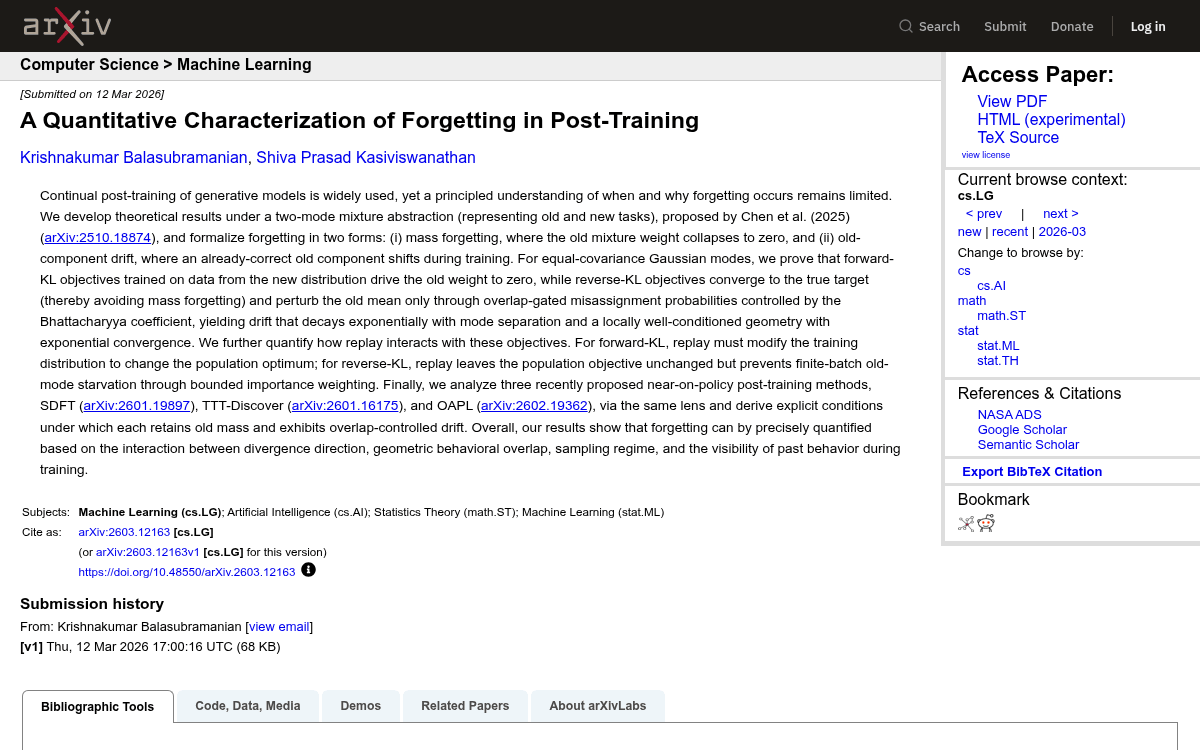
Catastrophic forgetting is one of the oldest headaches in continual fine-tuning: teach a model a new skill and, sometimes, the old ones quietly evaporate. A new theory paper on arXiv, A Quantitative Characterization of Forgetting in Post-Training, tries to move the discussion from folklore to formal math, proving exactly when forgetting must happen, when it cannot, and how techniques like replay and self-distillation fit into the picture.
Why the field needed a theory of forgetting
Continual post-training is now the default recipe for keeping frontier models current: successive rounds of supervised fine-tuning, preference optimization, and reinforcement learning are stacked on top of a base model. The empirical rule of thumb has been that on-policy methods forget less than off-policy ones. On-policy reinforcement fine-tuning forgets less than supervised fine-tuning, and this benefit has often been attributed to the use of on-policy data, but the mechanism has stayed fuzzy.
That fuzziness has real cost. To prevent degrading existing capabilities, many organizations isolate new tasks into separate fine-tuned models or adapters. That fragmentation increases costs and adds governance complexity, requiring teams to continually retest models to avoid regression. Knowing precisely which training objectives are safe would let teams collapse that model zoo back into one.
The setup: two Gaussians standing in for old and new skills
The authors work in a stripped-down abstraction: the model's output distribution is a mixture of two equal-covariance Gaussians, one representing an old task and one a new task. They separate forgetting into two clean failure modes:
- Mass forgetting, where the mixture weight on the old component collapses to zero, meaning the model stops producing old-task behavior at all.
- Old-component drift, where the old Gaussian is still present but its mean silently shifts during training, corrupting responses that used to be correct.
Forward KL versus reverse KL, formally settled
The paper's core result is about the direction of the KL divergence used as the training objective. Trained only on samples from the new distribution:
- Forward KL (data-to-model, the objective implicit in vanilla supervised fine-tuning) provably drives the old mixture weight to zero. Mass forgetting is not a bug, it is the population optimum.
- Reverse KL (model-to-data, closer to what RL-style and on-policy methods optimize) converges to the true target distribution, avoiding mass forgetting entirely.
Reverse KL still perturbs the old component's mean, but only through what the authors call overlap-gated misassignment. The perturbation is controlled by the Bhattacharyya coefficient, a similarity measure between the two Gaussians, so drift decays exponentially as the two tasks become more geometrically separated. Locally the optimization geometry is well-conditioned, giving exponential convergence rates.
The practical reading: if your old and new tasks look very different in output space, reverse-KL-style objectives barely touch the old skill. If they overlap heavily, expect drift no matter what.
What replay actually does
Replay, mixing old-task data back into the training set, gets a similarly crisp analysis:
- For forward KL, replay has to change the training distribution itself in order to move the population optimum. Sprinkling in old samples without rebalancing weights does not fix the underlying collapse.
- For reverse KL, replay leaves the population objective untouched but prevents finite-batch old-mode starvation through bounded importance weighting. Its job is variance control, not bias correction.
Putting modern methods on the same axis
The authors then run three recent near-on-policy algorithms through their lens: SDFT, TTT-Discover, and OAPL. SDFT distills the current policy toward an evolving teacher induced by demonstrations, TTT-Discover reweights samples drawn from the current policy using an entropic reward objective together with a KL anchor, and OAPL samples from a lagged reference policy and defines both its improvement target and regression objective relative to that same frozen reference. For each, the paper derives explicit conditions under which old mass is retained and drift stays overlap-controlled.
This matters because these methods are marketed as forgetting-resistant, and there is already empirical pushback showing that dense on-policy self-distillation can still regress on prior skills. A shared theoretical yardstick makes those comparisons less of a shouting match.
What the paper is and isn't useful for
This is a pure theory contribution: no code, no model weights, no benchmark numbers. The results live inside the two-mode equal-covariance Gaussian abstraction borrowed from Chen et al., which is a deliberate simplification of what a real LLM's output distribution looks like. Useful takeaways for practitioners:
- If forgetting is your main worry, prefer objectives whose population form is reverse KL, or arrange the training data so the forward-KL optimum is not degenerate.
- Use replay for its actual job: variance reduction under reverse KL, or explicit distribution reshaping under forward KL. Do not expect it to rescue a badly chosen loss.
- Expect drift to scale with behavioral overlap. Tasks that share vocabulary and format are the dangerous ones, not the exotic new domains.
The limits are equally clear. Real models are not two-Gaussian mixtures, covariances are not equal across tasks, and modern post-training pipelines combine many objectives, schedulers, and reward models. Treat this work as a principled compass for designing continual training recipes, not a drop-in predictor of how a specific 70B checkpoint will behave after another round of RLHF.