
New arXiv Framework Catches What Average Treatment Effects Silently Miss
A new causal framework uses persistent homology to detect treatment effects that reshape outcome distributions even when average treatment effects stay flat.
 Pro
Takeaways
- New arXiv paper proposes topological causal effects based on persistent homology to catch treatment-induced shape changes that ATE misses.
- Introduces topological ignorability, a target-dependent relaxation of classical conditional ignorability for noninjective structural summaries.
- Covariate-standardized effect τΨ is identifiable under hidden confounding where the full interventional law is not.
- Synthetic and Wisconsin breast-cancer benchmarks show Betti and Euler contrasts stay accurate while IPW-adjusted ATE remains biased.
- JOBS II randomized trial application reveals distributional shape differences the modest mean contrasts do not capture.
- Related Python implementation available at top-causal-effect; this paper itself ships no dedicated repository.
Classical causal inference lives and dies by the average treatment effect. Compute the mean under treatment, subtract the mean under control, worry about confounders. But what if a treatment splits a population into two disconnected subgroups, opens a hole in the joint outcome cloud, or reorganizes the geometry of the response entirely, all while leaving the centroid untouched? A new arXiv paper, Topological Ignorability for Structural Causal Effects Beyond Means, argues that mean-based estimands can silently return zero in exactly the settings where the intervention matters most, and proposes a framework grounded in persistent homology to fix it.
When the mean lies
The motivating failure mode is easy to picture. Many interventions alter the structure of an outcome distribution rather than its mean: they can split a population into disconnected regimes, create loops or holes, generate branches, or reorganize an outcome cloud while leaving the average response nearly unchanged. In such settings, mean-based causal estimands such as the average treatment effect may miss important structural effects. A control cloud might sit as a single blob, while treatment carves it into two well-separated modes with the same overall center of mass. The ATE registers nothing. Scientifically, everything has changed.

The authors' response is to swap the estimand. Instead of comparing means, they compare topological summaries of the treated and control outcome laws. They introduce topological-geometrical causal metrics based on summaries of interventional outcome laws, including density-superlevel Betti summaries, Euler signatures, and persistent-homology summaries. These metrics quantify structural differences between treated and untreated outcome laws beyond averages.
The machinery, in plain terms
The key primitive is the density superlevel set: for a distribution with density f, look at the region where f(y) ≥ c and sweep c from high to low. As the threshold drops, high-density islands emerge, grow, and eventually merge. Persistent homology tracks the birth and death of connected components (captured by the Betti number β0), loops (β1), and higher-dimensional voids across that sweep. The Euler characteristic χ = β0 - β1 + β2 - ... gives a coarser alternating summary.
These summaries plug into a treatment-effect formula. Let Ψ be any such topological transform. The paper defines a covariate-standardized topological causal effect that averages within-stratum topological differences across the covariate distribution, giving a clean plug-in target for estimation.
The real theoretical move
Swapping the estimand is only half the story. The deeper contribution is a new identifying assumption. Classical causal inference relies on weak (conditional) ignorability, which says the entire counterfactual law is unchanged by treatment selection once you condition on observed covariates. The authors introduce topological ignorability, a topological analogue of classical conditional ignorability that requires invariance of the chosen structural feature rather than the full counterfactual distribution.
This has a subtle consequence. When the chosen summary is injective, this condition coincides with weak ignorability; for noninjective summaries, it can identify the structural feature of interest without identifying the full interventional law. In other words, if you only care whether treatment turns one high-density blob into two, you can identify that effect under hidden confounding that would break identification of the full distribution. The scientific target is coarser, so the identifying assumption can be weaker.
The paper also flags a trap that would be easy to miss. Persistent homology does not commute with mixing over covariates, so the marginal effect ΘΨ = ||Ψ(P1) - Ψ(P0)|| is generally not identified from conditional topological ignorability alone. Only the covariate-standardized version τΨ is. The theory is careful about this: identification lives inside strata, not across them.
How the estimation actually runs
The proposed recipe reads like a topological cousin of propensity-score analysis:
- Fit a low-dimensional balancing summary such as a propensity score or a learned representation.
- Partition the sample into bins that contain both treated and control units.
- Within each bin, estimate the treated and control outcome densities and compute their topological signatures (Betti curves, Euler curves, persistence images).
- Take the norm of the difference within each bin.
- Average those contrasts over the empirical bin distribution.
Crucially, the order matters: condition first, apply Ψ second, average third. Reversing steps generally targets a different quantity because of the mixing issue above.
What the experiments show
The paper reports three benchmarks. The first two are hidden-confounding tests: a fully synthetic construction and a semi-synthetic one built on the 30 covariates from the Wisconsin breast-cancer dataset. Both are validated in hidden-confounding benchmarks where weak ignorability fails and balancing observed covariates nearly eliminates standardized mean differences, yet the coordinate-mean average treatment effect remains biased.
Numerically: on the synthetic benchmark, inverse-propensity weighting cuts the maximum absolute standardized mean difference from 0.728 to 0.001, but the ATE bias only drops from 0.257 to 0.221. On the breast-cancer benchmark, SMDs fall from 0.430 to 0.006 while ATE bias barely moves from 0.275 to 0.236. The Betti-0 and Euler contrasts, meanwhile, come out to exactly 1 across raw, observational, and IPW analyses, matching the oracle. The finite Euler Characteristic Transform, a directional shape signature, was more sensitive: only 85.6% of its slice coordinates matched the oracle on the synthetic benchmark and 72.2% on the breast-cancer version, so the authors treat it as a descriptive diagnostic rather than a formal claim.
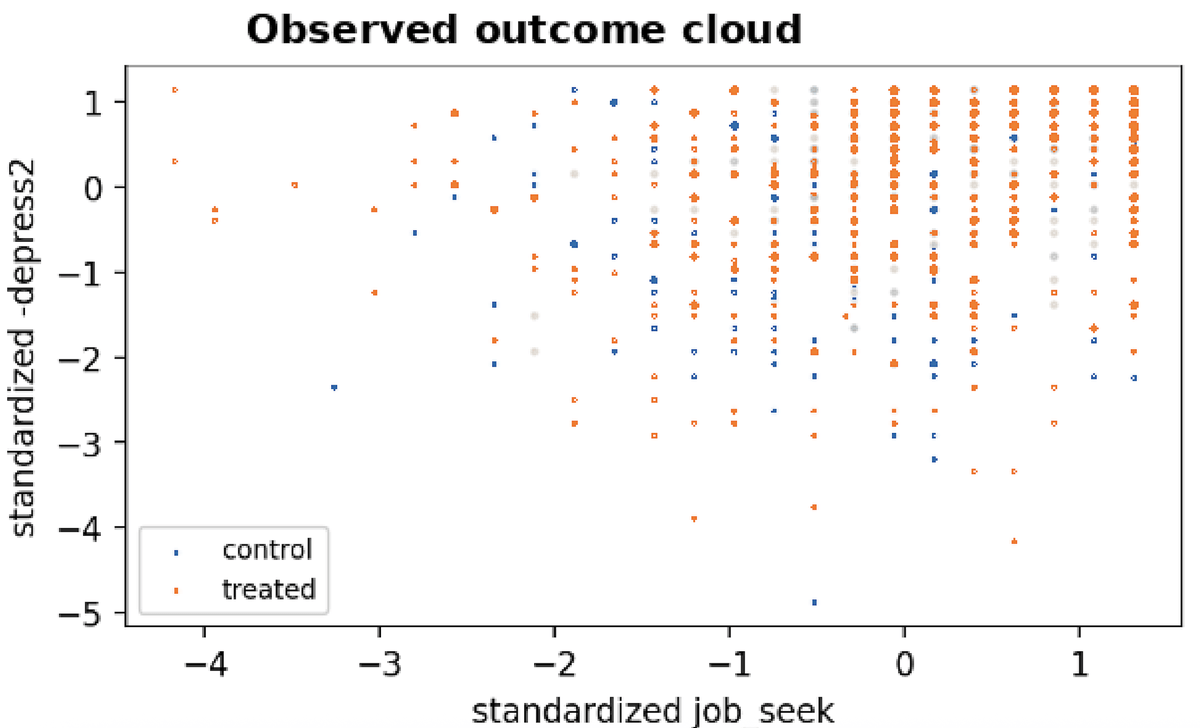
The third experiment applies the machinery to the JOBS II randomized job-training data, using standardized job-search self-efficacy and standardized negative depression as the joint outcome. Mean contrasts are modest (0.093 and 0.097), but the ECT signature picks up a shape difference that the means miss.

When it is useful, and when it is not
This framework is aimed at problems where the scientific question is genuinely about shape rather than average response. Cell-state perturbation studies where an intervention creates a new phenotypic cluster, social-policy interventions that split a population into distinct response regimes, and any high-dimensional outcome cloud where connectivity carries meaning are all natural fits.
The limitations are honest. Topological ignorability is not a free lunch: it is weaker than weak ignorability only relative to a specific noninjective summary Ψ, and choosing that summary requires scientific judgment. Like classical ignorability, it is not testable from observational data alone. And the machinery inherits all the usual causal-inference discipline: positivity, overlap diagnostics, sensitivity to hidden bias. No code repository is released with the paper itself, though the closely related Topological Causal Effects paper by Kim and Lee provides a Python implementation on GitHub that overlaps in spirit.
The broader shift is worth noting. The paper sits alongside a growing family of alternatives to ATE, including distributional and quantile treatment effects, kernel-based two-sample comparisons, and causal inference on functional or random-object outcomes. What sets it apart is the argument that the identifying assumption itself should depend on the target: pick a coarser question and you can sometimes answer it under weaker premises. That is a genuinely new lever in the causal-inference toolbox.