
NeuCo-Bench Forces Satellite AI Embeddings to Prove Their Worth
A new Earth Observation benchmark evaluates fixed-size embeddings via hidden downstream tasks, ranking foundation models under a ~7000x compression ratio.
 Pro
Takeaways
- NeuCo-Bench evaluates fixed-size neural embeddings for Earth Observation via linear probing on hidden downstream tasks
- Framework validated at 2025 CVPR EarthVision challenge with 23 teams compressing satellite cubes at ~7000x ratio
- Rank-then-aggregate scoring weights tasks by score variance across submissions to surface differentiating tasks
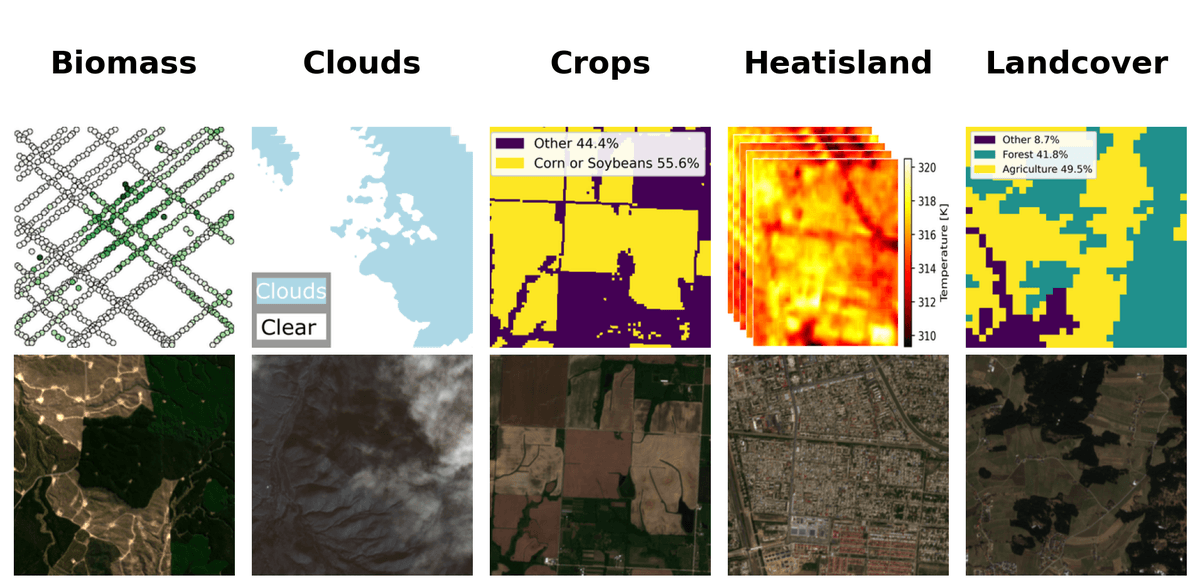
- SSL4EO-S12-downstream dataset released on HuggingFace with crops, landcover, biomass, clouds, heatisland tasks
- TerraMind led foundation model comparison with average R² 0.659, ahead of Clay-V1 and Prithvi-EO-V2
- Code is Apache 2.0 open source on GitHub, runs on CPU-only commodity hardware
Earth observation datasets are ballooning into the petabyte range, and the community has responded with a wave of foundation models that spit out huge embedding vectors. The problem: those embeddings are sometimes bigger than the original satellite pixels they claim to compress. A new benchmark called NeuCo-Bench, built by researchers at the German Aerospace Center, IBM Research, and Juelich Supercomputing Center, tries to fix how we measure whether a compressed embedding actually retains anything useful.
The framework was stress-tested at the 2025 CVPR EarthVision workshop challenge, where teams competed to squeeze multi-modal satellite cubes into 1,024-dimensional vectors without knowing what tasks their embeddings would be graded on.
Why pixel fidelity is the wrong yardstick
Traditional codecs such as JPEG2000 and more recent learned autoencoders are optimized for pixel-level distortion, largely reflecting human visual perception. That is fine when a human is looking at the picture. But most ML pipelines only care whether the compressed representation still contains the semantic signal needed for downstream work like flood mapping or biomass estimation.
In Earth Observation this mismatch is painful. EO data are characterized by substantial redundancy and noise across multiple spectral bands and temporal sequences, amplifying the need for compression strategies that efficiently capture underlying, task-relevant information. Existing benchmarks like GEO-Bench and PANGAEA typically require backbone fine-tuning or big decoder heads, which sidesteps the question of how compact the representation itself can be.
How the benchmark works
NeuCo-Bench treats the encoder as a black box. You feed it multi-modal, multi-temporal data cubes and it must return fixed-size embeddings. The benchmark then trains a linear probe (a single linear layer with N+1 parameters) on top of those embeddings for each downstream task.

For each task, it runs K random train/test splits and computes a signal-to-noise style quality score that rewards both high mean accuracy and low variance across splits. Scores that beat the label-mean baseline live in [0, 100] and can be read roughly as a percent accuracy figure. Experiments with negative Q are flagged as unreliable.
The ranking layer is where things get interesting. Instead of averaging task scores uniformly, NeuCo-Bench uses a rank-then-aggregate scheme that weights each task by the standard deviation of the Q values of all experiments on the task. Tasks where everyone scores about the same get pushed to low weight; tasks that actually separate methods dominate the leaderboard. The authors compare it to a football tournament where 1-1 and 8-8 are both draws.
The dataset behind it
Alongside the framework, the team released SSL4EO-S12-downstream, a curated multispectral and multitemporal EO dataset. Each sample is a data cube of 27 bands (13 from Sentinel-2 L1C, 12 from Sentinel-2 L2A, and 2 radar polarizations from Sentinel-1) captured across four seasonal snapshots at 264x264 pixels.
The initial task suite covers five real-world use cases:
- Crops - fraction of corn and soybean in patches over the US Corn Belt
- Landcover - percent forest and percent agriculture from CORINE data in Europe
- Biomass - mean and std above-ground biomass in Mg/ha from GEDI LIDAR
- Clouds - cloud cover fraction from CloudSen12+
- Heatisland - Landsat-8 land surface temperature statistics over cities

What the CVPR challenge revealed
The challenge asked teams to produce 1,024-dim embeddings from data cubes, which corresponds to a compression ratio of roughly 7,000. Crucially, the participants did not know which downstream tasks would be graded, only that the embeddings had to be general purpose. Twenty-three teams submitted to the development phase; sixteen went on to the final evaluation, nine of which shared their submissions publicly.
The dynamic ranking mattered. The dynamic ranking caused a swap between the original first and second place methods due to a third team, highlighting the impact of adaptive weighting. The winning entries stacked foundation model representations, though the fourth-place team skipped pretraining entirely and used the MOSAIKS random-features method.
The foundation model shootout
The authors also ran a fair-comparison study with popular EO foundation models under the same 1,024-dim linear-probe protocol. TerraMind, IBM and ESA's multimodal generative EO model, came out on top with an average R² of 0.659 across tasks, ahead of Clay-V1 (0.588) and Prithvi-EO-V2-300M (0.549).
A few practical takeaways from the ablations:
- Post-encoding aggregation wins. Averaging embeddings across seasons after encoding beats averaging raw pixels before encoding, especially on time-sensitive tasks like cloud fraction where gains reach +0.42 R² for ViTs.
- 1024 dims is a sweet spot. CNN backbones peak between 128 and 1024 dims; ViTs prefer their native patch-token dim. Bigger embeddings mostly add cost.
- Linear probes are enough. Swapping in one- or two-layer MLPs adds 170x to 464x more parameters for only marginal accuracy gains on strong embeddings.
- Neural rate-distortion compressors underperform FMs. Factorized-Prior autoencoders beat the naive averaging baseline but stay below R² = 0.5 under this aggressive compression setting.
What you can actually use
The framework is available under Apache 2.0 as a standalone Python package. Running it locally is a single command that points at a CSV of embeddings and a directory of task labels, and the whole thing runs on 8 vCPUs without a GPU. At the CVPR challenge, over 400 submissions were scored within minutes on commodity hardware.
The obvious use case is picking an EO foundation model for a storage- or bandwidth-constrained pipeline. The less obvious one is competition design: because tasks are shared as simple CSV label files against public data cubes, organizers can mix and match hidden tasks for future challenges to keep pretraining bias out of the results. The current limitation is that everything is image-level classification or regression. Pixel-wise segmentation and time-sensitive prediction are on the roadmap but will require lower compression ratios than the current 7,000x.