
NetDiffuser Fools AI Security Systems by Making Attacks Look Like Real Traffic
NetDiffuser uses diffusion models to generate adversarial network traffic that fools both intrusion detectors and the defenses designed to catch them
 Pro
Takeaways
- NetDiffuser generates adversarial network traffic using diffusion models that fools both NIDS classifiers and the secondary detectors built to catch adversarial examples.
- Achieves up to 29.93% higher attack success rate than standard attacks (FGSM, PGD, ACG) after adversarial detectors attempt purification.
- Drops the Artifact adversarial detector's AUC-ROC from ~0.99 to ~0.47 (near random), and MANDA's by up to 0.267.
- A novel automated feature categorization algorithm identifies which traffic features can be safely perturbed without violating network protocol constraints, replacing manual expert selection.
- Evaluated on three benchmark datasets (CICIDS2017, CICDDoS2019, UNSW-NB15) across four model architectures; code is open source.
- Main limitation is runtime: generating adversarial samples is 10-30x slower than baseline attacks due to the multi-step diffusion process.
Deep learning has made network intrusion detection systems (NIDS) dramatically better at catching malicious traffic. But that same power comes with a well-known weakness: neural networks can be fooled by adversarial examples, inputs that have been subtly tweaked to cause misclassification. A new framework called NetDiffuser, from researchers at New Mexico State University and the University of Hartford, takes this threat to a new level by generating adversarial network traffic that not only evades detection but also looks statistically indistinguishable from real traffic, defeating the secondary defenses built specifically to catch adversarial examples.
The problem with existing attacks
Most adversarial attacks on NIDS borrow techniques from computer vision: methods like Fast Gradient Sign Method (FGSM) or Projected Gradient Descent (PGD) that nudge input features in the direction that maximizes the model's classification error. Existing studies in adversarial learning against NIDS directly implement adversarial attacks designed for computer vision tasks, ignoring the fundamental differences in the detection pipeline and feature spaces between CV and NIDS. These blunt perturbations work, but they leave a statistical fingerprint. The adversarial traffic looks different from legitimate traffic in ways that dedicated adversarial detectors can catch.
The deeper challenge is that network traffic features are not independent. You cannot just perturb any feature freely. Features like Flow IAT Mean, Flow IAT Std, and Flow IAT Max are all derived from the same underlying packet intervals, so changing one without respecting the others produces logically inconsistent flows that scream "adversarial" to any careful observer. Features such as port number, destination address, and network service must be valid and consistent in any generated adversarial example to preserve its functional plausibility.
Natural adversarial examples: a harder target
NetDiffuser's goal is not just to fool the NIDS classifier. It aims to generate Natural Adversarial Examples (NAEs), a concept borrowed from computer vision where adversarial inputs are constrained to stay on the real data manifold. In plain terms: the adversarial traffic should be statistically plausible enough that even a human analyst, or a dedicated adversarial detector, cannot tell it apart from legitimate traffic.
NAEs exploit inherent variability within natural data distributions by introducing subtle deviations that resemble legitimate fluctuations, making them challenging for both humans and machine learning models to distinguish from legitimate inputs. This is a fundamentally harder problem than traditional adversarial attacks, and it is the gap NetDiffuser targets.

How NetDiffuser works
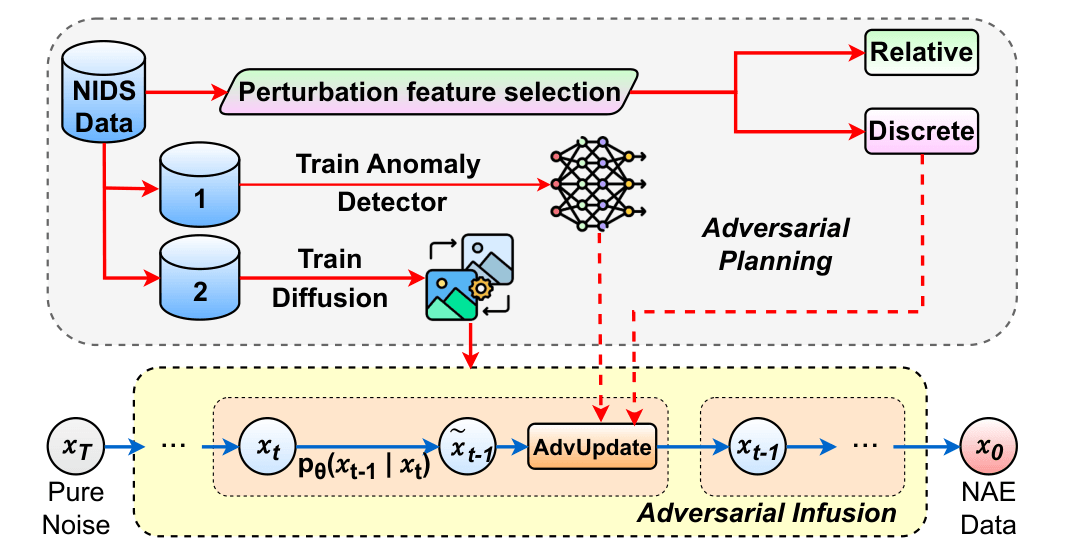
The framework has two main stages: Adversarial Planning and Adversarial Infusion.
The first stage solves the feature constraint problem automatically. Rather than relying on domain experts to manually pick which features can be safely perturbed, NetDiffuser runs a data-driven feature categorization algorithm:
- Compute pairwise Pearson correlation coefficients between all feature pairs in the dataset.
- Convert correlations into a distance matrix and run agglomerative hierarchical clustering to build a dendrogram (a tree showing which features are tightly coupled).
- Use the Calinski-Harabasz Index to find the optimal cut point in the tree, separating features into Discrete (relatively independent, safe to perturb) and Relative (tightly coupled, leave untouched).
This step is fully automated. On the CICIDS2017 dataset it identified 30 discrete features out of 77 total; on UNSW-NB15 it found 16 out of 39. Only these discrete features are ever modified during the attack.
The second stage is where diffusion models enter. A Denoising Diffusion Probabilistic Model (DDPM) is trained on the NIDS dataset to learn the real traffic distribution. During attack generation, a real malicious traffic sample is first corrupted with Gaussian noise across many forward diffusion steps, then reconstructed step-by-step through the reverse denoising process. At each denoising step, a gradient-based adversarial update (FGSM, PGD, or ACG) is injected into the discrete features to push the sample toward misclassification. The diffusion model then smooths those perturbations back into the natural data distribution. The result is an adversarial sample that carries adversarial intent but wears the statistical clothing of real traffic.
# Conceptual sketch of the Adversarial Infusion loop
for t in reversed(range(T_rev)):
    # Diffusion model predicts a cleaner version
    x_denoised = diffusion_model.reverse_step(x_noisy, t)
    # Inject adversarial perturbation into discrete features only
    for i in range(I):  # refinement iterations
        if model_fooled(x_denoised):
            break
        delta = adv_update(x_denoised, target_model, discrete_features)
        x_denoised[discrete_features] += delta
    x_noisy = x_denoised  # feed into next reverse step
x_nae = x_denoised  # final natural adversarial example
Benchmarks and what they reveal
The team evaluated NetDiffuser on three standard NIDS datasets: CICIDS2017 (2.8M flow records, 77 features), CICDDoS2019 (1M instances, 78 features), and UNSW-NB15 (257K instances, 39 features). They tested against four model architectures (MLP-1L, MLP-5L, CNN-2L, CNN-3L) and two state-of-the-art adversarial detectors: MANDA (manifold and decision-boundary-based detection) and Artifact (kernel density + Bayesian uncertainty).
The headline numbers:
- +29.93% Attack Success Rate over baseline attacks like FGSM and PGD, measured after adversarial detectors attempt purification.
- AUC-ROC drop of 0.267 to 0.534 on adversarial detectors. The Artifact detector, which normally scores near 0.99 against FGSM, drops to ~0.47 against NetDiffuser attacks, essentially random guessing.
- NetDiffuser's adversarial samples had Wasserstein distances 5-10x lower than baseline attacks, confirming they sit much closer to the real data distribution.
A key behavioral difference explains why NetDiffuser is harder to catch. Baseline attacks like FGSM create adversarial examples by applying perturbations that directly push the input toward a misclassification, distorting features in unnatural ways and leading to a sharp drop in accuracy. That sharp drop is itself a signal that something is wrong. NetDiffuser's more moderate accuracy degradation makes the attack blend in, avoiding the kind of sudden performance cliff that triggers automated monitoring.
The real breakthrough
The key innovation is not just that NetDiffuser beats existing attacks on raw success rate. It is that it defeats the second line of defense. Most adversarial attack papers stop at fooling the classifier. NetDiffuser specifically targets the adversarial detectors that are deployed precisely because classifiers can be fooled. Existing adversarial example detectors in the NIDS domain are primarily designed to identify carefully crafted adversarial examples that manipulate the model's decision boundary, enabling them to detect such flows relatively easily. NetDiffuser's NAEs sidestep this entirely by never looking like carefully crafted adversarial examples in the first place.
The automated feature categorization is also a meaningful step forward. Prior work required security domain experts to manually specify which features could be perturbed, an approach that does not generalize across datasets. NetDiffuser's algorithm derives this from the data itself, making it portable across different NIDS setups without manual intervention.
Limitations to keep in mind
NetDiffuser is not without trade-offs:
- Runtime cost: Generating 2,000 adversarial samples with ND-ACG takes up to 23 minutes, compared to under a minute for baseline ACG. The multi-step diffusion process is expensive.
- White-box assumption: Current experiments assume the attacker has full access to the target model's architecture and gradients. Real-world attacks often operate with less information, though the authors note the framework can extend to gray-box and black-box settings.
- Inconsistent gains on DDoS traffic: On the CICDDoS2019 dataset, some model/attack combinations show smaller improvements over baselines, suggesting the approach may be more effective against certain traffic types than others.
- No new defenses proposed: The paper is an offensive contribution. It explicitly calls for future work on defenses that can handle NAEs.
Who should pay attention
NetDiffuser is most directly relevant to security teams stress-testing NIDS deployments and researchers building the next generation of adversarial defenses. The framework's modular design, where the diffusion backbone is attack-agnostic and can wrap FGSM, PGD, or ACG, means it could serve as a red-teaming tool for evaluating how robust a given NIDS is against statistically stealthy attacks. The code is available on an open repository, built on top of the Adversarial Robustness Toolbox and the TabDDPM diffusion framework.
The broader implication is a familiar one in adversarial ML: defenses and attacks co-evolve, and the bar for what counts as a "good" adversarial example keeps rising. NetDiffuser raises it again, specifically in the network security domain where the stakes are critical infrastructure.