
NetArena Exposes AI Agents Failing at Real Network Tasks With 13-38% Scores
A dynamic benchmark that stops AI network agents from gaming static test sets exposes correctness rates as low as three percent.
 Pro
Takeaways
- NetArena introduces dynamic benchmark generation for AI network agents, avoiding contamination that plagues static test sets. Paper
- State-action abstraction lets one framework generate unlimited queries across datacenter, routing, and Kubernetes tasks.
- Scaling from 100 to 5000 queries cut confidence-interval overlap between agents from 85% to zero.
- Top agents score only 13-38% average correctness; some drop to 3% on complex realistic queries.
- Framework doubles as SFT and GRPO reinforcement-learning training environment via emulator-grounded reward signals.
- Open source with Docker packaging, live leaderboard, and A2A protocol at Froot-NetSys/NetArena.
Static benchmarks have a nasty habit of flattering the models they measure. Manually curated test sets rarely exceed a few hundred queries, get scraped into pretraining corpora, and cover a narrow slice of real work. A team from the University of Maryland, Microsoft Research, and UIUC just published NetArena, an ICLR 2026 framework that swaps that model for on-demand query generation grounded in actual network emulators, and the results are unflattering for current agents.
Existing benchmarks risk contamination due to static design, show high statistical variance from limited dataset size, and fail to reflect the complexity of production environments. The authors point out something specific about the network domain that makes this worse: tasks like data center capacity planning, root cause analysis, and policy synthesis require not just correctness, but robustness and efficiency. Getting one command wrong in a production topology can trigger cascading outages, so a benchmark that overstates capability is not just embarrassing but dangerous.
Why static test sets break down
The core issue is data scarcity. Because network tasks require domain-expert labels, current benchmarks rely on manually curated queries and ground truths by domain experts, and even after months of work, most of them ship with fewer than 300 questions. With that few samples, confidence intervals across competing agents overlap so heavily that you cannot tell which model is actually better. NetArena's headline finding is that agents achieve only 13-38% average performance (as low as 3%) for large-scale, realistic queries, numbers that only become statistically distinguishable at scale.

State-action abstraction as the trick
Making a benchmark truly dynamic in networking is harder than in math or code, because ground truth depends on running the system. NetArena's answer is to model every task as a finite state transition system with three pieces: a state space S (network topologies with attributes), an action space A (atomic operations like add-node, change-IP), and an execution function E that applies actions to states. Once you define those, the framework can sample initial states, sample legal action sequences, execute them in a real emulator, and hand the resulting (initial state, natural-language query, target state) triple to the agent under test.
The paper splits tasks into two categories worth understanding:
- Constructive tasks are white-box. The query expresses a clear intent, and agents must generate a policy update that fulfills that intent. In such cases, LLM agents modify the current network state into a target state using interpretable operations. Ground truth is the exact action sequence sampled during generation.
- Reactive tasks are black-box. The framework injects a hidden fault sequence into a healthy network and asks the agent to restore connectivity. Multiple recovery paths can be valid, so grading compares the final restored state, not the trajectory.
Three applications, one interface
The paper instantiates the framework on three representative workloads pulled from real infrastructure:
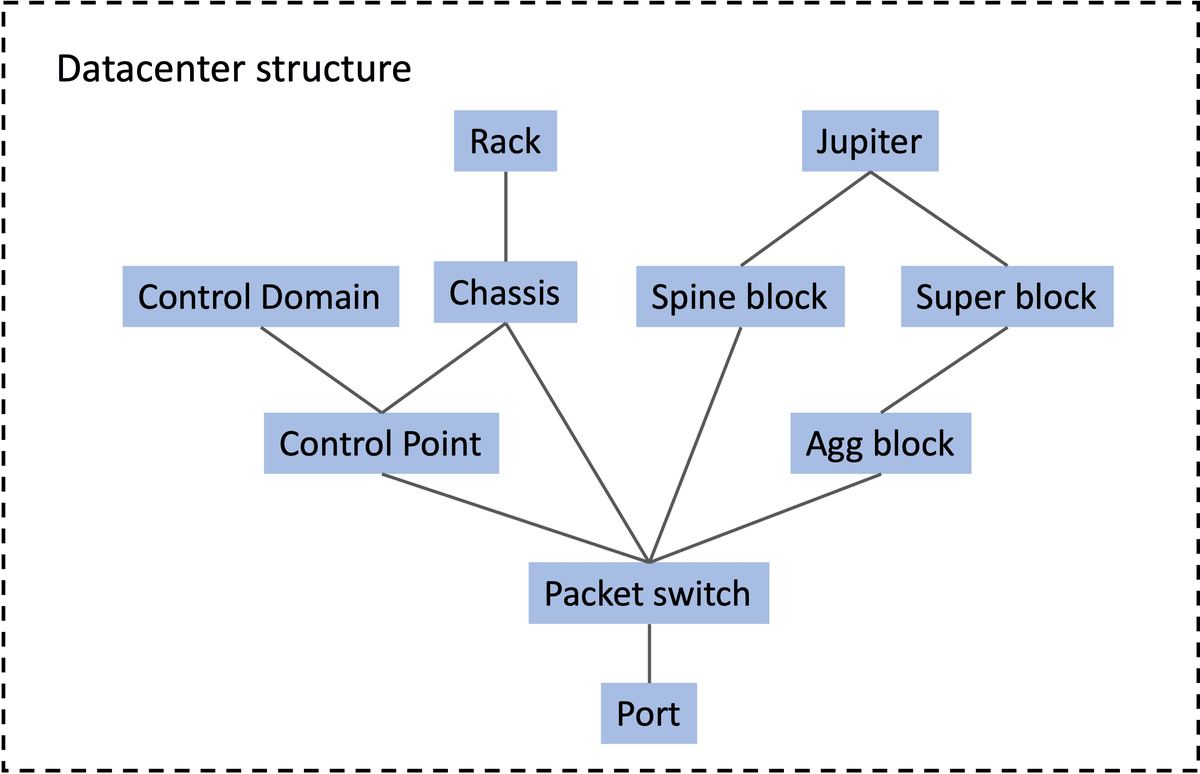
- Datacenter capacity planning on a topology modeled after Google's multi-layer abstraction with 5,493 nodes and 6,424 edges across 10 device types. Twelve operation types (add, update, count, rank, etc.) generate the queries.
- Routing misconfiguration in Mininet, where the framework injects one of five fault families (disable routing, disable interface, remove IP, drop subnet traffic, wrong routing table) and the agent must diagnose and repair using shell commands like
ip routeandifconfig. - Kubernetes policy troubleshooting on Google's Online Boutique microservices demo, with faults injected into network policy YAML.

Every action gets executed end-to-end against the emulator, which lets the framework measure three metrics simultaneously: correctness (did the final state match?), safety (did each intermediate step preserve invariants and not disrupt healthy services?), and latency (how many commands and how much wall time?).
What the numbers actually show
The authors evaluated five agents built on GPT-4o and Qwen2.5-72B with Chain-of-Thought, Few-shot, and ReAct strategies. The reliability finding is the most striking:
- On a 100-query capacity planning set, GPT+ReAct's confidence interval overlapped more than 50% with two Qwen variants, making rankings meaningless.
- Scaling to 5,000 queries eliminated that overlap entirely, revealing GPT+ReAct as the clear winner. NetArena significantly improves statistical reliability across AI agents, reducing confidence-interval overlap from 85% to 0.
- Correctness alone is misleading. On Kubernetes tasks, GPT+ReAct and Qwen+Fewshot looked comparable on 150-query sets, but at 2,000 queries GPT+ReAct exhibited a noticeably lower safety rate, meaning it applied more risky fixes.
The breakdown by complexity level exposed another pattern: some agents are too aggressive (issuing destructive fixes like deleting running pods or reordering commands so an IP gets assigned before the interface is up), while others are too conservative and never act even when a safe fix exists. Static single-number leaderboards hide all of this.
Training use cases, not just evaluation
Because NetArena can synthesize the exact action trace that produced a target state, it doubles as a labeled-data generator for supervised fine-tuning. The team fine-tuned Qwen-7B models on Level-1, Level-2, Level-3, and mixed-complexity subsets of capacity planning queries. Single-level models overfit sharply, scoring near-perfect on their training level and collapsing on others, while the mixed-level model held above 0.96 correctness across all levels.
They also ran a preliminary reinforcement-learning experiment with GRPO from TRL on Qwen2.5-0.5B in the Mininet environment, using rewards of -100 for invalid commands, +10 for valid diagnostics, and +100 for correct fixes. Before RL, the tiny model spat out non-executable strings like try to ping. After training, it produced actual diagnostic commands like ping -c 3 192.168.1.2 and iptables -L -v -n. Overall correctness stayed low at that scale, but the environment provided learnable feedback, which is the whole point.
Where it stops being useful
The authors are explicit that NetArena does not claim that success in an emulator directly implies deployment readiness. Real production systems bring noisy observability, missing instrumentation, operational drift, and hidden dependencies that Mininet and kind clusters simply do not reproduce. The framework is best treated as a stress test for planning, diagnosis, and remediation behavior before real trials, not a certification.
The code is open on GitHub, with each benchmark app packaged as a Docker container following the A2A agent protocol. A public leaderboard is already tracking submissions from Alibaba, DeepSeek, Meta, MiniMax, Moonshot, NVIDIA, OpenAI, and Zhipu. Extending the framework to a new application requires defining a state space, an action space, an emulator hookup, and three metric functions, following the six-step recipe in the paper's appendix.