
NCATS Open-Sources Nyxus, an Image Analysis Tool 357x Faster Than Rivals
A research team from NCATS and Axle Research introduces an open-source library that unifies radiomics and cell profiling feature extraction at petabyte scale.
 Pro
Takeaways
- Researchers from NCATS and Axle Research published a paper introducing Nyxus, an open-source image feature extraction library.
- Ships 261 2D and 70 3D feature classes covering radiomics and cell profiling under an MIT license.
- Introduces soft feature hyperparameter tuning that optimizes compute time and class separability jointly.
- Benchmarked up to 357x faster than PyRadiomics on targeted feature extraction on Medical Decathlon data.
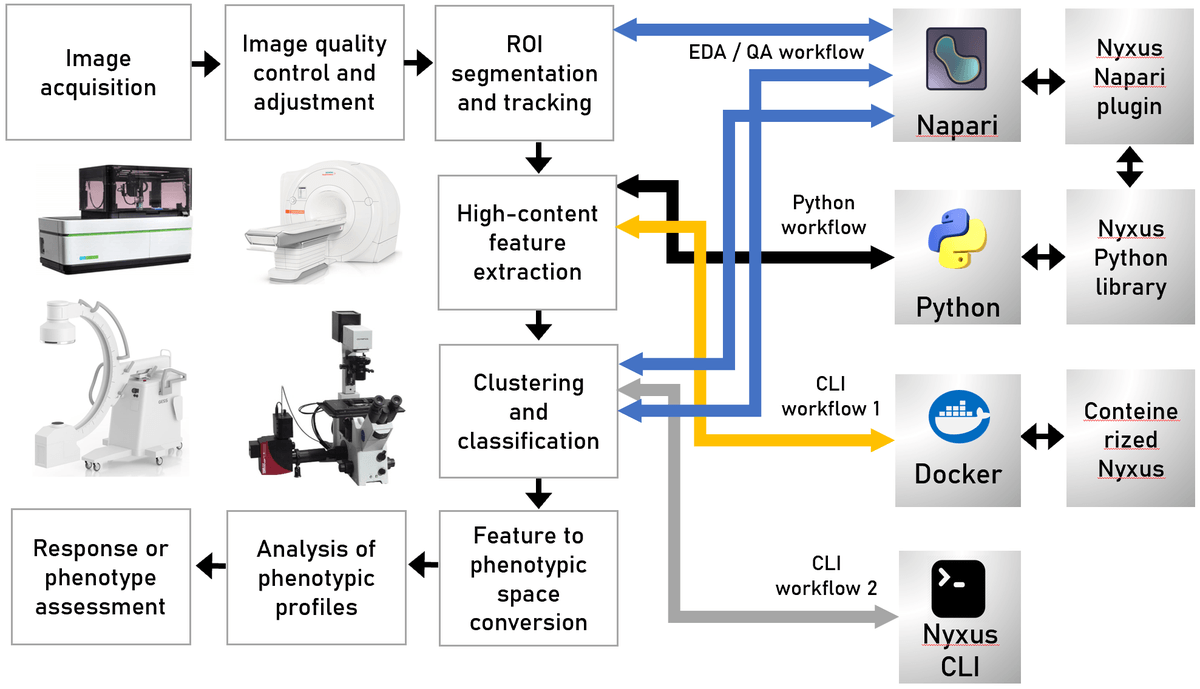
- Available on GitHub as a Python package, CLI, OCI container, and Napari plugin.
- Supports OME-TIFF, OME-NGFF, DICOM, NIfTI inputs and Arrow, Parquet, Pandas outputs for scalable pipelines.
A team of researchers from the National Center for Advancing Translational Sciences (NCATS), Axle Research, and NovaGen Research Fund has published a paper introducing Nyxus, an open-source image feature extraction library built for the terabyte and petabyte scale datasets that modern biomedical imaging equipment now routinely produces. The paper documents the library's architecture, benchmarks it against eight established tools, and proposes a new methodological framework for tuning feature hyperparameters that the authors call soft feature optimization.
Feature extraction, the process of turning raw pixels into quantitative measurements like intensity histograms, shape descriptors, and texture statistics, sits at the heart of both clinical radiomics and cellular microscopy workflows. But the two communities have historically built parallel toolchains with inconsistent implementations. The expansion of domain specific feature extraction libraries across scientific disciplines has made it difficult to compare the performance and accuracy of extracted features. Even seemingly simple measurements like perimeter can yield different numbers depending on which library you use.
What the library actually does
Nyxus computes over 450 combined intensity, texture, and morphological features at the ROI or whole image level with more in development. The authors report 261 two-dimensional feature classes and 70 three-dimensional feature classes, making it broader than any other library they tested. It reads OME-TIFF, OME-NGFF (Zarr), DICOM, and NIfTI formats, and it exports to CSV, Apache Arrow, Feather, and Parquet, plus in-memory Pandas DataFrames for Python workflows.

The core engine is written in C++17 and bound to Python via pybind11. Nyxus is a feature-rich, optimized, Python/C++ application capable of analyzing images of arbitrary size and assembling complex regions of interest (ROIs) split across multiple image tiles and files. This accomplished through multi-threaded tile prefetching and a three phase analysis pipeline. That tile-prefetching design is what lets Nyxus operate out-of-core, processing images that do not fit in RAM by streaming tiles from disk while workers compute on ROIs that may span multiple tiles.
Soft features and the targeted mode
The most conceptually novel piece of the paper is the split between hard and soft features. Hard features have fixed algorithms with no tunable knobs. Soft features expose hyperparameters like gray-level depth, spatial offset, or Gabor filter bank size, and the paper argues these should be optimized per dataset. The authors formalize this as a minimax problem where you search for a hyperparameter vector that maximizes class separability (measured as a ratio of between-class to within-class variance) on a small calibration subset, while respecting a compute budget.
Concretely, they show a GLCM (Gray-Level Co-occurrence Matrix) example on TissueNet where the best classification accuracy occurs at a gray depth around 30 and an offset between 1.5 and 2.5, far below the defaults used by most libraries. This produces an order-of-magnitude speedup while improving accuracy. Nyxus formalizes this as two profiles: an untargeted mode that runs everything with defaults, and a targeted mode that uses tuned soft features.
Benchmarks and where it wins
The team compared Nyxus against CellProfiler, PyRadiomics, MITK, RadiomicsJ, Imea, WND-CHARM, NIST Feature2DJava, and MATLAB's Image Processing Toolbox on two datasets: TissueNet (many small ROIs per image) and the Medical Segmentation Decathlon (few large ROIs). On TissueNet, untargeted Nyxus runs roughly 3x faster than CellProfiler on intensity features and 35x faster on texture. In targeted mode, the gap widens substantially on the texture group. On the Decathlon clinical data, Nyxus was more than 5x faster than PyRadiomics across every feature group in default mode, with targeted mode pushing the maximum speedup to 357x on some categories.

GPU acceleration is available but not universally beneficial. The paper is upfront that for whole slide imaging with hundreds of thousands of small nuclear annotations, the CPU-to-GPU transfer overhead can dominate compute time. GPUs help when ROIs are larger than roughly 5,000 pixels. Multithreading also flattens after 6 to 10 threads on most hardware, meaning the library benefits more from embarrassingly parallel process-level scaling than from packing high thread counts on a single node.
Accessibility and licensing
Nyxus ships in more forms than most academic research code. There is a GitHub repository under the MIT license, a PyPI package, a Conda package, a command-line tool with CWL and WIPP wrappers, a prebuilt OCI container, and a Napari plugin for users who prefer a GUI. The Python API is straightforward:
from nyxus import Nyxus
nyx = Nyxus(["ALL_INTENSITY", "ALL_GLCM"], using_gpu=-1)
features = nyx.featurize_files(intensity_files, label_files)
The permissive MIT license is a deliberate choice. Most competitors ship under GPL or BSD variants, and the authors argue that MIT removes a friction point for commercial adoption while still enabling community contribution. The documentation includes the mathematical formulae for every feature, which addresses the reproducibility gap that has plagued cross-library feature comparisons.
What it is not good at
The paper is candid about limitations. Some 3D volumetric feature classes are still in development. Miscellaneous features like skeleton analysis and time-series descriptors are on the roadmap rather than shipping. GPU acceleration hurts more than it helps for whole slide imaging with many small ROIs. And while Nyxus has an IBSI-compliant profile that correlates strongly with PyRadiomics and MATLAB, its default performance profile trades some IBSI compliance for speed, so users doing regulated clinical work should stick to the compliant profile despite the compute cost.
For teams working on cellular microscopy or radiomics pipelines who have been juggling multiple libraries to get comprehensive feature coverage, Nyxus is a plausible consolidation target. The out-of-core support and the targeted feature tuning are the differentiators that make it more than another CellProfiler alternative.