
NC State's Survey Shows Hybrid AI Training Replaced Pure SFT by 2024
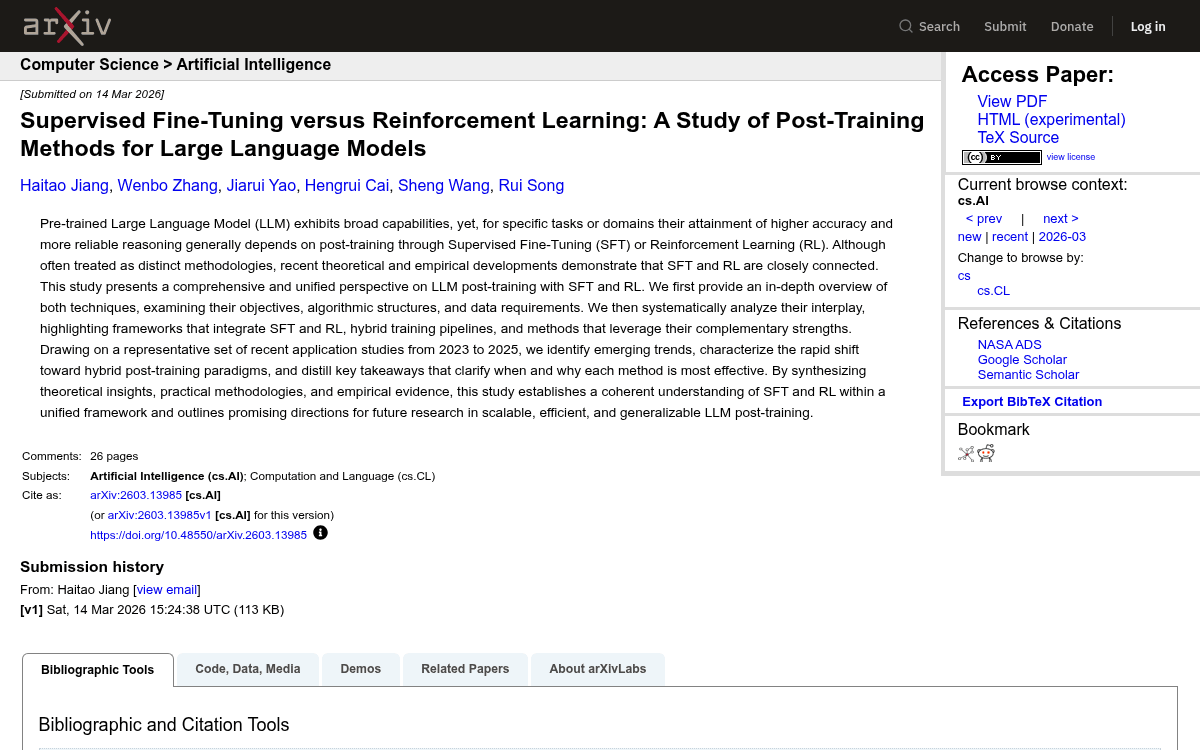
A new survey from NC State, UC Irvine, UIUC, UW, and Amazon maps how supervised fine-tuning and reinforcement learning are converging into hybrid post-training pipelines.
 Pro
Takeaways
- Six researchers from NC State, UC Irvine, UIUC, UW, and Amazon published a survey unifying SFT and RL post-training.
- Hybrid SFT+RL training jumped from 20% of studies in 2023 to over 70% in 2024 and 2025.
- Code-related post-training papers grew 272% in 2024 and nearly doubled again in 2025.
- Proprietary API-generated training data dropped from 32% to 11%; open-weight generation more than doubled to 25%.
- SFT can be framed as a special case of RL, enabling techniques to transfer between paradigms.
- RL demands 1.5 to 3x more VRAM per parameter than SFT due to rollouts and reward models.
A team of researchers has released a comprehensive survey that maps the fast-moving landscape of large language model post-training, comparing supervised fine-tuning and reinforcement learning side by side and cataloging how the two are being fused into hybrid pipelines. The paper synthesizes roughly 150 references and analyzes application trends from 2023 through 2025 across question answering, math, agents, and code.
The authors, from North Carolina State University, UC Irvine, UIUC, the University of Washington, and Amazon, argue that the community has been treating these two techniques as separate stages for too long. Their contribution is a unified analytical framework plus an empirical trend study showing where hybrid post-training is actually working.
The problem the survey tackles
Pre-trained LLMs are broadly capable but rarely task-ready. For specific tasks or domains, higher accuracy and more reliable reasoning generally depend on post-training through supervised fine-tuning (SFT) or reinforcement learning (RL). The two paradigms have very different mechanics:
- SFT maximizes the likelihood of tokens conditioned on context, essentially imitating expert demonstrations.
- RL optimizes a reward signal derived from human or automated preference feedback, learning from the model's own generations.
Most prior surveys examine one or the other. Our survey provides a systematic and integrated perspective on SFT and RL as complementary post-training tools, with particular emphasis on their interplay and practical applications.
The unifying view
The paper's theoretical anchor is a shared optimization structure. SFT can be viewed as a special case of RL under certain formulations, where an indicator function that measures whether the current policy reproduces an offline trajectory acts as a surrogate reward. Concretely, the SFT gradient can be rewritten as an RL-style policy gradient where the "reward" fires only when the sampled token matches the ground-truth token.
The practical consequence matters more than the algebra. Because both losses live in the same optimization family, techniques from one side transfer to the other. To combat the generalization loss that plagues pure SFT, you can borrow importance sampling and online rollouts from RL. To help RL memorize new knowledge, you can fold an SFT term into the objective. The stages become mutually reinforcing rather than sequential.
How hybrid methods actually combine the two
The survey organizes the recent flood of hybrid approaches into three buckets. A representative sample:
- SFT enhancing RL: SRFT integrates supervised and reinforcement objectives in a single-stage framework, avoiding inefficiencies of sequential fine-tuning. BREAD anchors branched rollouts with expert prefixes to cut demonstration cost.
- RL perspective improving SFT: DFT rescales each token's loss by its predicted probability to rectify implicit reward bias in SFT and boost generalization. iw-SFT reinterprets curated SFT as a lower bound on a sparse-reward RL objective.
- Joint objectives: Methods like CHORD, HPT, and SASR train a weighted mix of GRPO-style and SFT losses, sometimes switching adaptively based on rollout performance.
Prefix-based approaches are notably clean. One approach combines SFT and RL together through utilizing the prefix of a ground-truth response to generate new continuation based on the current policy model, and uses SFT loss to train the prefix partition while using RL loss to train the newly generated partition.
Three trends emerging from 2023 to 2025
The empirical section is the survey's most useful contribution for practitioners. The authors ran a benchmark-oriented keyword search over arXiv preprints, tagging papers by which datasets they use (GSM8K, HumanEval, WebShop, HotpotQA, and so on) to map research volume across domains. Three patterns dominate:
- Explosive domain growth, especially in code. Code-related studies climb from 115 in 2023 to 428 in 2024, a 272% jump, and nearly double again to 786 in 2025. This reflects the rapid maturation of code-centric benchmarks, tools, and evaluation pipelines. Math grows nearly 5x over the same window.
- Hybrid training becomes the default. In 2023, SFT dominated at 73.3%, with hybrid methods representing only 20.0%. By 2024, hybrid training expanded by 269%, becoming the most common approach at 73.8%, superseding pure SFT (19.1%) and growing further to 70.6% in 2025.
- Open weights are eating proprietary APIs for data generation. Reliance on proprietary API-based models declined from 32.2% in 2023 to 19.9% in 2024 and down to 11.1% by 2025. Open-weight usage more than doubled, growing from 12.2% in 2023 to 17.5% in 2024 and reaching 25.0% in 2025.
Practical takeaways: when to use what
The survey distills a decision framework that will feel familiar to anyone who has shipped a fine-tuned model:
- When high-quality expert data are available, SFT is generally preferred as an initial training stage over RL, possibly due to its simpler implementation and greater stability.
- When a reliable reward model can be trained, the common practice is to first perform SFT and then RL, which typically achieves the highest reported performance.
- SFT is essential when the policy model is unfamiliar with the downstream task or cannot efficiently generate sufficient positive samples. However, SFT may reduce the model's generalization ability compared with RL.
- Directly applying RL can better balance performance gains with exploratory capacity, though it may suffer from issues such as entropy collapse or reward hacking.
Domain-specific patterns worth knowing
The survey drills into four application areas. Some highlights that reveal how post-training choices are shaped by task structure:
| Domain | Typical Recipe | Key Challenge |
|---|---|---|
| General QA | SFT for chain-of-thought, then RL with answer-correctness rewards or rejection fine-tuning | Evaluating step-wise reasoning quality without expensive supervision |
| Math | SFT on curated corpora, then GRPO or Critique-DPO with process rewards from MCTS rollouts | Constructing reliable step-wise reward signals |
| Agentic | SFT on unified trajectories, then hierarchical RL with sentence-level rewards and token-level updates | Long horizons, sparse outcomes, environment specificity |
| Code | Instruction synthesis for SFT, then RL with unit-test or pull-request rewards | Verifiable but binary reward signals; large context windows |
Hardware reality check
An appendix gives blunt guidance on compute cost. Full fine-tuning of a transformer-based LLM requires approximately 16GB of VRAM per billion parameters at FP16, substantially greater than the roughly 2GB per billion parameters typically needed for inference. LoRA-based RL training consumes 15 to 25GB VRAM per billion parameters, compared with 16GB per billion for full SFT, illustrating that RL generally incurs 1.5 to 3x higher memory demands per parameter. For a 32B+ model, expect 4 to 8 high-memory GPUs for RL.
What is still unsolved
The authors flag two open problems that matter for anyone planning post-training work over the next year. The first is efficiency: current SFT and RL pipelines burn substantial compute, and while early work on data-efficient SFT and selective rollouts helps, there is no broadly applicable recipe yet. The second is training under sparse or indirect feedback, common in safety-critical or subjective tasks where explicit rewards are unavailable. Verbal feedback, self-evaluation signals, and user-churn behaviors are all being explored as implicit supervision sources.
The bottom line from the survey is that treating SFT and RL as separate boxes on an org chart is increasingly outdated. The winning recipes for reasoning, agents, and code all mix the two, and the tooling and data infrastructure have caught up enough that hybrid pipelines are now the mainstream path rather than a research curiosity.