
NBAvatar Renders Hand-on-Face Avatars 30% Sharper at 52 FPS
NBAvatar combines textured planar primitives with deferred neural rendering to produce sharper head avatars during hand touching, cutting LPIPS by up to 30 percent.
 Pro
Takeaways
- NBAvatar introduces Neural Billboards, textured planar primitives with learned features, for hand-face avatar rendering.
- Cuts LPIPS by up to 30 percent versus GaussianAvatars and SplattingAvatar at 1024x1024 resolution.
- A U-Net decoder learns contact shadows and deformations implicitly from spatial feature aggregation, no interaction MLP needed.
- An intermediate silhouette Dice loss keeps geometry and appearance from collapsing into each other during training.
- Runs at 52 FPS on a single RTX 4090 using fp16 inference at megapixel resolution.
- Code release promised on the project page; main limit is sensitivity to FLAME and MANO fitting quality.
Rendering a talking head is largely a solved problem. Rendering a talking head that also rubs its eyes, scratches its cheek, or rests a chin on a hand is not. Hands crush skin, cast shadows, and pull soft tissue in ways that current avatar pipelines struggle to reproduce cleanly. A new method called NBAvatar, from researchers at the Istituto Italiano di Tecnologia and Università degli Studi di Genova, tackles exactly this problem with a hybrid representation the authors call Neural Billboards.
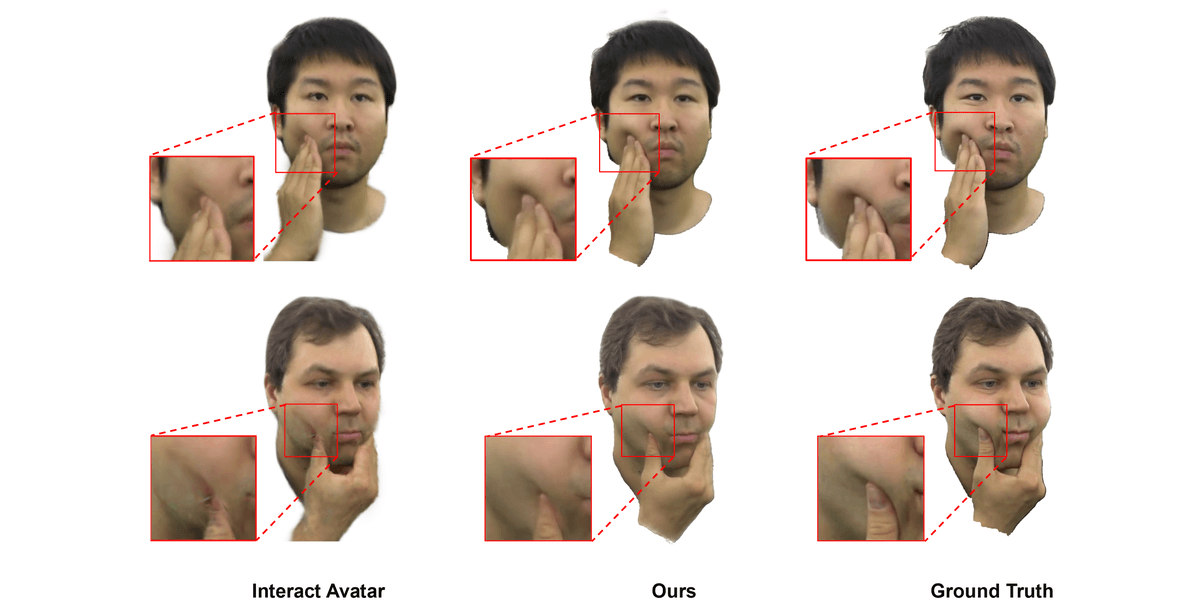
The headline result: NBAvatar achieves up to 30% LPIPS reduction under high-resolution megapixel rendering compared to Gaussian-based avatar methods, while also improving PSNR and SSIM, and achieves higher structural similarity compared to the state-of-the-art hand-face interaction method InteractAvatar. LPIPS is a perceptual similarity metric that correlates with human judgment, so a 30 percent drop is a visible quality jump, not just a numerical one.
Why hands on faces break current avatars
Most photorealistic head avatars today lean on 3D Gaussian Splatting (3DGS), which represents a scene as a cloud of translucent 3D blobs projected to the screen. It renders in real time and looks great on static heads. Modern head avatar methods utilize 3DGS to handle realistic animated rendering and lighting effects. While the head avatar's rendering quality has significantly improved, non-rigid face deformations and hand-face interactions remain underrepresented.
The closest prior work, InteractAvatar represents appearance using 3DGS and interaction-aware MLPs predicting pose-driven color and position offsets. While InteractAvatar successfully simulates self-cast shadows and face deformations, it inherits 3DGS-specific artifacts, blurry facial textures and Gaussians protruding at the body boundary, that limit its realism. Anyone who has trained a Gaussian avatar recognizes the failure mode: fuzzy silhouettes, and stray blobs hovering around ears, hair edges, and fingertips.
The Neural Billboard trick
NBAvatar swaps Gaussians for textured planar primitives called billboards, then attaches a learned feature map to each one instead of raw RGB. The billboards handle geometry. A small U-Net handles appearance. This is the key design bet.

Concretely, each Neural Billboard is defined by a 3D center, 2D scale, quaternion rotation, a learnable neural texture with 6 channels, and a learnable opacity texture. During rendering, the billboards are rasterized into a 6-channel feature image plus an alpha map, and a U-Net decoder converts that feature image into RGB. The authors call this style of pipeline deferred neural rendering (DNR): geometry is rasterized cheaply, and the expensive neural work happens once, in screen space, rather than per-point in 3D.
The interesting part is what this buys them. The neural renderer R not only provides high-frequency details but also introduces interaction-aware inductive bias via spatial feature aggregation. Intuitively, the renderer can alter the interpretation of features based on their neighboring values. When a hand touches a cheek, the hand billboards and face billboards land next to each other in the rasterized feature map. The U-Net's receptive field sees them together and learns to darken the contact region, deform the outline, and blend colors, all without an explicit interaction module. No hand-face MLP. No PointNet++. Just a convolutional decoder reading spatial context.
Making the joint optimization actually converge
Combining learnable geometry with a learnable neural decoder is famously unstable. Either the billboards drift to fake appearance changes, or the decoder overcompensates for bad geometry. The paper's second contribution is a training scheme that forces the two to stay in their lanes:
- Fit FLAME (a parametric face model) and MANO (a parametric hand model) to the input video, and run position-based dynamics to get a rough deformed face mesh.
- Anchor one Neural Billboard to each mesh polygon, so billboards move with the parametric surface.
- Add an intermediate Dice segmentation loss on the rasterized alpha map, forcing the billboards to hug the ground-truth silhouette before the U-Net sees anything.
- Regularize neighboring billboards to have similar rotations and scales, and keep positions close to the mesh surface.
- Train the neural textures and the U-Net renderer end-to-end with MSE plus LPIPS.
Ablations confirm each piece matters. Without the silhouette loss, billboards drift and produce noisy borders. Without the DNR renderer, the model cannot reproduce shadows or contact deformations at all.
Numbers on Decaf
Evaluation runs on the Decaf dataset, which is the only publicly available dataset providing multi-view video of subjects performing hand-face interactions with calibrated cameras and fitted FLAME and MANO parameters. Following InteractAvatar's protocol, the team trains on seven views and holds one out.
At megapixel resolution (1024x1024), NBAvatar beats both GaussianAvatars and SplattingAvatar on mean PSNR (25.65), SSIM (0.958), and LPIPS (0.056). The LPIPS gains are the story: NBAvatar reduces the mean perceptual distance (LPIPS) by 26.3% relative to GaussianAvatars (0.056 vs. 0.076) and by 30.0% relative to SplattingAvatar (0.056 vs. 0.080). On self-reenactment with held-out poses, the perceptual improvement holds at roughly 21 percent.

The comparison against InteractAvatar is more mixed. Under InteractAvatar's own protocol, NBAvatar wins SSIM but loses PSNR and LPIPS. The authors note their preprocessing and cropping do not exactly match the original pipeline, which is not publicly released, so they recommend readers weight the fully controlled Decaf comparison more heavily. Visually, NBAvatar's outputs are noticeably sharper along facial features and cleaner along body silhouettes.
Speed, cost, and what's shipping
Training runs for 400,000 iterations on a single RTX 4090. Inference is real time: rasterization takes 1.3 ms with neural textures, the fp16 U-Net pass takes 18.1 ms, and the full pipeline hits 19.2 ms per frame, corresponding to 52 FPS at a resolution of 1024 x 1024. Six channels turned out to be the sweet spot for the neural texture; three underfits and 24 both overfits and tanks throughput.
The authors state they adapted StopThePop per-ray sorting of surfel primitives to support neural textures and will open the code of the proposed method to the community. The project page is live, though code was not posted at the time of the paper's release.
Where this fits, and where it breaks
If you are building telepresence, avatar streaming, or any pipeline where subjects touch their own faces (which is most of them, once you record real users), the Gaussian-primitive artifacts around edges and contact regions are a real usability problem. NBAvatar demonstrates that a hybrid of explicit surface primitives and a screen-space neural decoder can fix those artifacts without adding a heavy interaction module.
The main limitations are honest. Performance depends on the quality of FLAME and MANO fitting. Subject S2 in the paper illustrates this: parametric fitting errors under held-out poses drag PSNR below the Gaussian baselines even when perceptual quality remains competitive. The pipeline also requires multi-view capture with the Decaf-style rig, so monocular deployment is not addressed. And every subject needs its own training run; there is no cross-identity generalization yet. Pose-dependent warping to compensate for fitting errors is flagged as future work.