
NavDP Gets Smarter as GRPO Fine-Tuning Cuts Robot Wall Collisions
A new GRPO-based fine-tuning framework teaches pretrained diffusion navigation policies to adapt online, cutting collisions and boosting success rates.
 Pro
Takeaways
- New paper adapts GRPO to fine-tune diffusion-based robot navigation policies without a value network.
- Uses diffusion's built-in multi-trajectory sampling to compute group-relative advantages directly.
- Freezes the visual encoder and updates only decoder layers plus action head to preserve pretrained features.
- PointGoal success rate on unseen Isaac Sim scenes rises from 52.0% to 58.7%, SPL from 0.49 to 0.54.
- Fine-tuned policy transfers zero-shot to a real quadruped with reduced collisions.
- Baseline is NavDP, a state-of-the-art diffusion navigation policy trained purely in simulation.
Diffusion policies have become one of the more interesting recipes for robot navigation. Feed a robot RGB-D images, denoise a trajectory, and let it walk. The catch is that these policies are trained by imitation on offline datasets, so the moment the robot walks into a room the dataset never saw, small errors compound into wall collisions. A new paper, Beyond Imitation: Reinforcement Learning Fine-Tuning for Adaptive Diffusion Navigation Policies, proposes a way to fix that with a reinforcement learning loop built specifically around how diffusion policies sample.
The authors adapt Group Relative Policy Optimization (GRPO), the same trick that powered the DeepSeek-R1 reasoning training, and port it to a robotics setting where the policy outputs continuous trajectories instead of tokens. The baseline they fine-tune is NavDP, a state-of-the-art diffusion navigation policy trained in simulation. The contribution here is not a new policy architecture, it is the RL wrapper that makes any diffusion navigation policy safer and more adaptable after deployment.
Where imitation learning stops working
Diffusion-based navigation policies like NoMaD, NaviDiffusor, and NavDP all follow the same pattern: they use iterative denoising to sample multiple candidate trajectories from a visual observation, bypassing the classical localize-map-plan pipeline. NavDP, for example, was trained on 363 kilometers of simulated trajectories across 1,244 scenes, and it generalizes zero-shot to quadrupeds, wheeled robots, and humanoids.
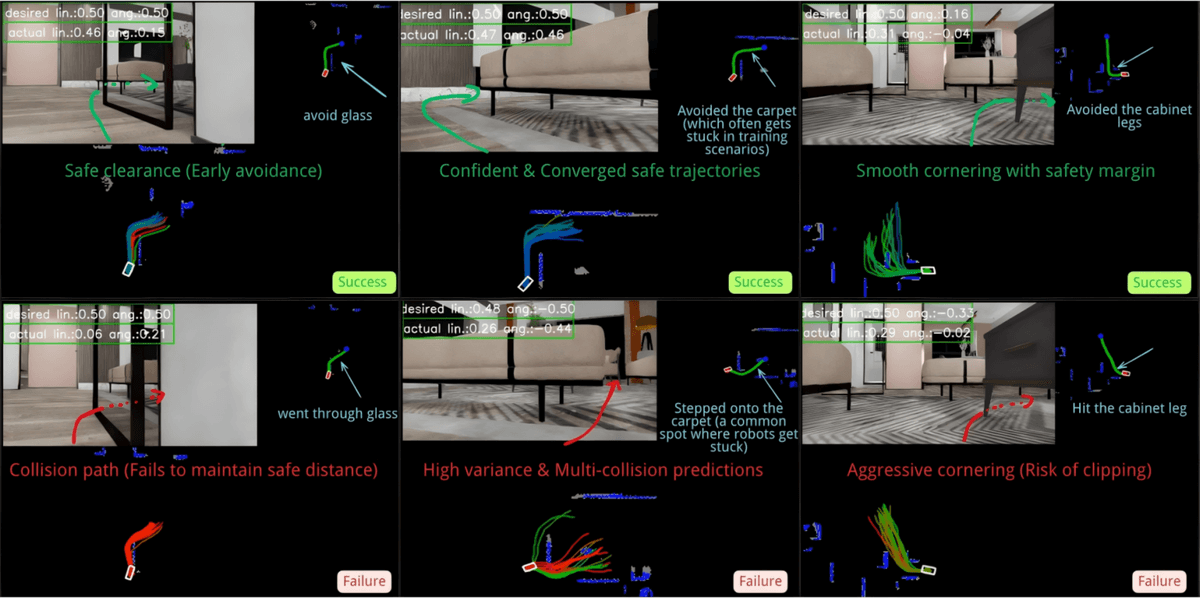
But offline datasets, no matter how large, do not cover every hallway, doorway, and cluttered office. When the robot's real observations drift away from the training distribution, the sampled trajectories start clipping walls. Imitation learning has no mechanism to correct this because it never sees the consequences of its own actions. What you want is reinforcement learning, where the robot rolls out, hits things, and learns not to.
Two things have historically made RL fine-tuning of diffusion policies painful:
- The iterative denoising process makes gradient backpropagation through the full sampling chain awkward and unstable.
- Standard actor-critic algorithms like PPO require training a separate value network, which is expensive and often unstable in high-dimensional visuomotor settings.
Turning a bug into a feature with GRPO
The clever observation in the paper is that diffusion policies already sample many candidate trajectories per observation, that is literally how they work. GRPO, originally designed for LLM reasoning, computes advantages by comparing samples within a group rather than against a learned value baseline. Feed the group of sampled trajectories through the environment, score each one, and normalize the rewards inside the group to get a relative advantage signal.
No value network required. The framework becomes:
- At each state, the diffusion policy samples a group of candidate trajectories through denoising.
- Each trajectory is executed (or simulated) and receives a reward based on progress toward the goal and collision penalties.
- Rewards are normalized within the group to produce relative advantages.
- The policy is updated to push probability toward the higher-scoring trajectories in each group, with a KL penalty to keep it close to the pretrained model.
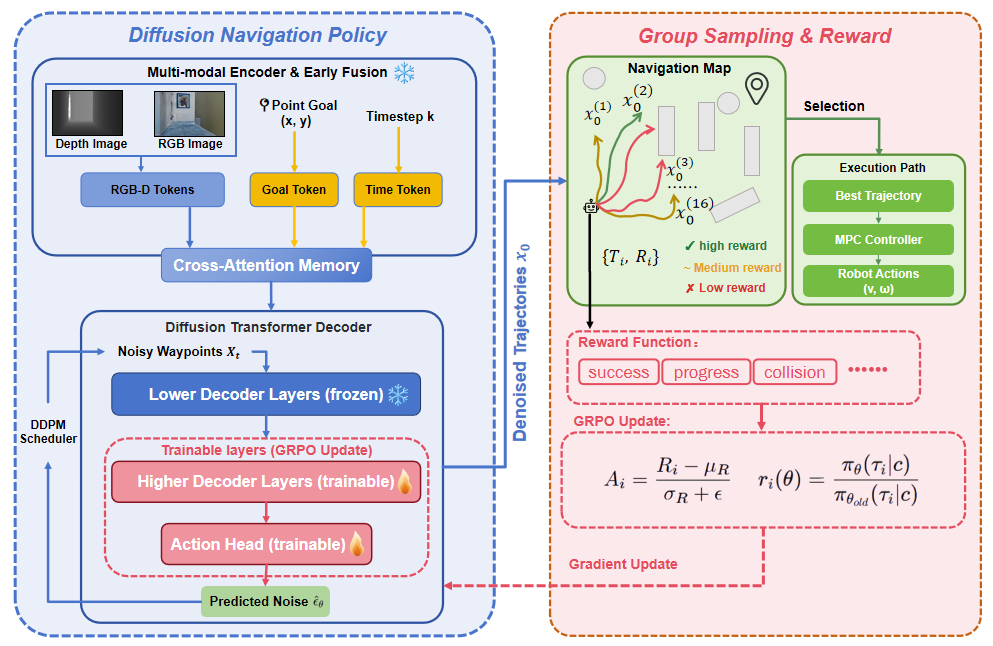
The second design choice is what gets updated. The visual encoder stays frozen, preserving the representations learned from the massive pretraining dataset. Only the higher decoder layers and the action head are unfrozen. This partial fine-tuning avoids catastrophic forgetting of the visual grounding while still letting the policy adjust its behavior in response to environmental feedback.
The numbers on PointGoal
Evaluation runs on the PointGoal navigation task in NVIDIA's Isaac Sim, where the robot receives a goal coordinate and has to reach it without collisions. On unseen scenes:
| Metric | Baseline diffusion policy | After GRPO fine-tuning |
|---|---|---|
| Success Rate | 52.0% | 58.7% |
| SPL (Success weighted by Path Length) | 0.49 | 0.54 |
| Collision frequency | Higher | Reduced |
SPL is the standard PointGoal metric that rewards success but discounts for taking longer paths than optimal. A jump from 0.49 to 0.54 combined with a 6.7 point success rate gain is meaningful in this benchmark, where the ceiling is bounded by how well any policy can generalize to unseen layouts.
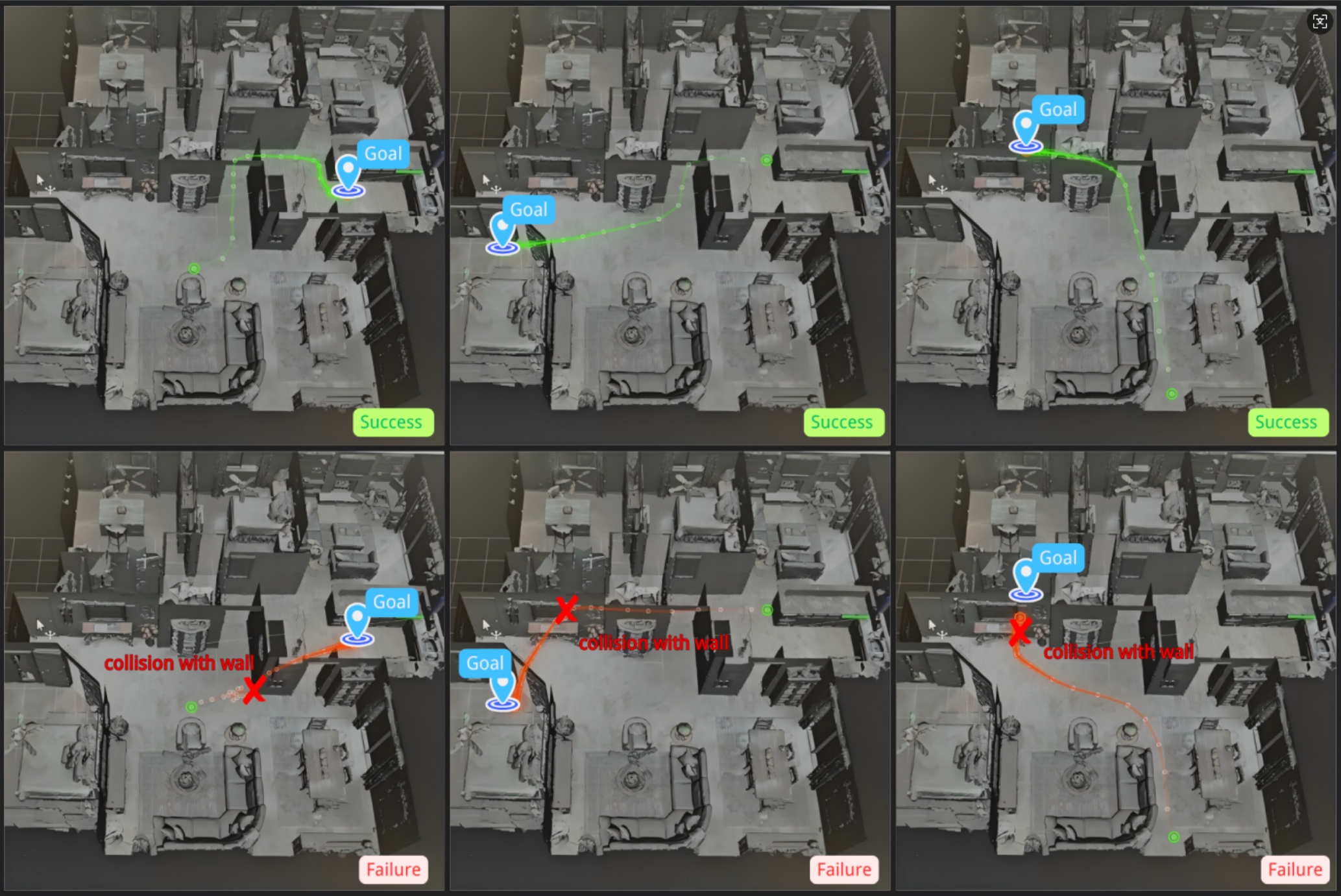
The more interesting result is the transfer test. The authors deploy the fine-tuned policy zero-shot on a real quadruped and report stable performance in geometrically out-of-distribution environments, meaning rooms with layouts that differ substantially from the training scenes. The RL fine-tuning did not overfit to the simulator, it made the policy genuinely more robust.
What is actually new here
The real contribution is a template for RL fine-tuning any diffusion-based robot policy without paying the value-network tax. A few things stand out for practical adoption:
- No critic to train. Group-relative advantages come for free from the diffusion sampler's existing behavior.
- Selective unfreezing. Keeping the visual encoder frozen protects the expensive pretrained representations and cuts the fine-tuning compute significantly.
- Safety-aware reward shaping. Collision penalties in the reward directly translate to fewer real-world contact events, which is the failure mode operators actually care about.
- Sim-to-real intact. Fine-tuning in Isaac Sim did not break the zero-shot transfer to the physical quadruped.
Where it falls short
The paper is a research prototype and it shows. Absolute success rates in the high 50s on PointGoal mean roughly four out of ten unseen episodes still fail. GRPO requires rolling out groups of trajectories per state, which is sample-inefficient compared to gradient-based methods that reuse experience more aggressively. The authors also do not release code alongside the arXiv posting, so reproducing the setup means rebuilding the GRPO loop against NavDP or a similar diffusion policy yourself.
The evaluation is also narrow. PointGoal with known coordinates is the easiest navigation task, and it does not test object goals, language-conditioned goals, or dynamic obstacles like people walking around. Whether the same GRPO recipe scales to those harder settings is an open question.
Why this matters for anyone building robot policies
If you are working with diffusion policies for manipulation or navigation, the takeaway is that GRPO gives you a lightweight way to close the loop with the environment after imitation pretraining. You do not have to choose between the multi-modal expressiveness of diffusion sampling and the adaptability of RL. The sampler is the exploration mechanism, and group-relative rewards handle the credit assignment. That combination is likely to become a standard pattern as more teams push diffusion policies from lab demos into production robots.