
National University of Defense Technology Maps the Entire Audio AI Landscape
A new systematic survey maps the fragmented field of Audio-Language Models, unifying architectures, training objectives, and evaluations across speech, music, and sound.
 Pro
Takeaways
- First systematic survey unifying Audio-Language Models across speech, music, and general sound domains.
- Introduces four-architecture taxonomy: Two Towers, Two Heads, One Head, and Cooperated Systems.
- Formalizes contrastive, generative, and discriminative training objectives with concrete loss functions.
- Compares zero-shot, linear probe, and fine-tuned results across CLAP, WavCaps, FLAP, and Pengi.
- Flags hallucination, adversarial attacks, voiceprint privacy leakage, and benchmark data leakage as core risks.
- Points to RL, DPO, LoRA adapters, and on-device deployment as the next frontiers.
Audio has quietly become the next frontier for multimodal AI. While vision-language models absorb most of the attention, a parallel field called Audio-Language Models (ALMs) has been growing rapidly, powering everything from Whisper-style transcription to MusicLM-style generation and SALMONN-style audio chatbots. The problem is that the literature has splintered into narrow silos: speech people cite speech work, music people cite music work, and sound-event researchers rarely talk to either. A new systematic survey from researchers at the National University of Defense Technology tries to fix that by mapping the entire ALM landscape under one taxonomy.
Why natural language beats labels for audio
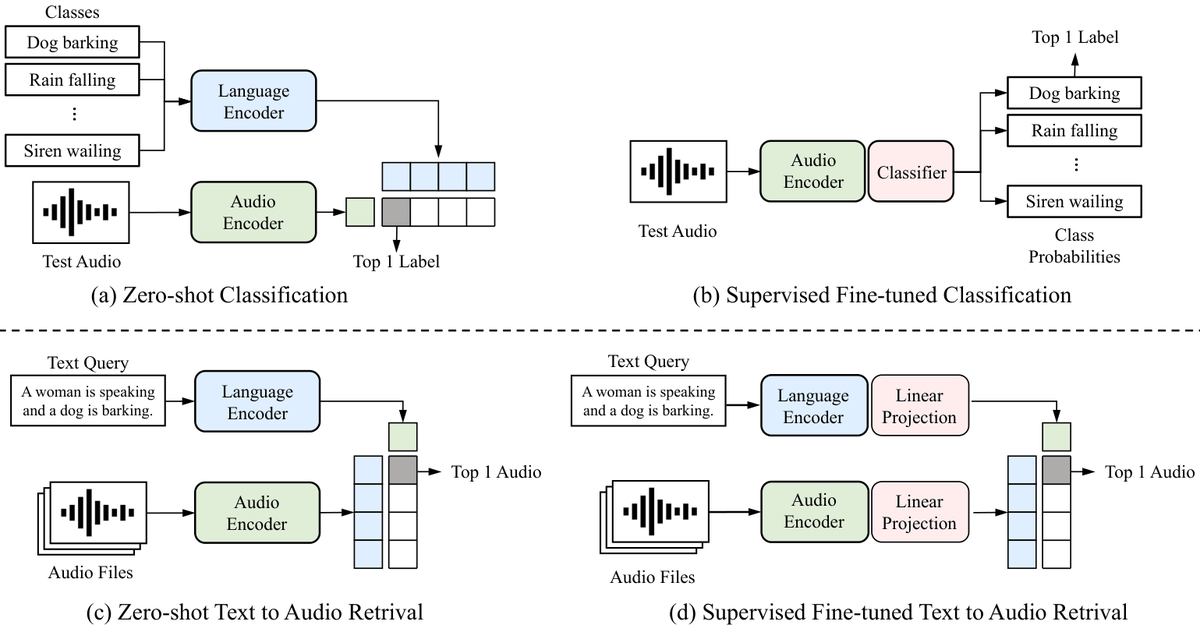
Traditional audio models are trained on fixed label sets: dog bark, car horn, applause. That approach breaks in the real world because real-world audio often involves multiple overlapping sound events, and natural language effectively characterizes these scenes, enabling models to learn their intrinsic relationships. A caption like "a woman speaks while a dog barks in the background" carries structure that a one-hot label cannot. Using natural language as supervision also eliminates dependency on predefined task-specific labels, enhancing generalization in open-world scenarios, and it lets datasets scale beyond hand-annotated tags to include web-sourced titles and descriptions.
Four architectures, one taxonomy
The survey's core contribution is a clean four-way split of ALM architectures, which developers can use as a decision framework when picking a base model.

- Two Towers: Separate audio and text encoders projected into a shared space. Exemplified by CLAP, this late-interaction design yields low inference complexity, with strengths in cross-modal retrieval and zero-shot classification, and achieves low-latency deployment by shifting inference to similarity computation over cached embeddings.
- Two Heads: Adds a language model on top of the two encoders. Language modeling enhances speech tasks, while evolving LLMs serve as reasoning backbones. This is the mainstream architecture for models like SALMONN and Qwen-Audio.
- One Head: A single unified encoder processes both modalities. Promising but immature, with no existing work incorporating LLMs for decoding.
- Cooperated Systems: An LLM acts as a planning agent that orchestrates multiple specialist models, like AudioGPT delegating to Whisper for ASR and AudioLDM for generation.
The practical guidance is worth quoting directly: two-tower models win on retrieval-heavy edge deployments, two-head models on open-ended reasoning, and cooperated systems when you need tool use or modular decomposition.
Training objectives and what they actually do
The survey formalizes three families of training objectives that most ALMs mix and match.

Contrastive learning uses the symmetric InfoNCE loss familiar from CLIP, pulling matched audio-text pairs together and pushing mismatched ones apart. This objective is non-decomposable because the loss for a positive pair couples with all negatives in the batch, meaning finite batch sizes create sampling bias and suboptimal convergence. That is why FLAP ran with a batch size of 4608 across 72 by 64 GPUs. The authors flag momentum encoders and debiased contrastive techniques as underexplored fixes.
Generative objectives cover masked spectrogram reconstruction and autoregressive language modeling on captions. Discriminative objectives handle classification, retrieval, and fine-grained audio-text matching as a binary task.
Where ALMs actually work and where they fail
Benchmark results tell a nuanced story. On zero-shot ESC50 classification, MS-CLAP V2 hits 93.9% and WavCaps reaches 94.8%, showing that contrastive pretraining alone yields strong open-set capability. On audio-text retrieval on AudioCaps, FLAP achieves 41.5% R@1 for text-to-audio and 53.0% for audio-to-text after supervised fine-tuning.
But the limitations are serious. The survey catalogs several failure modes that anyone deploying these systems needs to internalize:
- Weak compositional reasoning: Vanilla CLAP has trouble with the order and simultaneity of sound events, which is why work like COMPA and T-CLAP had to introduce temporal contrastive losses.
- Hallucination and textual priors: LALMs often lean on language priors instead of what they actually hear.
- Security holes: Models remain vulnerable to adversarial perturbations, spoofed audio, and prompt injection attacks.
- Privacy leakage: End-to-end models retain rich acoustic information like intonation and speaker identity, potentially enabling unauthorized tracking via implicit voiceprint storage.
- Data leakage in benchmarks: YouTube-sourced datasets suffer from link rot, leading to inconsistent data compositions, and unintended audio overlaps between WavCaps and Clotho/AudioCaps can inflate metrics.
What is actually new here
The real contribution is not a new model. It is a research landscape that connects pretraining, transfer, datasets, and benchmarks into a single coherent picture that spans speech, music, and general sound. Previous reviews covered slices, such as speech-language models or audio captioning in isolation. This one lets you look at a task like language-queried source separation and immediately trace the relevant pretrained backbones, transfer strategies, and evaluation datasets. For anyone starting a project with LAION-Audio-630K, CLAP, or a codec-based generator, the taxonomy and comparison tables save weeks of literature triage.
The forward-looking sections point at four directions that are already heating up: parameter-efficient adaptation via LoRA-style adapters, reinforcement learning and DPO for audio reasoning where RL shows potential to surpass supervised fine-tuning in audio reasoning, on-device deployment for privacy-preserving healthcare, and unified real-time speech-to-speech pipelines like OpenAI's Realtime API. If you are building anything that listens to the world and talks back, this survey is the map.