
National Taiwan University Finds MOS-Bias Makes AI Voice Ratings Favor Male Listeners
New research shows male listeners rate speech quality higher than female listeners, and automated MOS models silently inherit that skew.
 Pro
Takeaways
- First systematic study of gender bias in Mean Opinion Score for speech quality (paper).
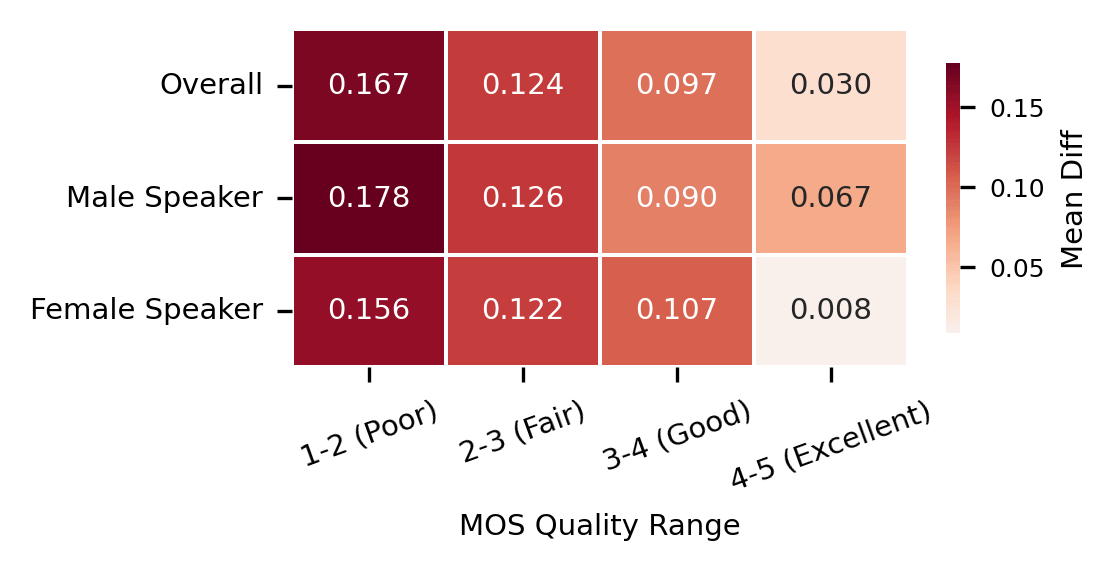
- Male listeners rate 0.167 points higher on low-quality speech, gap shrinks to 0.030 at top quality.
- SSL-MOS trained on aggregated labels shows up to 37.6% higher system-level MSE against female ground truth.
- Proposed gender-aware model uses abstract binary group embeddings, not explicit demographic labels.
- Overall utterance LCC improves 0.853 to 0.862; MSE drops from 0.290 to 0.239 on BVCC.
- Built on SHEET toolkit; analysis limited to BVCC, the only dataset with listener gender metadata.
A new study out of National Taiwan University, Nagoya University, and Academia Sinica takes a hard look at the Mean Opinion Score, the standard yardstick for judging synthetic speech quality, and finds something uncomfortable buried in it. MOS-Bias shows that male and female listeners systematically disagree, that the disagreement leaks into the automated MOS predictors used across text-to-speech and voice conversion research, and that a small architectural change can recover both listener groups' perspectives at once.
The metric everyone trusts, quietly biased
MOS is a 1-to-5 rating collected from human listeners and averaged into a single number. It is the gold standard for judging TTS, voice conversion, and speech enhancement systems, and it feeds automated predictors like MOSNet, SSL-MOS, and UTMOS that many teams use as a cheap proxy for human evaluation. The authors conduct the first systematic analysis of gender bias in MOS, revealing that male listeners consistently assign higher scores than female listeners, with the gap most pronounced in low-quality speech and gradually diminishing as quality improves.
The size of the effect is not trivial. The mean rating difference is largest for low-quality speech at 0.167 points and diminishes to near zero at excellent quality, a quality-dependent structure that fixed calibration strategies cannot correct. Averaged across all conditions in the BVCC dataset, male listeners rated at 2.988 versus 2.886 for female listeners, with Welch's t-test producing p-values as low as 4.58 x 10 to the negative 17. That is not sampling noise.
Why a simple offset does not fix it
The natural instinct is to just subtract a constant. It does not work here. The gap shrinks monotonically across four quality tiers, going from 0.167 in the 1-to-2 range to 0.124, 0.097, and finally 0.030 in the 4-to-5 range. That looks like a ceiling effect near excellent quality, and it means any fixed correction will over- or under-adjust depending on the sample's quality, exactly what you cannot know in advance.
The bias leaks into the models
Here is where it stops being a labeling curiosity and starts mattering for anyone using automated MOS. The team trained the standard SSL-MOS baseline on aggregated labels with three random seeds and evaluated it against three ground truths: overall MOS, male-only MOS, and female-only MOS. Predictions land closer to male ratings across the board.
At the utterance level, mean squared error against male ground truth was 0.372 versus 0.430 against female, a 15.6% relative gap. At the system level the gap widened. Even without any gender supervision, model predictions align systematically closer to male ratings, with system-level MSE gaps reaching up to 37.6% relative to female ground truth. The training set actually had more female listeners per clip (4.25) than male listeners (3.6), so this is not a numerical majority effect. The aggregated label itself encodes a male-leaning perceptual standard.
A gender-aware model without gender labels as input
The proposed fix is deliberately conservative. Starting from SSL-MOS, the authors add a parallel prediction branch that shares the self-supervised encoder with the original mean-MOS head. The clever move is how gender enters the model: not as an explicit demographic label, but as two hard-coded binary values (0 and 1) that condition the gender-MOS branch. The model is left to discover that one code corresponds to male rating patterns and the other to female patterns, purely from the data.

Training uses an equal-weighted multi-task loss with three MSE terms, one for the average MOS branch and one each for the male and female gender branches. The design keeps the base branch gender-agnostic so it remains a drop-in replacement for existing pipelines, while the gender branch produces two parallel scores.
What the numbers show
The auxiliary objective helps the main branch, not just the specialized heads. Averaged over three seeds on the BVCC test set:
- Overall utterance-level LCC improves from 0.853 to 0.862 and MSE drops from 0.290 to 0.239.
- Against male ground truth, LCC rises from 0.806 to 0.817 and MSE falls from 0.372 to 0.332.
- Against female ground truth, LCC rises from 0.802 to 0.807 and MSE falls from 0.430 to 0.366.
- The male-side gains are larger, which the authors attribute to stronger internal consistency in male ratings.
What it is good for, and what is missing
If you evaluate TTS or voice conversion with automated MOS, this work suggests two things worth doing: report gender-specific scores when your dataset supports it, and consider a multi-branch head so you are not tuning models toward one listener population by accident. It is especially relevant when systems are being benchmarked in the low-to-mid quality range, which is exactly where the gap is largest.
The limitations are real. The analysis runs on BVCC because among all datasets supported by the SHEET toolkit, BVCC is the only one providing both speaker and listener gender metadata, making it the only viable choice for this analysis. Gender is treated as binary. And while the paper builds on the open-source SHEET toolkit and the SSL-MOS baseline, the authors have not yet released a standalone code repository for the gender-aware architecture. The framing they push at the end is the more important contribution: subjective evaluation is not a neutral yardstick, and the community needs to treat rating labels as a fairness surface, not just an accuracy target.