
Nanjing University's TIER Beats Graph AI Rivals While Running 5x Faster
TIER automatically builds a topic hierarchy from any text-graph, then uses it to regularize node embeddings — beating LLM-based baselines at a fraction of the cost.
 Pro
Takeaways
- TIER is a new framework for learning node embeddings in text-rich graphs that automatically builds a topic hierarchy and uses it to regularize training.
- It beats all 13 baselines on 7 of 8 benchmarks with an average accuracy of 82.62%, vs 81.54% for the second-best method (TAPE).
- TIER uses only RoBERTa-355M for text encoding, runs in 16.8 minutes on ArXiv, and uses just 6.78 GB GPU memory — vs 36+ hours and 60+ GB for LLM-based competitors.
- The taxonomy is built automatically via hierarchical K-Means + LLM-powered cluster refinement (split, merge, relabel, reassign outliers), with no ground-truth hierarchy labels needed.
- A novel CCC (Cophenetic Correlation Coefficient) regularization loss aligns embedding geometry with the tree structure — the ablation shows this is the single most important component.
- Code and pre-built taxonomies are open-sourced on GitHub; benchmark data is on Hugging Face.
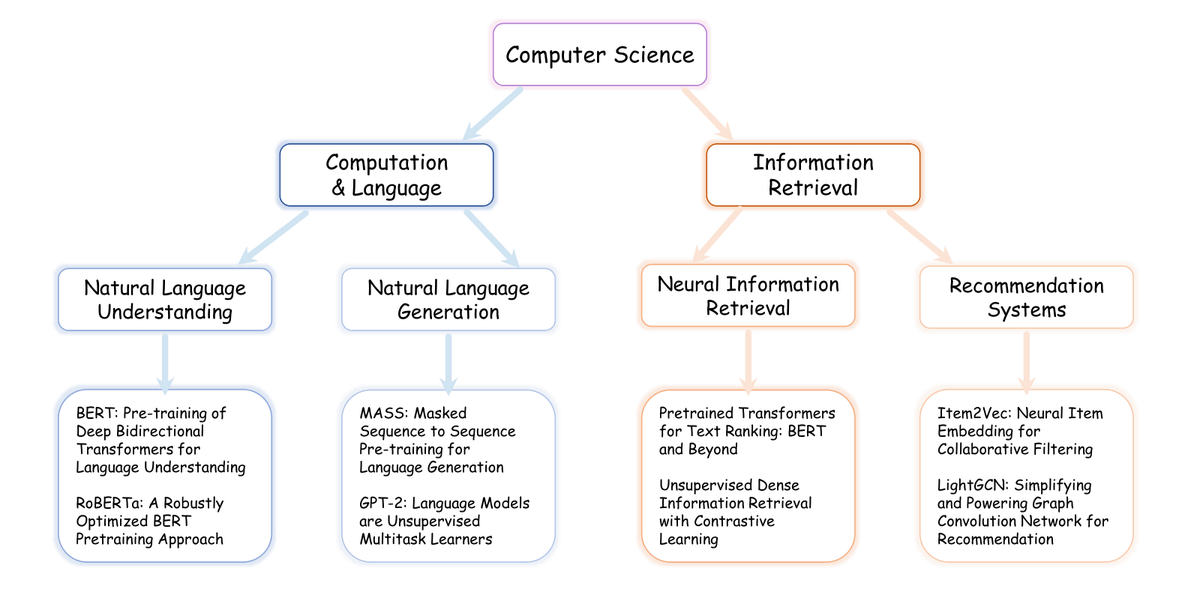
Graph neural networks have gotten very good at learning from graphs where nodes carry text , citation networks, product co-purchase graphs, Wikipedia link graphs. The standard playbook is to encode each node's text with a language model, pass those embeddings through a GNN, and train with cross-entropy. It works, but it throws away something important: the fact that real-world documents are not flat. A paper on "Natural Language Understanding" is closer to one on "Natural Language Generation" than it is to one on "Recommender Systems", and both of those are closer to each other than to a paper on "Computer Vision." That tree-shaped structure of meaning is exactly what current methods ignore.
A new paper accepted at KDD 2026 from Nanjing University and Ant Group proposes TIER (Taxonomy-Informed REpresentation learning), a framework that automatically discovers this hierarchy from the graph itself and bakes it into the learned node embeddings. The result: state-of-the-art node classification on eight benchmarks, using only a mid-sized language model (RoBERTa-355M), while running 5x faster and using a fraction of the GPU memory of LLM-based competitors.
The gap nobody was filling
Text-Rich Networks (TRNs) are graphs where every node has a text document attached , think arXiv papers connected by citations, Amazon products connected by co-purchases, or Wikipedia pages connected by hyperlinks. While hierarchical structures have been widely used in taxonomy systems, biomedical ontologies, and retrieval-augmented generation, their potential remains underexplored in the context of TRNs. The field has been racing to plug larger and larger LLMs into GNN pipelines, but existing methods for learning on TRNs often focus on flat semantic modeling, overlooking the inherent hierarchical semantics embedded in textual documents.
The practical consequence is real. If your embedding space is flat, a model trying to classify a paper as "NLU" has no structural signal telling it that NLU and NLG are siblings while NLU and Databases are cousins. Every class looks equidistant from every other. TIER is built to fix exactly this.
Two-stage design: build the tree, then use it
TIER operates in two sequential stages. First it constructs a hierarchical taxonomy automatically from the graph. Then it uses that taxonomy to regularize the final node embeddings during training.

Stage 1 , Building the taxonomy. TIER starts by training a GNN with a custom contrastive objective called Similarity-Guided Contrastive Learning (SGCL). Standard contrastive learning treats each node as its own positive pair and pushes everything else away. SGCL is smarter: it treats two nodes as a positive pair if (a) they share a known label, or (b) they are directly connected in the graph (exploiting the homophily assumption , connected nodes tend to be semantically similar). The paper proves theoretically that this similarity matrix is a strictly better approximation of the ground-truth semantic similarity than either vanilla contrastive learning or supervised contrastive learning alone.
Once those cluster-friendly embeddings exist, TIER runs bottom-up hierarchical K-Means to build a multi-level taxonomy tree. Fine-grained clusters at the leaf level get merged upward into progressively coarser super-clusters, all the way to a single root. But raw K-Means in high-dimensional space is known to produce geometrically coherent but semantically messy clusters. So TIER adds an LLM-powered refinement pass with five operations:
- Split low-cohesion clusters that contain multiple latent topics (the LLM decides how many sub-clusters are needed)
- Merge pairs of clusters whose centroids are very similar (the LLM confirms semantic overlap)
- Redistribute tiny clusters with fewer than a minimum number of samples into their nearest large neighbor
- Label and summarize each cluster with a short natural-language topic label and a 1-2 sentence summary
- Reassign outliers , nodes far from their cluster centroid are re-assigned by prompting the LLM with the node's text and the candidate cluster summaries
The LLM used for refinement is DeepSeek-V3 via API, and crucially it is only called on clusters and outliers , not on every individual node. This keeps API costs manageable even on large graphs.
Stage 2 , Taxonomy-informed regularization. With the taxonomy tree in hand, TIER introduces a novel regularization loss based on the Cophenetic Correlation Coefficient (CCC) , a classical statistics measure of how well a hierarchical clustering tree preserves pairwise distances. In TIER's context, CCC measures how well the learned embedding geometry matches the tree-based semantic distances: nodes in the same fine-grained cluster should be close, nodes in sibling clusters should be a bit further, and nodes in distant branches should be far apart. The final training objective is simply:
L_total = L_CE + λ * L_CCC
# L_CE: cross-entropy on labeled nodes
# L_CCC: 1 - CCC(embedding distances, tree distances)
# λ = 1.0 by default
Because the CCC loss is computed only over cluster centroids (not all node pairs), it adds minimal computational overhead , O(d * min(b², k²)) per iteration, where k is the number of leaf clusters.
Benchmarks and results
TIER is evaluated on 8 datasets from the LLMNodeBed benchmark, spanning diverse domains including academic networks, web graphs, and product co-purchase networks, covering a wide range of scales from thousands to hundreds of thousands of nodes. The datasets include Cora, Citeseer, Pubmed, ArXiv, WikiCS, Books, Photo, and Computer.
TIER achieves an average accuracy of 82.62% across all eight datasets, compared to 81.54% for the second-best method (TAPE). More importantly, TAPE requires prompting an LLM to generate a lengthy explanation for every single node in the graph. TIER prompts the LLM only for selected clusters and outliers, drastically reducing the number of queries.
On efficiency, the gap is even more striking. TIER achieves the second-lowest memory footprint at only 6.78 GB, significantly smaller than LLM-based methods such as GraphGPT and LLM_IT, both of which require more than 60 GB of GPU memory. In terms of training time, TIER ranks third-fastest, completing training in 16.8 minutes, which is at least 5x faster than most LLM-based approaches. TAPE and LLM_IT require over 36 hours each.
The ablation study confirms that every component matters:
- Removing the similarity-guided contrastive loss (replacing it with vanilla SupCon) drops accuracy, especially on WikiCS and Photo
- Removing LLM refinement and using pure K-Means causes noticeable degradation, particularly on WikiCS
- Removing the CCC regularization causes the largest drop of all three variants , confirming that the hierarchical alignment signal is the most important piece
What the taxonomy actually looks like
One of the more compelling results in the paper is that the automatically constructed taxonomies are semantically coherent and human-interpretable. On Citeseer, the taxonomy groups papers into clusters like "Mobile Agent Security" and "BDI Agent Sociality" under a coarse "Agents" parent, and groups Web Search, Image Retrieval, Recommender Systems, and Text Classification under "Information Retrieval." These groupings align well with domain knowledge , and they were discovered entirely without any ground-truth taxonomy labels.
The representation visualizations tell the same story. With taxonomy-informed regularization, clearer block structures emerge in the pairwise distance matrix, where darker diagonal blocks correspond to coarser-grained clusters, reflecting improved semantic hierarchy in the learned representation space. The t-SNE plots show noticeably better separation of coarse-grained semantic classes when the CCC loss is used.
Where it works and where it doesn't
TIER is strongest on datasets with natural hierarchical structure , citation networks and product graphs where documents cluster into meaningful topic trees. On the ArXiv dataset, TIER's performance is slightly lower than LLM_IT, which may be attributed to the limited text understanding capability of RoBERTa compared to powerful instruction-tuned LLMs. ArXiv has 40 fine-grained CS sub-categories, and the semantic distinctions between them are subtle enough that a larger LLM encoder would help.
The paper also notes that tasks less aligned with taxonomy structure , like anomaly detection , are unlikely to benefit from TIER's hierarchical signals. The method is best suited for classification, retrieval, and link prediction tasks where semantic proximity between categories is meaningful. The link prediction experiments confirm this: on Cora, BUDDY benefits from a notable improvement of 3.76 points (26.40 to 30.16), and on Citeseer, GCN improves by 3.87 points (50.01 to 53.88) when augmented with TIER's regularization.
Practical use-cases
TIER is most useful when you have a large text-attributed graph and want strong node classification or retrieval without paying for per-node LLM inference. Concrete scenarios:
- Scientific literature graphs , classifying papers by research area, building topic-aware citation recommendation systems
- E-commerce product graphs , categorizing products in co-purchase networks where category hierarchies (Electronics > Cameras > DSLRs) matter
- Knowledge graph enrichment , automatically discovering and labeling topic hierarchies in large document collections
- RAG systems , hierarchical retrieval where coarse-to-fine semantic organization improves recall at multiple granularities
The code and pre-built taxonomies are open-sourced on GitHub, including intermediate artifacts like the constructed taxonomy trees for all eight benchmark datasets. The benchmark data is available via the LLMNodeBed dataset on Hugging Face.