
Nanjing University's EvoStage Cuts Chip Wiring by 9% Where LLMs Usually Fail
EvoStage uses LLMs to automatically design industrial algorithms stage-by-stage, beating human experts on chip placement with just 25 evaluations
 Pro
Takeaways
- EvoStage is a new LLM-based framework that designs algorithms stage-by-stage with live execution feedback, beating human experts on chip placement.
- It achieved historically state-of-the-art HPWL results on all 16 chip cases across two open-source benchmarks within just 25 evaluations.
- On a real commercial 3D chip tool, it delivered a 9.24% wirelength improvement and a 52.21% reduction in optimization iterations.
- A multi-agent system splits design work: coordinator agents reflect on runtime state; coder agents implement each algorithm component separately.
- A global-local perspective mechanism balances stage-by-stage refinement with one-shot exploration to avoid local optima.
- EvoStage also ranked first on all 8 Bayesian optimization benchmarks, showing generalization beyond chip design. Read the paper.
Getting an LLM to design a good algorithm sounds straightforward until you realize that most real-world engineering problems are nothing like the textbook examples in an LLM's training data. Chip placement, drug discovery, material design -- these are expensive, opaque, and deeply case-specific. Throw a black-box prompt at an LLM and you get hallucinated nonsense that looks plausible but fails in practice. A new paper from Nanjing University and Huawei Noah's Ark Lab proposes a fundamentally different approach: Evolutionary Stagewise Algorithm Design (EvoStage), a framework that breaks algorithm design into sequential stages and feeds the LLM live feedback at each step -- much like chain-of-thought reasoning, but for writing optimization code.
The results are striking. On every chip layout benchmark tested, EvoStage achieved historically state-of-the-art half-perimeter wirelength (HPWL -- a standard measure of how efficiently wires connect components on a chip; lower is better) results, beating both human-expert-tuned placers and prior LLM-based methods like AlphaEvolve and EoH. When deployed on a real commercial 3D chip placement tool, it cut wirelength by 9.24% on the logic die and slashed the number of optimization iterations needed by 52.21%.
Why black-box LLM design keeps failing in industry
The dominant approach to LLM-based algorithm design -- used by FunSearch, EoH, AlphaEvolve, and ReEvo -- follows a simple loop: prompt the LLM to write an algorithm, run it, get a score, repeat. This black-box modeling deprives LLMs of any awareness of the intrinsic mechanism of the target problem, disabling them from utilizing intermediate feedback to correct possibly wrong design directions. The LLM is essentially flying blind, only learning whether its design was good or bad after the entire run completes.
This matters enormously in industrial settings for two reasons. First, evaluating a chip placement result can take several hours to assess power, performance, and area (PPA), which implies a very limited evaluation budget for algorithm design. Second, industrial problems are poorly represented in LLM training data -- chip designs are proprietary, case-specific, and structurally diverse. LLMs tend to apply existing mismatched knowledge to optimize algorithm design, which appears logically coherent but may lead to completely incorrect optimization directions in practice.
Stagewise design: CoT for algorithm engineering
EvoStage's core insight is borrowed from chain-of-thought (CoT) prompting. Instead of asking an LLM to produce a complete algorithm in one shot, EvoStage decomposes the complex algorithm design task into multiple intermediate stages, with each stage as a simpler design subtask. In each subtask, the LLM agents are required to carry out algorithm design for the corresponding algorithm execution stage.
Crucially, after each stage completes, the system feeds real execution metrics back to the LLM before it designs the next stage. For chip placement, this means the LLM sees current wirelength, overflow (how much cells are overlapping), gradient norm, and how these metrics changed during that stage. This intermediate feedback updates LLM agents' domain-specific understanding of the target problem, which can help mitigate the hallucinations of LLM-designed algorithms and improve their performance and reliability.

Three interlocking mechanisms
EvoStage is built from four components working together:
- Evolutionary framework: Maintains a population of algorithm candidates. At each generation, it selects promising parents (with probability weighted by rank), generates offspring via operators, and keeps the top performers. This is the outer loop that drives improvement over multiple evaluations.
- Stagewise Design (local perspective operator): The LLM designs each algorithm stage sequentially, receiving real-time feedback between stages. A coordinator agent reflects on the current execution state and writes guidance for the next stage; separate coder agents implement each algorithm component.
- Multi-agent system: One individual LLM coder agent is in charge of designing one specific algorithm component, whereas a dedicated coordinator agent performs reflection on the current stage information and provides design guidelines for subsequent stages. Splitting responsibilities reduces the design space per agent and avoids long-context code generation errors. The coordinator runs at higher temperature (0.7) for creative reflection; coders run at lower temperature (0.2) for stable, valid code.
- Global-Local Perspective mechanism: Two global operators complement the stagewise local operator. The Global-Explore operator prompts the LLM to generate a completely novel multi-stage algorithm in one shot, preventing the population from converging prematurely. The Global-Enhance operator takes an existing design and asks the LLM to make targeted improvements. All three operators are applied at a 1:1:1 frequency ratio.
The global operators exist specifically to prevent the local stagewise approach from getting stuck. Greedily optimizing partial algorithms by targeting a sequence of stage goals may not come up with a globally optimal algorithm. The fast/slow thinking analogy is apt: local operators refine, global operators explore.
Application 1: Designing Adam optimizer schedules for chip placement
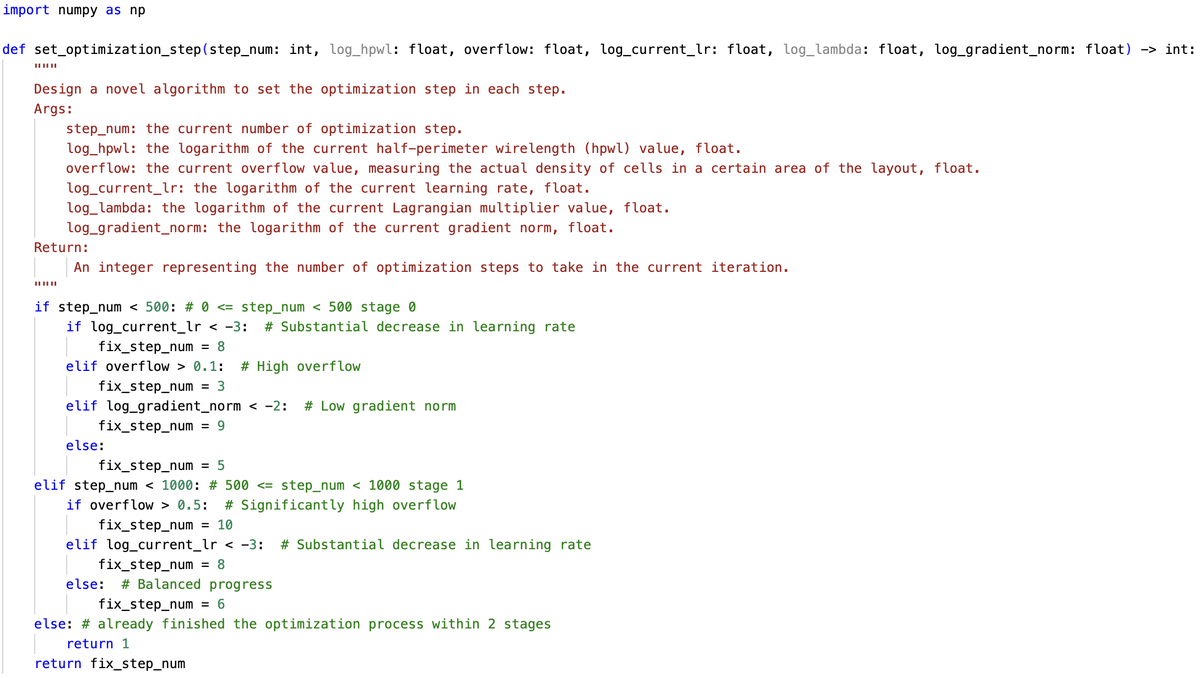
Global placement (GP) -- the step that decides where every cell goes on a chip -- is typically solved by gradient descent using the Adam optimizer. The key knobs are the learning rate schedule and the optimization step schedule (how many gradient steps to take per Lagrangian subproblem). Human experts spend months tuning these by hand. EvoStage was asked to design both from scratch.
EvoStage surpasses the historically state-of-the-art GP results obtained by DREAMPlace and Xplace that are elaborately designed and fine-tuned by human experts on all the chip cases of two open-source benchmarks within just 25 evaluations. The two benchmarks are ISPD 2005 (8 chip cases) and ICCAD 2015 (8 chip cases). For context, DREAMPlace and Xplace represent years of expert engineering effort from the EDA community.
Compared to other LLM-based methods on the same 25-evaluation budget, the gap is even more dramatic. EoH achieved only a 23% pass rate (fraction of generated algorithms that even ran successfully) on ISPD 2005, while AlphaEvolve managed 25.25%. EvoStage hit 78% -- and its generated algorithms actually outperformed the human-tuned baseline, while EoH and AlphaEvolve mostly failed to beat it.
The generated schedules are not simple decay curves. They adaptively branch on live metrics -- increasing the learning rate when wirelength is improving, backing off when overflow is high, adjusting step counts based on gradient norm. Here is a simplified sketch of what EvoStage generated:
def adjust_learning_rate(init_lr, step_num, log_hpwl,
                         log_hpwl_prev, overflow, log_gradient_norm):
    if step_num < 500:  # stage 0: slow decay
        lr = init_lr * (0.997 ** step_num)
        if log_hpwl < log_hpwl_prev:
            lr *= 1.05  # reward improving wirelength
    elif step_num < 1000:  # stage 1: respond to overflow
        lr = init_lr * (0.994 ** step_num)
        if overflow > 0.07:
            lr *= 1.15
        if log_gradient_norm > 1.0:
            lr *= 0.9
    ...
    return lr
Application 2: Designing acquisition functions for Bayesian optimization
To prove EvoStage generalizes beyond chip design, the authors also applied it to Bayesian optimization (BO) -- a technique for optimizing expensive black-box functions (no gradients available) used in drug discovery, neural architecture search, and material design. The key component EvoStage was asked to design is the acquisition function -- the function that decides which point to evaluate next by balancing exploration (trying unknown regions) and exploitation (refining known good regions).
EvoStage designs the best acquisition function for every single case compared to the popular acquisition functions UCB and EI and those designed automatically by LLM-based methods EoH and AlphaEvolve with a budget of 9 evaluations, even achieving an order-of-magnitude improvement on the SliceLocalization problem. Across 8 benchmarks (4 synthetic functions, 4 neural architecture search problems), EvoStage ranked first on every single one.
One generated acquisition function captured an elegant insight: pure exploration (use predicted standard deviation as the utility) in early stages, then a weighted blend of EI and UCB (0.4 EI + 0.6 UCB) as the budget runs down. This is a known heuristic in the BO literature -- but EvoStage derived it autonomously from runtime feedback.
The 3D chip result that matters most
The most commercially significant test was on a real industrial 3D chip design -- a memory-on-logic stack (where memory dies sit on top of logic dies, connected by dense vertical interconnects). This is the architecture behind AMD's 3D V-Cache and Intel's Foveros. EvoStage significantly outperforms the original results across multiple metrics, with a 9.24% improvement of the HPWL on the logic die, a 7.51% improvement on the memory die, and a dramatic 52.21% improvement of the optimization iterations.
The improvement is larger here than on open-source benchmarks -- and the authors explain why: for open-source benchmarks, human experts have devoted many efforts and much time to iteratively refining several state-of-the-art algorithm designs, achieving highly competitive performance that leaves little room for further improvement, while in real-world industry scenarios, human experts have not conducted thorough research and do not have as much budget to iteratively refine the algorithm design through trial-and-error. In other words, EvoStage is most valuable precisely where human expertise is thinnest.
What it cannot do (yet)
EvoStage has one hard structural limitation. The proposed Stagewise Design degenerates into a traditional black-box modeling algorithm design when confronted with scenarios involving one-time execution algorithms or those where the algorithm cannot be paused for information acquisition during execution. If your algorithm runs end-to-end without checkpoints, you lose the intermediate feedback that makes EvoStage work. The authors flag this as an open problem for future work.
There is also a sampling cost consideration for the Bayesian optimization application: each EvoStage run consumes 9 × 15 = 135 total function evaluations to design and validate an acquisition function, versus 15 for just running UCB directly. EvoStage still wins on final solution quality, but the overhead is real and must be weighed against the value of the problem.
What this unlocks
The practical scope here is broader than chip design. Any iterative optimization algorithm with observable intermediate state is a candidate: training schedulers, reinforcement learning reward shaping, solver parameter tuning, hyperparameter optimization pipelines. EvoStage outperforms human-expert designs and existing LLM-based methods within only a couple of evolution steps, and when deployed on a commercial-grade 3D chip placement tool, achieves record-breaking efficiency. The code uses GPT-4o as the underlying LLM (with separate temperature settings per agent role), and the full prompt templates are published in the paper's appendix -- making this reproducible without proprietary infrastructure.
The paper does not release a public code repository, but the prompt templates, hyperparameter tables, and generated algorithm examples are detailed enough in the appendix to reimplement. For teams working on EDA tooling, black-box optimization, or any domain where algorithm tuning is a bottleneck, EvoStage represents a concrete and tested path toward automating that work -- not with a general-purpose agent, but with a structured evolutionary loop that forces the LLM to learn from what it builds.