
Nanjing University's AdaClearGrasp Lets Robots Decide When to Clear Clutter
A hierarchical framework pairs a vision-language planner with a geometry-aware grasping policy, deciding when to shove clutter aside versus grab directly.
 Pro
Takeaways
- AdaClearGrasp lets a VLM decide when to clear clutter versus grasp directly, using MCP-exposed atomic skills.
- GeoGrasp RL policy uses 18 hand-keypoint distances to object point cloud for zero-shot object generalization.
- Trained on just 3 objects (cube, cup, apple), transfers to 4 unseen YCB categories without fine-tuning.
- Clutter-Bench: 210 simulation scenarios across 7 objects and 3 clutter levels, built on ManiSkill3.
- Simulation success: 89% / 84% / 76% across increasing clutter versus 6% / 0% / 0% baseline.
- Sim-to-real transfer hits 70% across 90 xArm7 + XHand trials, code coming to project site.
Grabbing a mug out of a crowded drying rack is trivial for humans and brutal for robots. Direct dexterous grasping tends to fail in clutter because of occluded views, unstable finger contacts, and neighboring items physically blocking the approach. Aggressive strategies that just sweep everything out of the way work in simulation but risk knocking dishes off the counter in real life. A team from Nanjing University, NUPT, and NUS is proposing a middle path with AdaClearGrasp, a closed-loop framework that lets a vision-language model decide, on the fly, whether to clear obstacles or just go for the target.
The clutter problem, formalized
Prior dexterous grasping systems mostly fall into two camps. End-to-end reinforcement learning policies like ClutterDexGrasp or DexSinGrasp treat manipulation as a low-level control problem and rely on emergent behaviors like nudging to handle interference. VLM-guided systems bring semantic reasoning but tend to run open-loop, with no way to recover when a push fails or the target slips. Neither approach handles the multi-constraint problem of visibility, kinematic reachability, and interaction safety in densely cluttered scenes, where deciding whether and how to clear surrounding objects must be tightly coupled with low-level control.
AdaClearGrasp reframes the task as a hierarchical partially observable MDP with two decision levels: a high-level planner picks between clearing skills and a grasp skill, and low-level policies execute them. The high-level action space is split into A_clear (parameterized push, pull, move_to primitives) and A_grasp (invoke the learned grasping policy).

Wiring a VLM to a robot hand through MCP
The high-level reasoner is Qwen3-VL-32B-Instruct, which receives an RGB image plus a textual list of detected objects and outputs a structured JSON object containing an action name, arguments, and a reason field for interpretability. The interesting engineering choice is how the VLM talks to the robot. Instead of hardcoded function calls, the authors expose each manipulation primitive as a tool via the Model Context Protocol. Manipulation primitives are encapsulated as model-agnostic tool interfaces rather than model-specific function calls, decoupling high-level decision making from hardware-specific implementations. At runtime, when the VLM emits something like tool_use: push(side="left"), the MCP server parses the request and dispatches it to the corresponding skill executor.
The atomic skill library holds a few deterministic primitives (push, pull, move_to, lift, initarm for recovery) alongside the learned grasping policy. If a skill fails, execution feedback like "stuck detected" or "collision detected" is fed back into the next prompt, and the VLM proposes an alternative, up to five replanning attempts.
GeoGrasp: teaching a hand to reason about geometry, not identity
The low-level grasping skill, called GeoGrasp, is where zero-shot generalization comes from. Rather than conditioning on object category or appearance, the policy sees only local hand-object geometry. The 59-dimensional observation encodes hand-object relations (54 dims of unit-normalized nearest-neighbor vectors from 18 hand keypoints to the object point cloud), target height (1 dim), and end-effector pose (4 dims).
The 18 keypoints are distributed across the palm and phalanges of the XHand. For each keypoint, the policy sees the direction toward the closest point on a 1024-point cloud sampled from the object mesh. In the real world, that mesh is transformed using pose estimates from FoundationPose. By grounding the policy in local directional geometry instead of appearance cues, the representation becomes largely insensitive to texture, material properties, and moderate dynamics discrepancies.
Training uses PPO with 400 parallel environments for 6M steps on just three objects: a cube, a cup, and an apple. The reward combines dense shaping terms (lift height, contact count, nearest-neighbor distance reduction) with a sparse success bonus at 15 cm lift and an action-magnitude penalty.
Clutter-Bench and how it scores
To measure progress, the authors built Clutter-Bench on top of ManiSkill3. It includes seven target objects from YCB, ordered by grasping difficulty: cube, can, pear, apple, mug, lego, and ball (small, spherical, hard because it rolls). Three difficulty levels correspond to 2, 4, or 6 obstacles placed in a 20x20 cm region around the target. Ten pre-generated JSON scene configurations per object-difficulty pair make results reproducible across methods.

Against the VLM Scaffolding baseline, the results are lopsided. AdaClearGrasp averages 89%, 84%, and 76% at the three levels, while the baseline gets 6%, 0%, and 0%. The baseline models manipulation as a sequence of collision-free waypoints, which rarely exist in dense scenes due to severe occlusions. Ablations isolate two ingredients:
- Adaptive clearing matters most at high density. Direct grasping without VLM clearing achieves 77% at Level-1 but drops to 40% at Level-2 and 27% at Level-3.
- Closed-loop replanning saves the hard cases. Without replanning, Level-3 performance falls to 41%, versus 76% for the full system.
- Geometry-aware observations generalize. On four unseen YCB objects, GeoGrasp scores 83% on cans, 72% on pears, 61% on balls, and 47% on non-convex LEGOs, all without fine-tuning.
Sim-to-real without fine-tuning
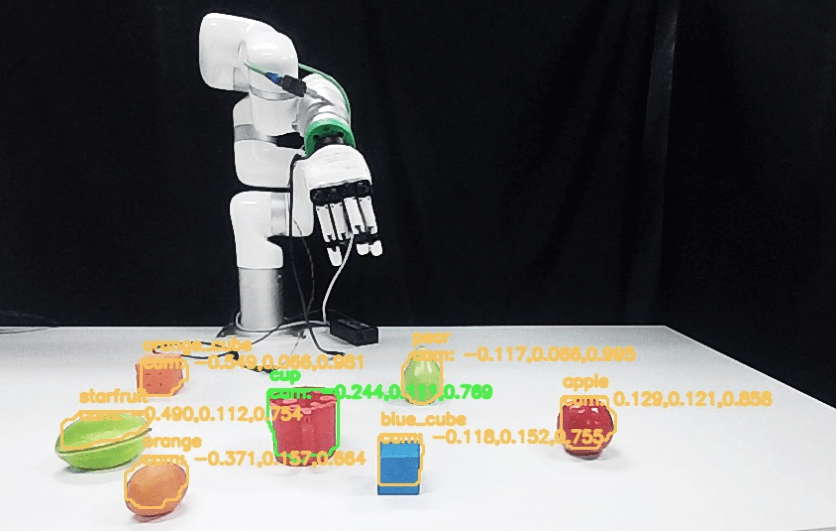
The real-world setup uses an xArm7 with an XHand and a Gemini 336L camera. The learned grasping policy is transferred directly from simulation with no fine-tuning, relying on domain randomization (friction in [0.5, 2.0], mass +/- 20%, 5 mm Gaussian noise on the point cloud) to bridge the reality gap.

Across 90 trials on apple, orange cube, and cup targets, AdaClearGrasp hits 70% overall success. The trend by clutter density is clean: 90% with two obstacles, 70% with four, 50% with six. Failures in dense scenes were mainly due to real-world uncertainties, such as the cup being knocked over while clearing adjacent obstacles due to unpredictable contact forces.
What is useful here
The practical contribution is less about any single component and more about the interface between them. Treating clearing as a discrete high-level decision that the VLM can reason about, rather than an emergent RL behavior, means you can debug plans, swap the VLM, add new skills, or port to a different hand without retraining the reasoning layer. The MCP-based skill interface is a genuinely useful pattern for anyone building VLM-driven manipulation stacks.
The main caveats are honest ones from the paper itself. Rolling objects and non-convex geometries like LEGO bricks still trip the grasping policy up. Real-world performance halves as clutter goes from sparse to dense, and pose estimation jitter accounts for a meaningful chunk of failures. Code, videos, and the Clutter-Bench scenes are promised on the project website, though at time of writing the page is still a stub.