
NAIST's SPDIM Fixes Brain-Computer Interfaces With One Tiny Matrix
Researchers propose SPDIM, a geometric deep learning method that fixes a critical flaw in EEG domain adaptation when class distributions shift between subjects or sessions.
 Pro
Takeaways
- Researchers from NAIST, ATR, and RIKEN published SPDIM at ICLR 2025, a method for adapting EEG models to new subjects or sessions without any labeled data.
- The paper formally proves that the standard Riemannian recentering approach -- the current state-of-the-art -- actively hurts performance when class distributions differ between domains (label shift).
- SPDIM fixes this by learning a single SPD-manifold-constrained bias matrix per target domain using an information maximization objective on unlabeled data.
- On sleep staging across 426 subjects and 4 datasets, SPDIM(bias) outperforms all baselines, with ~5% improvement over the prior best method in patient groups.
- On motor imagery BCI with severe label imbalance (80/20 split), SPDIM consistently ranks at or near the top across 4 public datasets and 34 subjects.
- The method is parameter-efficient and modular: the feature extractor and classifier are frozen; only one small matrix per target domain is optimized. Paper on arXiv.
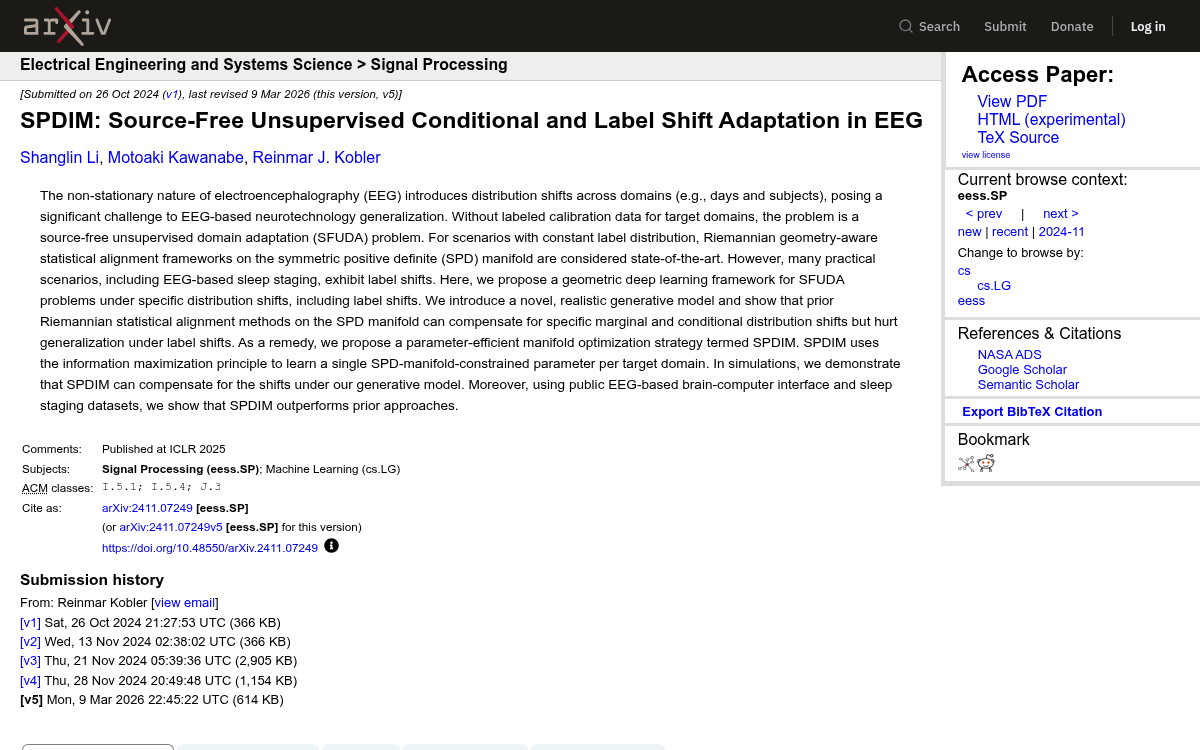
Brain-computer interfaces and sleep staging tools share a frustrating problem: a model trained on one person's EEG data often falls apart when applied to another. A new paper accepted at ICLR 2025 from researchers at NAIST, ATR, and RIKEN identifies a specific, underappreciated reason why the standard fix makes things worse -- and proposes a lightweight remedy called SPDIM that consistently outperforms prior approaches.
The EEG generalization problem is harder than it looks
EEG signals are notoriously unstable. The non-stationary nature of EEG introduces distribution shifts across domains -- such as different days or different subjects -- posing a significant challenge to EEG-based neurotechnology generalization. When you want to deploy a model on a new subject without collecting any labeled data from them, you're dealing with what's formally called a source-free unsupervised domain adaptation (SFUDA) problem: adapt to a new target domain using only unlabeled data, with no access to the original training data at inference time.
The standard toolkit for this in EEG uses Riemannian geometry -- a branch of math that treats EEG covariance matrices as points on a curved surface (called the SPD manifold, for Symmetric Positive Definite matrices) rather than flat Euclidean space. This turns out to be a natural fit for EEG because brain signals mix linearly from underlying sources, and covariance matrices on this manifold are invariant to those mixings. For scenarios with constant label distribution, Riemannian geometry-aware statistical alignment frameworks on the SPD manifold are considered state-of-the-art.
The dominant approach is called Recentering (RCT): compute the geometric mean (Fréchet mean) of each domain's covariance matrices and shift them to a common reference point. This works well when the proportion of classes is roughly the same across domains. The problem is that this assumption is often false.
When the class mix changes, alignment backfires
Many practical scenarios, including EEG-based sleep staging, exhibit label shifts. A label shift means the proportion of classes differs between source and target domains -- for example, a patient who sleeps poorly will have far more "awake" epochs than a healthy subject. When you try to align the geometric mean of such a domain to a reference, you're not just correcting for electrode placement or signal amplitude differences. You're inadvertently moving the data in a direction that reflects the skewed class mix, not just the domain-specific noise.
Prior Riemannian statistical alignment methods on the SPD manifold can compensate for specific marginal and conditional distribution shifts but hurt generalization under label shifts. The researchers prove this formally: RCT+TSM (the standard pipeline) compensates for the way brain signals mix differently across subjects, but when class priors differ, the alignment overcorrects and pulls the data in the wrong direction.

SPDIM: one parameter to fix the overcorrection
As a remedy, the authors propose a parameter-efficient manifold optimization strategy termed SPDIM, which uses the information maximization principle to learn a single SPD-manifold-constrained parameter per target domain. That single parameter -- a bias matrix living on the SPD manifold -- is applied after the standard recentering step to undo the label-shift-induced overcorrection.
The key insight is that the overcorrection introduced by label shift can be approximately factored out as a bilinear transformation on the SPD manifold. So instead of re-training the whole model, SPDIM just learns one small correction matrix per target domain using unlabeled target data. The optimization objective is information maximization (IM): a combination of two losses that together push predictions to be individually confident and collectively diverse across classes. This prevents the model from collapsing to always predicting the same class.
The full pipeline works like this:
- Train a source model (TSMNet) end-to-end on labeled data from multiple source domains using cross-entropy loss.
- At test time, freeze the feature extractor and classifier entirely.
- For each new target domain, compute its Fréchet mean (standard recentering, step 1).
- Initialize a domain-specific SPD bias parameter
Phi_jto the identity matrix. - Optimize
Phi_jusing the IM loss on unlabeled target data for 50 epochs with Riemannian ADAM.
The authors also propose a simpler variant, SPDIM(geodesic), which constrains the bias to move along a single geodesic (the shortest path on the manifold connecting the domain mean to the identity), reducing the parameter to a single scalar. This is faster but slightly less powerful than the full SPDIM(bias) variant.
Benchmarks: sleep staging and motor imagery
The team tested SPDIM on two classes of EEG tasks across eight public datasets:
- Motor imagery BCI (4 datasets, 34 subjects): imagining hand movements to control a cursor or prosthetic. Label shifts were artificially introduced by dropping samples to create an 80/20 class imbalance in target domains.
- Sleep staging (4 datasets, 426 subjects): classifying sleep stages (Wake, N1, N2, N3, REM) from overnight EEG recordings, where label shifts occur naturally because patients and healthy subjects have very different sleep architectures.
TSMNet+SPDIM(bias) significantly outperforms all other methods for the patient and healthy subject groups. Overall, the margin to TSMNet+SPDDSBN was approximately 5% in the patient group, which indicates that SPDIM has great potential for clinical applications.
On motor imagery with a 0.2 label ratio (severe imbalance), SPDIM(bias) reached an average balanced accuracy of 77.5% cross-session and 68.5% cross-subject -- consistently at or near the top across all four datasets. Crucially, the ablation study reveals that every component matters: removing either the IM loss or the manifold-constrained bias parameter causes a drop of at least 3% in sleep staging accuracy. Applying IM to the full model weights (rather than just the bias) causes a catastrophic collapse of over 27 points -- a stark warning against naive test-time fine-tuning.
What this means in practice
SPDIM is most useful when you have a pre-trained EEG model and want to deploy it on new subjects or new recording sessions without collecting any labeled data. It is particularly well-suited for:
- Clinical sleep staging, where patient populations have inherently different sleep stage distributions than healthy controls used in training.
- BCI systems deployed across sessions, where a user's mental state or fatigue level shifts the relative frequency of imagined movements.
- Any EEG application where you suspect the class balance in deployment differs from training.
The method has a known limitation: the IM loss, due to large noise and outliers, can sometimes estimate an inappropriate bias parameter, leading to the data being shifted in the wrong direction. While it generally improves average performance, it also increases variability. In other words, SPDIM raises the floor but can occasionally misfire on particularly noisy recordings.
The real breakthrough
Beyond the practical gains, the paper's most important contribution may be theoretical. The authors formally prove that the standard Riemannian recentering approach -- used widely in EEG BCI research -- is provably broken under label shift. This is not a minor edge case: sleep staging, emotion recognition, and many real-world BCI deployments all involve label shifts. The paper gives the community both a diagnosis and a fix, and the fix requires optimizing just one matrix per target domain rather than retraining anything. The ICLR 2025 paper is available on arXiv, implemented using standard Python libraries including pyRiemann, geoopt, and braindecode -- though a dedicated public code release is not yet listed in the paper.