
NAIST's ADQ Teaches Robots to Untie Knots by Ignoring Most Force Data
A new observation trick called ADQ throws away most of the force signal on purpose, and it makes robot cloth untangling policies survive the jump from simulation to hardware.
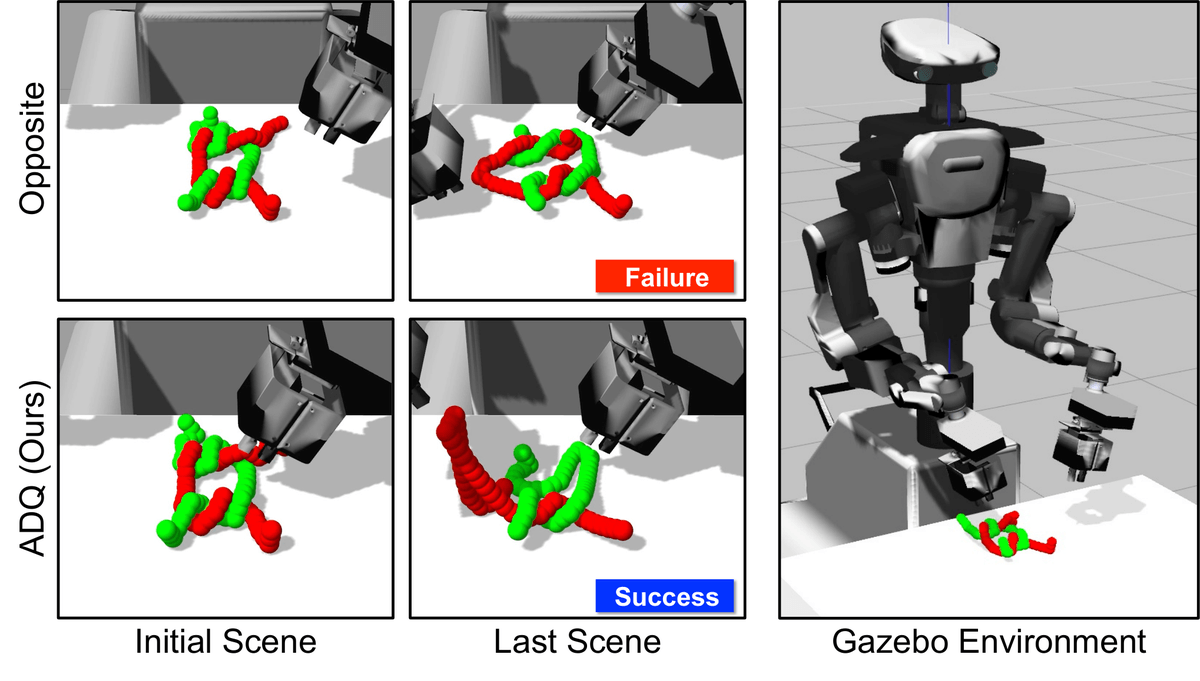 Pro
Takeaways
- ADQ replaces raw force inputs with 3-level (up/flat/down) temporal differences to survive sim-to-real transfer.
- Quantization thresholds are policy outputs, updated online, so sensitivity adapts to each phase of untangling.
- On real double-overhand knots, ADQ hit 92% success versus 63% for raw-force policies and 82% for a heuristic.
- Wasserstein distance between sim and real force distributions dropped 71% with the new representation.
- Trained in Isaac Gym in 12 hours on one RTX 4090 using a capsule-chain local entanglement model.
- Paper: arxiv.org/abs/2603.13785. Weakness: bad for tasks needing fine-grained force magnitudes.
Getting a robot to untie a knot in a T-shirt sleeve sounds trivial until you try to train it. Cloth is soft, self-occluding, and every friction detail matters. Researchers from the Nara Institute of Science and Technology and Karlsruhe Institute of Technology have published a paper arguing that the fix is neither better force sensing nor better simulation, but deliberately throwing away most of the force information the robot sees.
Their method, Adaptive Force-Difference Quantization (ADQ), collapses the continuous force reading into three values per axis: going up, going down, or roughly flat. A policy trained on this coarse signal in NVIDIA Isaac Gym transfers directly to a real dual-arm humanoid untying double-overhand knots in synthetic, cotton, and fleece garments.
Why raw force signals break at transfer time
Cloth untangling is dominated by contact and friction, and policies that depend on precise force magnitudes often fail after transfer because the exact response cannot be reproduced across the reality gap. Two simulators, or a simulator and a real Robotiq force-torque sensor, will disagree on scale, bias, noise, and how a contact transition actually looks in the time series.
The authors' key observation is that a human untangling a knot doesn't care about the exact Newton value on the string. What matters is whether tension is rising, falling, or steady, because those transitions signal that something in the contact geometry just changed. Emphasizing coarse force-change patterns while suppressing fine environment-dependent variations, they argue, should improve robustness of sim-to-real transfer.

Three tricks stacked on top of each other
ADQ is built from three components working together:
- Force differencing. Instead of feeding the policy the raw 3-axis force, it sees the temporal difference between the current force and the previous step. This kills steady bias and drift.
- Ternary quantization. Each axis of that difference is discretized to -1, 0, or +1 using a threshold. The policy loses magnitude information but keeps sign-level information about contact transitions.
- Threshold-as-action. The quantization thresholds themselves are outputs of the policy, updated online at every step, so the robot can decide how sensitive its own force perception should be depending on the current phase of the untangling.
That last piece is the interesting one. Most quantization schemes fix the threshold as a hyperparameter you tune. Here the threshold lives in the action space alongside the pull direction, bounded between 0.005 and 2.5 with an initial value of 0.15. At each step, the policy observes the stacked ternary signal over the last five steps, the most recent threshold update, and the direction vector between the two hands.

Training on a fake knot
Simulating a full knot in cloth is expensive and numerically unstable, so the team built a local entanglement model: the fabric involved in the knot is approximated as a chain of overlapping capsule segments connected by spherical joints, with collisions disabled between neighbors and enabled between non-neighbors. Training used PPO-style reinforcement learning with a reward combining a Gauss-linking-integral entanglement score, the free-end length on the pulling side, and a success bonus.
Domain randomization was applied to force-sensor scale and bias, pull-vector multiplier, chain density, joint friction and damping, and surface friction. The policy converged after roughly 157M training steps over 12 hours on a single RTX 4090.
The numbers
Testing ran on a Nextage dual-arm humanoid with a Robotiq FT 300 force-torque sensor and a 1-DoF gripper. A trial counted as a success if the knot was resolved within 15 pulls and no pull exceeded a 30 N safety limit. Results across six configurations (loose or tight knots crossed with low, medium, or high friction fabrics, 10 trials each):
| Method | Success rate | Peak force (N) |
|---|---|---|
| Opposite (heuristic) | 0.82 | 17.9 |
| Naive (raw force policy) | 0.63 | 17.7 |
| ADQ | 0.92 | 14.2 |
The heuristic baseline that just pulls the two hands apart works fine when friction is low, but collapses to 10% success on tight, high-friction knots. ADQ holds 70% on that hardest configuration and uses lower peak forces, which matters when the safety limit would otherwise trip and abort the trial.
A separate analysis measured the 1D Wasserstein distance between the force observation distributions in Isaac Gym and on the real robot. Raw force inputs showed an average gap of 2.51, while the ADQ representation reduced it to 0.71, roughly a 71% reduction. Grad-CAM attribution confirmed that both in simulation and on hardware, the policy fires most strongly on recent ternary force-difference features and flips its pulling direction when the x-component sign flips.
Where the pattern travels, and where it breaks
ADQ works as a design pattern more than a system, and it should port to any contact-rich sim-to-real task where interaction events matter more than absolute magnitudes: peg-in-hole assembly, cable manipulation, wiping, or bimanual grasping under uncertain friction. If you are training in a simulator that doesn't match your real sensor calibration, quantizing the observation on both sides is a cheap way to close the gap without touching the physics.
The authors are upfront about two limits. Discretizing to three levels throws away information, so tasks that genuinely need high-frequency vibration cues, like slip detection or texture discrimination, will suffer. And if the threshold updates move too fast, the quantized signal becomes non-stationary and destabilizes training. They suggest smoothing penalties on the threshold rate of change, and multi-level quantization as future work. The paper does not appear to release code at the moment, though a supplementary video is available and the group's other work is listed on the NAIST Robot Learning Lab page.