
MVHOI Lets AI Swap Handheld Objects in 3D Video Without Flickering
MVHOI uses a 3D foundation model to swap objects into videos while preserving realistic hand-object dynamics under complex rotations and occlusions.
 Pro
Takeaways
- MVHOI is a two-stage framework for swapping objects in human-object interaction videos under complex 3D motion. Paper
- Stage I builds a Unified Object Anchor on top of Depth Anything 3 to produce view-consistent coarse guidance from multi-view references.
- Stage II uses a Wan2.1-based DiT video generator with a VACE-style multi-reference adapter for high-fidelity texture synthesis.
- Attention maps from the 3D foundation model are injected as logit biases into the video generator to steer view-correct texture retrieval.
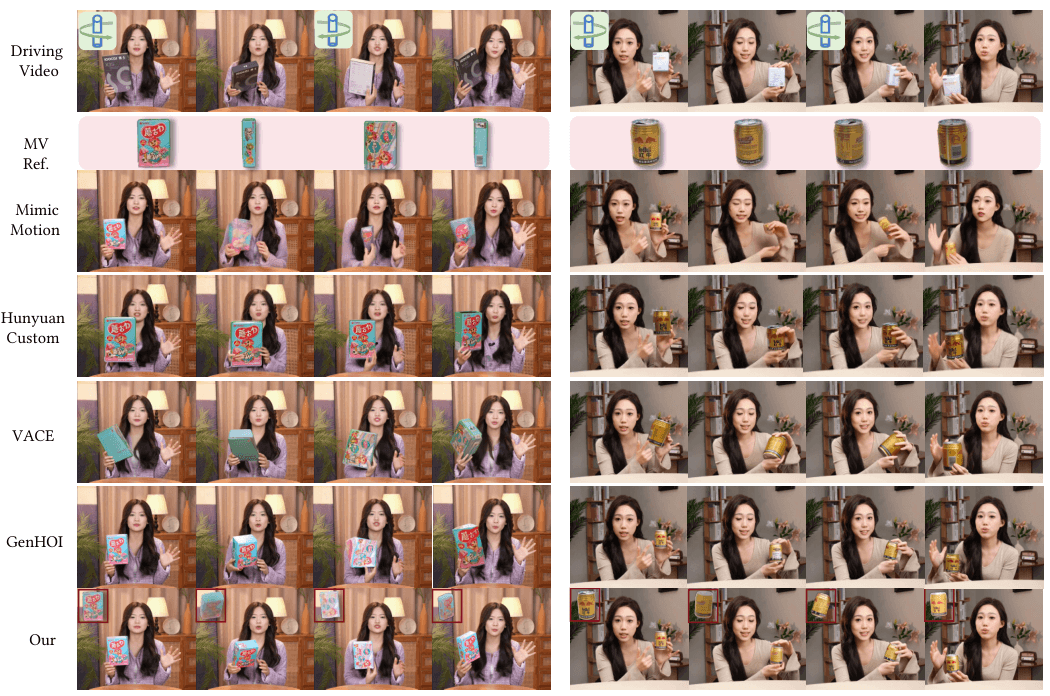
- Beats VACE, HunyuanCustom, MimicMotion, and HuMo across PSNR, SSIM, LPIPS, FVD, and identity metrics on self and cross reenactment.
- A cross-iterative inference loop between the two stages suppresses drift in 10-second long-video generation.
Swapping objects in a video of a person holding, spinning, or manipulating something sounds simple until you actually try it. Current video generators can slide a new object across the frame, but they fall apart the moment the object rotates in 3D, gets occluded by a hand, or shifts orientation. A new paper from researchers at ANU, Baidu, Sun Yat-sen University, and CSIRO introduces MVHOI, a two-stage framework that finally tackles this problem by wiring a 3D foundation model into the video generation pipeline.
Why 2D keypoints keep breaking
Human-Object Interaction (HOI) reenactment is the task of taking a source video (say, someone rotating a paint can) and regenerating it with a different target object while preserving the same motion. Existing approaches primarily handle simple image-plane motion like in-plane translations, struggling with complex non-planar manipulations like out-of-plane reorientation.
The authors pinpoint two failure modes in prior work:
- Representation gap: Sparse 2D descriptors like bounding boxes and keypoints cannot capture view-contingent geometric deformation. Explicit 6D pose estimation is an obvious alternative, but it is notoriously prone to orientation ambiguity, especially when encountering symmetric or texture-less objects, causing objects to drift out of sync with the hand.
- Texture inconsistency: A single reference image cannot show what an object looks like from behind or from the side, so diffusion models hallucinate occluded surfaces stochastically, and the result flickers across frames.
The core idea: a Unified Object Anchor
MVHOI's insight is that 3D foundation models (3DFMs) like Depth Anything 3 already learn to fuse multi-view images into a shared, view-consistent latent space. The team repurposes this as what they call a Unified Object Anchor (UOA): a latent repository where the geometry and appearance of the target object are aligned, and rendering a novel view becomes a deterministic query rather than a stochastic guess.

The framework runs in two stages that reinforce each other at inference time:
- Stage I - 3D-aware object reenactment. A motion extractor (borrowed from DisMo) encodes the frame-to-frame dynamics of the source video into latent motion embeddings, skipping any explicit pose estimation. These embeddings modulate the object tokens inside the UOA via learned scale-and-shift, and an RGB head decodes a coarse, view-consistent target-object sequence. The output is blurry but geometrically correct.
- Stage II - Multi-reference video generation. A DiT-based video generator (initialized from Wan2.1-T2V-14B) takes the coarse guidance plus the multi-view reference images and synthesizes the final high-fidelity video. A context-adapter branch cloned from VACE handles the multi-reference conditioning.
Attention as a geometry-aware router
A clever detail sits in Stage II. When a video diffusion model gets multiple reference views of an object, it often picks the wrong one for a given frame because attention is appearance-driven and appearance changes with rotation. The authors noticed that the internal attention maps of the Stage I UOA already encode which reference view corresponds to which target frame, because that is exactly what the 3D foundation model was trained to do.
They extract that attention map w, convert it into a logit bias B = α · log(w / (1-w)), and add it to the self-attention logits inside the video generator. The result: the diffusion model is nudged to retrieve textures from the geometrically correct reference view for each frame, even during 360-degree rotations.

Training tricks and long-video inference
Training Stage II end-to-end alongside Stage I would be prohibitively expensive, so the authors use a proxy: the object crop from each training frame stands in for the coarse guidance. This creates an information-leakage problem, since the model can just copy the crop verbatim. Their fix is to aggressively augment the proxy with random scaling, warping, blur, and color jitter, forcing the model to lean on the multi-view references for detail while using the guidance only for pose alignment.
For long videos, naive autoregressive rollout drifts. MVHOI uses a cross-iterative inference loop: Stage I produces sparse anchor views over a long horizon, Stage II refines them into a clip, and the last high-quality frame of that clip re-initializes Stage I for the next segment. This periodic re-anchoring keeps identity and texture stable over 10-second sequences.
The numbers
The team evaluated on the AnchorCrafter dataset and 100 self-collected videos, against MimicMotion, VACE, HunyuanCustom, and HuMo. Stage I training used 40,000 objects from Objaverse with rendered motion frames and reference views; Stage II used roughly 100 hours of proprietary multi-view HOI video.
| Method | PSNR ↑ | SSIM ↑ | LPIPS ↓ | FVD ↓ | O-CLIP ↑ |
|---|---|---|---|---|---|
| MimicMotion | 19.34 | 0.806 | 0.233 | 632.9 | 0.685 |
| HunyuanCustom | 25.56 | 0.925 | 0.090 | 247.4 | 0.791 |
| VACE | 27.25 | 0.954 | 0.036 | 204.6 | 0.706 |
| MVHOI | 30.21 | 0.960 | 0.025 | 86.6 | 0.848 |
On self-reenactment, MVHOI cuts FVD by more than half compared to the strongest baseline. Ablations show both components matter: coarse reenactment guidance alone drops FVD from 296.7 to 282.1, and adding the attention enhancement pushes it further to 273.95 while lifting the object-CLIP identity score.
Where it fits and what to watch for
MVHOI is aimed at object-swap applications where physical plausibility matters: virtual try-on for handheld products, e-commerce demos where you want to reshoot a video with a different SKU, and any character-animation pipeline that involves manipulating props. It supports up to 720p and 81 frames per segment.
A few caveats worth flagging:
- The Stage II dataset is proprietary and no code or model release is mentioned in the paper, so reproducing the full system is not straightforward today.
- The framework needs multiple reference views of the target object. If you only have a single front-view image, the multi-view retrieval mechanism loses most of its advantage.
- Compute is non-trivial: two large models running with cross-iterative inference between them makes this heavier than a single-stage generator.
Still, the broader lesson is worth internalizing. Rather than trying to teach a video diffusion model 3D geometry from scratch, MVHOI shows you can bolt on an existing 3D foundation model as a spatial oracle, and even reuse its attention maps as routing signals downstream. That pattern, using one foundation model to condition another through its intermediate activations, is likely to show up in a lot more video generation work.