
MSU's POMDP Framework Teaches 20-Joint Exoskeleton Skills 150 Trials Faster
A hand exoskeleton study shows that vibrotactile nudges chosen by a POMDP over a hidden skill model beat both heuristic feedback and no feedback.
 Pro
Takeaways
- MSU researchers built a POMDP framework that picks haptic nudges based on a learner's hidden skill state, not raw performance error.
- They modeled motor learning with an Input-Output Hidden Markov Model using target pair and nudged finger as inputs.
- A QMDP approximation with soft Bellman updates yields a real-time nudging policy trained on only five participants' data.
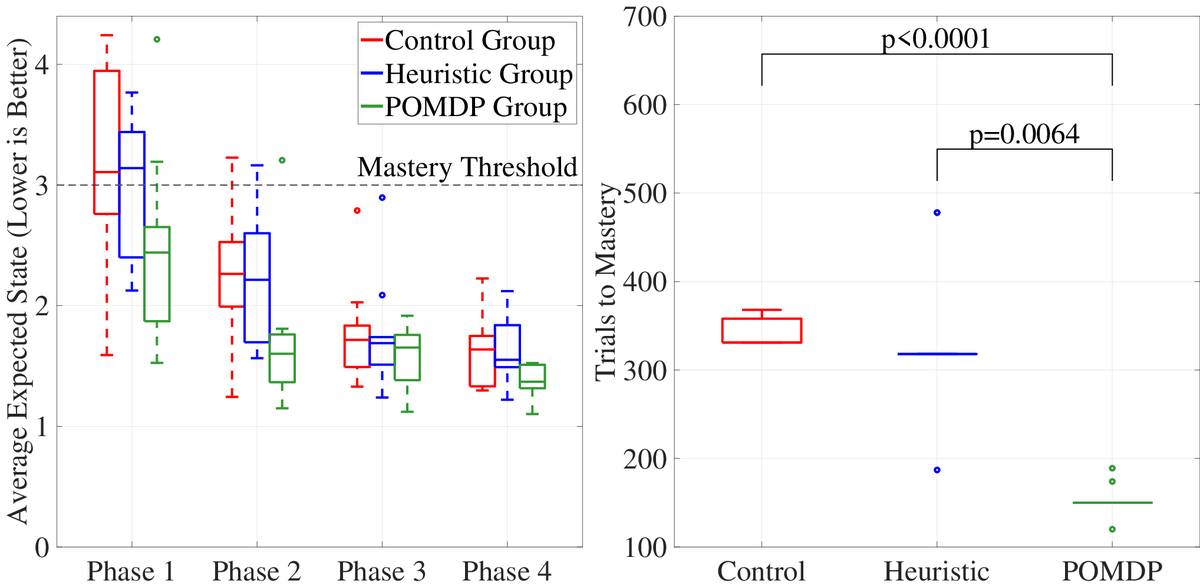
- In a 30-person hand-exoskeleton study, POMDP participants reached mastery by trial 150 versus significantly later for controls.
- Synergy analysis showed POMDP learners collapsed 20 joints into task-relevant principal components faster than heuristic and no-feedback groups.
- Framework is interpretable and sample-efficient, positioning it for stroke rehab and BMI training with patient-specific tuning.
Teaching someone a genuinely new motor skill, like piloting a hand exoskeleton with 20 joints to steer a 2D cursor, is a nasty control problem. A group at Michigan State University just published a framework that treats the learner's brain as a partially observable system and picks haptic nudges the same way a robot would pick actions in a POMDP. In a 30-participant study, the resulting policy beat both an intuitive heuristic and a no-feedback baseline on accuracy, efficiency, and how quickly people discovered good coordination patterns.
The redundancy trap
De-novo motor tasks are not the same as tweaking a reaching movement. De-novo learning requires the discovery of novel movement strategies, which fundamentally distinguishes it from the simple reduction of kinematic task errors observed in low-dimensional reaching tasks. Because the hand has far more degrees of freedom than a screen cursor, there are infinitely many joint configurations that produce the same cursor position, and most of them are bad long-term habits.
Prior haptic guidance systems fall into two camps, and both have problems. Expert-designed guidance does not scale to high-DoF tasks. Performance-driven guidance is reactive and, as the authors put it, assistance might overfit to the user, helping them perform well temporarily (low errors) by using a bad, compensatory habit (low skill). Continuous force feedback makes this worse by triggering the guidance hypothesis, where learners lean on the robot and never internalize the task.
Modeling the learner as a hidden Markov process
The core move in the paper is to treat motor skill as a latent variable that emits noisy performance signals, rather than something you can read directly off a trajectory. The authors fit an Input-Output Hidden Markov Model (IOHMM), a variant of an HMM where state transitions and emissions depend on external inputs. Here the hidden state is the learner's motor skill (discretized into 7 levels), the inputs are the current target pair and which finger just got buzzed, and the emissions are two measured performance metrics: reaching error and straightness of trajectory.
Transitions are parameterized with multinomial logistic regression, emissions with linear Gaussians, and everything is fit with a generalized EM procedure using the IOHMM Python library. Only data from the first five heuristic-group participants was used to fit the model, so the whole thing is genuinely sample-efficient.

From model to nudging policy
Once you have a probabilistic forward model, choosing the next nudge becomes a Partially Observable Markov Decision Process. The action space is small: which of the five fingers gets a 150ms buzz (or none). The reward penalizes both the predicted immediate error and the expected performance of the next latent state across all possible upcoming tasks, so the planner is pushed toward versatile skill states rather than just low error on this trial.
Exact POMDP solutions in belief space are intractable, so the authors use the QMDP approximation: solve the underlying fully-observable MDP, then sample states from the running belief at execution time. They also swap the hard max in Bellman updates for a softmax, which acts as a regularizer against imperfections in the model fit. The final belief is updated after every trial from the observed RE and SoT.
What the study measured
The experimental setup uses a SenseGlove DK1 exoskeleton with vibrotactile actuators on each fingertip, mapped to a 2D cursor via PCA on calibration postures. Thirty participants were split into three groups of ten: control (no nudges), heuristic (nudge the finger closest to the ideal pose in joint space), and POMDP. Each did 8 blocks of 60 target-capture trials.
Results across the three groups:
- The POMDP group achieves statistically significantly (at significance level $\alpha < 0.10$) lower RE compared to the other two groups across all experiment trials, meaning better endpoint accuracy.
- Movement efficiency (straightness of trajectory) improved fastest for the POMDP group, particularly at higher thresholds early in training.
- The POMDP group reached mastery by trial 150 (median), whereas the other two groups reached this threshold statistically significantly later (p < 0.0001 for Trials(POMDP) < Trials(Control), and p = 0.0064 for Trials(POMDP) < Trials(Heuristic)).
- Synergy analysis showed POMDP participants collapsed their 20-joint variance into fewer principal components faster, suggesting they discovered the underlying 2D task manifold more quickly.
The interpretability bonus
An unexpected win is that the fitted IOHMM is legible. The learned state transition matrices show that thumb nudges cause the largest jumps toward high-performing states, matching the biomechanics of the calibration where thumb abduction drives most of the vertical cursor motion. Neighboring fingers produce similar transition patterns. None of this was hand-coded, it fell out of the data.

Where this is useful, and where it is not
The obvious application is neurorehabilitation. The framework builds on prior work modeling human motor learning dynamics in high-dimensional tasks, and stroke recovery, spinal cord injury, and prosthesis training all involve learning novel motor mappings under redundancy. Any teleoperation or brain-machine interface training task with similar structure is also a candidate.
Caveats worth flagging. The study is on 30 healthy adults, not patients. The 7-state discretization is coarse. The IOHMM is trained on a population-average model, so personalization would either require patient-specific data or online adaptation. And no code release is mentioned in the paper, though the underlying IOHMM library is open source. For anyone working on adaptive human-in-the-loop training systems, the recipe is worth stealing: model the human as an IOHMM, plan with QMDP, and let the belief state drive intervention timing instead of raw performance error.