
MSG-LDM Stops AI From Hallucinating Fake Brain Tumors in MRI Scans
A latent diffusion model separates anatomy from modality style, letting a single network fill in any missing MRI sequence without warping brain structure.
 Pro
Takeaways
- MSG-LDM is a latent diffusion model for synthesizing missing MRI modalities from any available combination of T1, T2, T1CE, FLAIR.
- Disentangles modality style from shared anatomical structure in latent space using separate encoders and a shared segmentation decoder.
- Three modules (HFIB, MMSF, MSSE) capture low-frequency anatomy plus high-frequency edges at four scales.
- Adds a contrastive style consistency loss and a DCT-based frequency-domain SSIM structure loss.
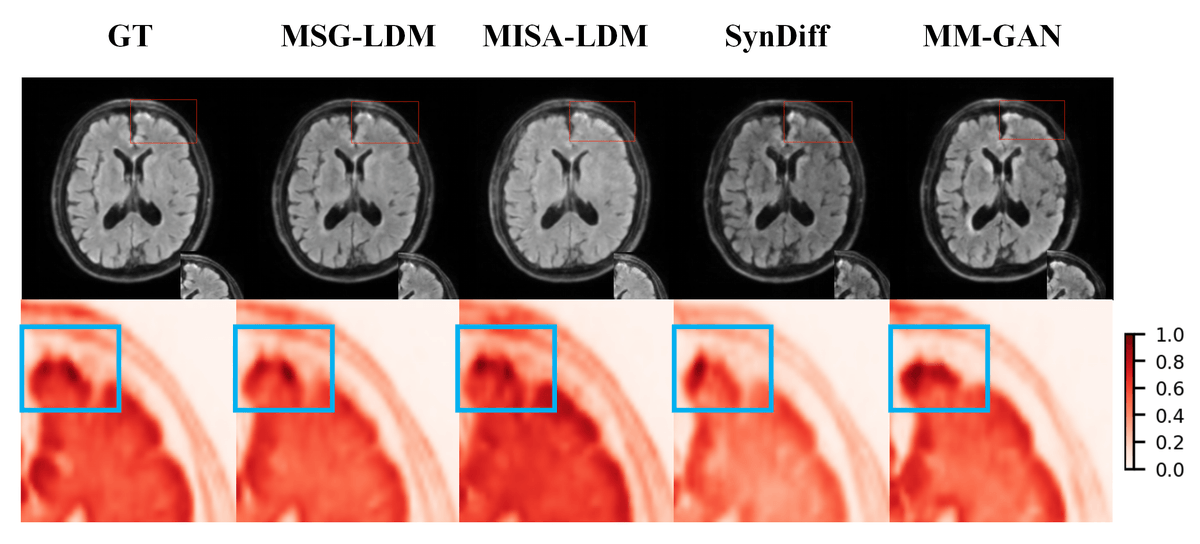
- Beats MM-GAN, SynDiff, and MISA-LDM on BraTS2020 and WMH across PSNR, SSIM, and Dice metrics.
- Code available at github.com/ziyi-start/MSG-LDM.
MRI scans come in flavors. Radiologists rely on multiple sequences (T1, T2, contrast-enhanced T1CE, and FLAIR) to see the brain from different angles because each highlights different tissue contrast. But in practice, patients rarely finish the full set. Scans get cut short, machines fail, or contrast agents are skipped, leaving downstream tumor segmentation and diagnosis algorithms working with holes in the input.
A team from Northeastern University in Shenyang and the University of Alberta has released MSG-LDM, a latent diffusion framework that synthesizes the missing sequences from whatever modalities are available. The interesting part is how it stops the diffusion model from hallucinating anatomy that isn't there. Code is on GitHub.
Why diffusion models keep drifting off the anatomy
Diffusion has largely replaced GANs for cross-modal MRI synthesis because it produces sharper images and trains more stably. But most diffusion-based synthesis models are constrained to fixed input-output modality pairs, and they inevitably sacrifice anatomical structure consistency and degrade critical texture details during generation, potentially leading to the misdiagnosis of subtle pathological patterns.
The paper's diagnosis is blunt: standard diffusion models are not built to respect structure. They learn to denoise pixel distributions, not skulls. When you ask them to reconstruct a T1CE from a T2 and a FLAIR, the tumor boundary drifts, edges soften, and modality-specific quirks like FLAIR's bright hyperintensities bleed into where they shouldn't be.

Splitting style from structure
MSG-LDM's central idea is a disentanglement trick borrowed from style transfer, applied inside a VAE latent space. Every modality passes through its own structural encoder and its own style encoder. A shared segmentation decoder forces the structural encoders to converge on the same modality-invariant representation of brain anatomy, while style encoders capture the per-modality contrast characteristics.
Three modules do the heavy lifting inside the structure branch:
- High-Frequency Injection Block (HFIB): a learnable Gaussian filter decomposes each feature map into low-frequency (global anatomy) and high-frequency (edges, textures) components, then re-injects the high-frequency residual so the encoder stops smoothing away boundary detail.
- Multi-Modal Structural Feature Fusion (MMSF): a sigmoid gating network computes per-modality attention weights at each of four scales, letting the model down-weight missing or noisy modalities on the fly.
- Multi-Scale Structural Feature Enhancement (MSSE): lower-scale features are projected, upsampled, and cross-attended into the highest-scale representation, producing a single unified structure feature that conditions the diffusion U-Net.

Two losses that keep the model honest
Beyond the standard latent diffusion denoising loss, the training objective adds two regularizers. A style consistency loss treats style features contrastively: features from the same modality across a mini-batch get pulled together, features from different modalities get pushed apart. This prevents the style branch from smuggling anatomical information the structure branch is supposed to own.
A structure-aware loss combines an L1 reconstruction term with a frequency-domain SSIM loss computed on the 2D discrete cosine transform of the generated versus ground-truth image. Comparing magnitude spectra in DCT space penalizes global structural drift more directly than a pixel-space loss would.
Numbers on BraTS2020 and WMH
The team evaluated on BraTS2020 (369 scans, four modalities) and the WMH white matter hyperintensity dataset. They sweep across scenarios with 1, 2, or 3 available input modalities and measure PSNR, SSIM, and downstream Dice score on tumor segmentation, comparing against MM-GAN, SynDiff, and the team's own prior MISA-LDM (which was published at MICCAI 2025).
With three modalities available and FLAIR as the target, MSG-LDM reaches 31.35 PSNR and 96.29 SSIM, versus 30.65 and 94.86 for SynDiff. Even in the hardest single-modality setting, it beats MISA-LDM by roughly a point of PSNR and two points of SSIM on average. Dice scores improve consistently, meaning the synthesized images are actually usable for downstream tumor segmentation rather than just looking pretty.
The ablations tell a clean story: removing the style consistency loss causes the biggest drop (PSNR falls from 29.68 to 27.11), followed by the structure-aware loss. HFIB and MSSE each contribute a smaller but consistent gain.
Where it fits, and where it doesn't
This is a 2D slice model trained at 192x192 resolution on three RTX 4090s for 100 epochs. It targets the arbitrary-missing-modality problem in clinical brain MRI pipelines, which makes it directly useful as a preprocessing step for segmentation networks that assume all four sequences are present. It's not a 3D volumetric synthesizer, so full-volume anatomical consistency across slices is not guaranteed the way it would be with a 3D approach like CG-DDPM.
The reference set for comparison is also relatively narrow. The team benchmarks against three prior methods rather than the broader landscape of many-to-many synthesis frameworks like M2DN, and the WMH evaluation is limited to two-modality translation. For anyone building a robust MRI imputation pipeline, MSG-LDM is a strong 2D baseline with released code, but the structure-versus-style disentanglement recipe is arguably the more portable contribution.