
Moshi's Always-On Listening Quietly Fingerprints Your Voice Identity
A new study finds that always-on voice AI models like Moshi and SALM-Duplex silently encode who you are inside their hidden states — and proposes real-time fixes that nearly erase the leak.
 Pro
Takeaways
- Full-duplex speech LLMs (Moshi, SALM-Duplex) continuously encode speaker identity in their hidden states across all transformer layers.
- Moshi's discrete codec encoder leaks the most: 6.4% EER means near-perfect speaker re-identification with no anonymization.
- Privacy degrades rapidly — both models fall into the "low-privacy zone" within just a few conversation turns.
- Two streaming fixes proposed: Anon-W2W (plug-and-play waveform swap) and Anon-W2F (feature-domain replacement requiring retraining).
- Best result: Anon-W2F raises EER from 11.2% to 41.0% (near random-chance), with sub-0.5s first response latency.
- All systems remain real-time viable (RTFx > 1), but anonymization reduces throughput from 17-263x down to 1.6-2.5x real-time.
Voice AI is getting better at sounding human. Models like Moshi and SALM-Duplex no longer wait for you to stop talking before they respond , they listen and speak simultaneously, just like a real conversation partner. But that always-on listening comes with a hidden cost: the LLM backbone at the heart of these systems quietly encodes who you are, not just what you said. A new paper from researchers at Nanyang Technological University, Huawei Leibniz Research Center, and collaborators is the first to measure this speaker identity leakage inside full-duplex speech LLMs , and to propose streaming-compatible fixes that nearly close the gap.
The always-on problem nobody was watching
Traditional voice assistants work in turns: you speak, they transcribe, they respond. Full-duplex models break that mold. Models such as SALM-Duplex, Moshi, and SyncLLM route raw user audio continuously through a decoder-only LLM backbone, computing hidden state representations at every transformer layer throughout the entire conversation. This is what makes them feel natural , but it also means your voice is being processed non-stop, at every layer, for the entire session.
Unlike cascaded systems where user and agent streams are processed separately, the LLM core of these full-duplex systems maintains a persistent internal state over the user's speech stream, capturing their voice, speaking style, and identity. Prior work on self-supervised speech models like wav2vec 2.0 and HuBERT had already shown that transformer hidden states encode speaker identity. But nobody had looked inside a full-duplex dialogue LLM , until now.
Under GDPR and similar regulations, the mere presence of identifiable speaker information in model representations constitutes a compliance risk, regardless of whether external access is exploited, making it essential to audit and mitigate such leakage proactively. The stakes are real: any service provider running one of these models on user speech could, in principle, be sitting on a re-identification risk they never knew existed.
How bad is the leak?
To measure leakage, the researchers used a technique called probing: they trained a lightweight speaker verification classifier (an ECAPA-TDNN network) directly on the hidden states extracted from each transformer layer. The classifier's job is to figure out who is speaking just from the model's internal activations , no access to the original audio needed. The privacy metric is Equal Error Rate (EER): a higher EER means the attacker is more confused, and 50% EER is the theoretical ceiling where the attacker is guessing at random.
The results are striking. The mean-pooled EER for the original SALM-Duplex (continuous encoder) is 28.5%, revealing significant speaker identity leakage, while Moshi's discrete encoder reaches 6.4% EER (near-perfect identification). To put that in context, a 6.4% EER means an attacker can correctly link speech segments to the same speaker with near-perfect accuracy , essentially a fingerprint.
Layer-wise and turn-wise analyses reveal that leakage persists across all layers, with SALM-Duplex showing stronger leakage in early layers while Moshi leaks uniformly, and that Linkability rises sharply within the first few turns.

The turn-length analysis is especially concerning for real deployments. Without any anonymization, both systems fall into what the authors call the "low-privacy zone" within just a few conversation turns. The more you talk, the more exposed you become.
Why discrete encoders are the worst offenders
The two models handle audio encoding differently, and that difference matters enormously for privacy. Discrete encoders, trained for high-fidelity speech reconstruction, leak substantially more speaker identity than the continuous encoder. Moshi uses a residual-quantization (RVQ) codec that converts audio into discrete tokens , great for audio quality, terrible for privacy. SALM-Duplex's original design uses an ASR-pretrained continuous encoder, which turns out to be a privacy-positive choice by accident: ASR pretraining optimizes for speech content rather than speaker characteristics, discarding speaker characteristics in favour of linguistic content.
This is a key architectural insight: the choice of audio encoder is not just a quality decision , it's a privacy decision. Models optimized for high-fidelity audio reconstruction will, by design, preserve speaker identity in their representations.
Two fixes, one streaming constraint
The paper proposes two anonymization setups, both built on top of Stream-Voice-Anon, an open-source real-time speaker anonymization system. Stream-Voice-Anon adapts modern causal LM-based neural audio codec architectures specifically for streaming speaker anonymization by integrating anonymization techniques. The key constraint throughout is that everything must work in real time , no buffering, no batch processing.
- Anon-W2W (Waveform-to-Waveform): Prepends Stream-Voice-Anon to anonymize the waveform before the unchanged ASR encoder. This is the plug-and-play option , the dialogue model itself is untouched. It works on both SALM-Duplex and Moshi.
- Anon-W2F (Waveform-to-Feature): Replaces the ASR encoder with the Stream-Voice-Anon encoder (anonymization active) and fine-tunes the LLM, eliminating the redundant waveform synthesis step. This requires retraining but achieves stronger privacy by operating natively in the feature domain.
The Anon-W2F setup required pretraining on roughly 12,000 hours of multi-turn dialogue data and fine-tuning on InstructS2S-200K. It is currently demonstrated only for SALM-Duplex; Moshi integration is left for future work.
The numbers: privacy vs. utility
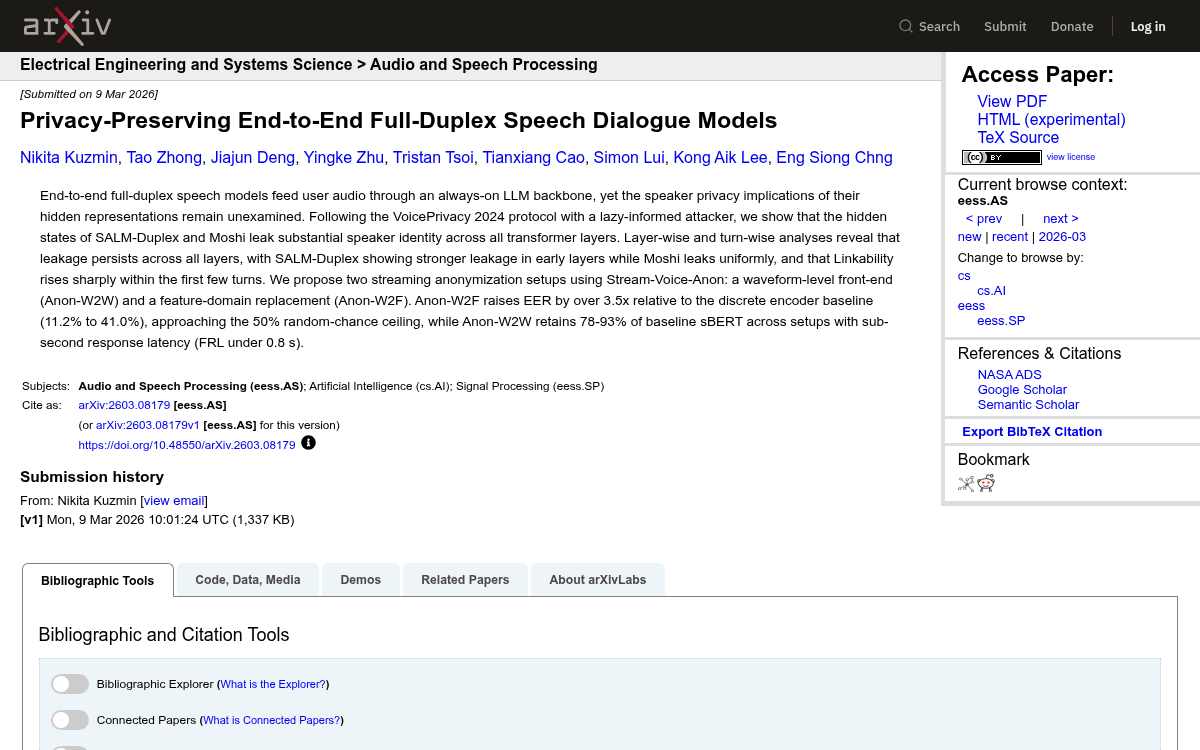
Anon-W2F raises EER by over 3.5x relative to the discrete encoder baseline (11.2% to 41.0%), approaching the 50% random-chance ceiling, while Anon-W2W retains 78-93% of baseline sBERT across setups with sub-second response latency (FRL under 0.8 s). The full picture across all conditions is shown below.
| Model | Encoder | Anonymization | EER (higher = more private) | Linkability (lower = more private) | RTFx (real-time factor) | First Response Latency |
|---|---|---|---|---|---|---|
| Moshi | Discrete | None | 6.4% | 0.90 | 17x | 0.50s |
| Moshi | Discrete | W2W | 36.9% | 0.35 | 1.6x | 0.72s |
| SALM-Duplex | Discrete | None | 11.2% | 0.79 | 238x | 0.44s |
| SALM-Duplex | Discrete | W2F | 41.0% | 0.23 | 2.5x | 0.50s |
| SALM-Duplex | Continuous | None | 28.5% | 0.29 | 263x | 0.68s |
| SALM-Duplex | Continuous | W2W | 34.6% | 0.24 | 1.7x | 0.80s |
There is a real cost to anonymization. Adding the anonymization module reduces RTFx substantially (from 17-263x to 1.6-2.5x) as the anonymizer dominates inference time, but all conditions remain real-time viable (RTFx > 1). Dialogue quality also takes a hit: sBERT scores drop 7-22% relative depending on the setup. The authors note that their text-based quality metrics do not capture speech naturalness or prosody, so the perceptual quality tradeoff may be larger than the numbers suggest.
What the probing methodology actually measures
The evaluation follows the VoicePrivacy 2024 Challenge protocol, which uses a "lazy-informed attacker" , a speaker verification model trained on the original (non-anonymized) speech. The protocol employs key metrics including Equal Error Rate (EER), Word Error Rate (WER), and Unweighted Average Recall (UAR) to assess privacy, speech intelligibility, and emotional fidelity. The researchers also report Linkability, a GDPR-aligned metric that measures how easily speech segments from the same speaker can be linked across a conversation.
Hidden states were extracted from three checkpoints in each model: early (layer 1), mid (layer N/2), and late (layer N), plus a mean-pooled representation across all layers. Moshi has 32 transformer layers; SALM-Duplex has 20. The dataset used is derived from LibriSpeech dev-clean and test-clean , read speech, not spontaneous conversation, which the authors flag as a limitation. The authors also note that the ECAPA-TDNN probe represents a lower bound on leakage; the VoicePrivacy Attacker Challenge has shown that more sophisticated attackers can further reduce EER, suggesting that actual privacy risk may be higher than reported.
What this means for builders
If you are building on top of a full-duplex speech model, or considering deploying one, here is what this paper changes:
- Encoder choice is a privacy decision. ASR-pretrained continuous encoders offer built-in partial privacy protection. Codec-based discrete encoders (like Moshi's RVQ) are highly exposed by default.
- The plug-and-play fix works. Anon-W2W requires no changes to the dialogue model and brings Moshi from 6.4% EER to 36.9% , a massive improvement, though with a latency and quality tradeoff.
- The deeper fix is better but requires retraining. Anon-W2F hits 41.0% EER and is faster than Anon-W2W at inference time, but it requires architectural changes and significant pretraining.
- GDPR compliance is not optional. The Linkability metric used here is legally validated. Deploying an always-on speech model without auditing its hidden representations is a compliance risk, not just a theoretical one.
- The code is available. The StreamVoiceAnon repository contains the implementation of StreamVoiceAnon, a real-time voice anonymization and voice conversion model. The paper's demo page is linked from the arxiv submission.
The broader implication is that privacy-by-design needs to become a first-class concern in speech AI architecture , not an afterthought bolted on after deployment. As full-duplex voice models move from research demos into production products, the hidden states they compute over your voice will need to be treated with the same care as the audio itself.