
Monash Teaches Qwen2.5-Omni to Hear Emotion, Jumping From 7% to 97%
Monash researchers show audio language models ignore how you speak. Their PE-FT protocol fixes this by fine-tuning only the layers that matter.
 Pro
Takeaways
- Monash researchers show audio LMs suppress speaker cues like age, gender, and emotion during standard tuning.
- Their PE-FT protocol fine-tunes only layers 0-14 plus an auxiliary classification head.
- Layer probing reveals paralinguistics live in layers 0-6, semantics in layers 7-14 for both tested models.
- PE-FT beats full-layer fine-tuning on Qwen2.5-Omni and Kimi-Audio while preserving VoiceBench scores.
- Child-safety response rate jumps from 4-7% to 97-98% without topic-specific training data.
- Code, dataset, and new PA-score metrics released on GitHub.
Talk to a modern audio language model and it will happily transcribe your words, then answer as if it read them off a page. The fact that you sound like a seven year old asking how to fix a lamp, or an angry adult venting about the rain, mostly gets thrown away. A new paper out of Monash University argues this is not a small oversight, it is a fixable architectural problem, and the fix lives in a very specific band of transformer layers.
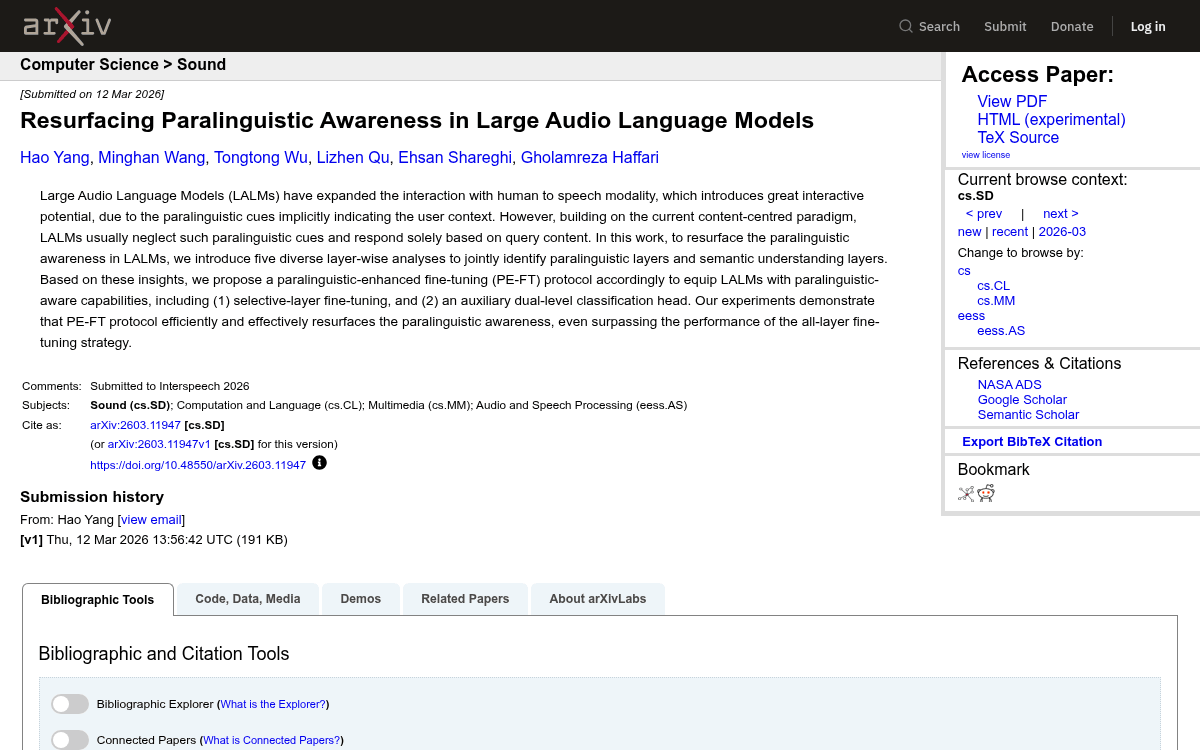
The authors call their method Paralinguistic-Enhanced Fine-Tuning (PE-FT). It teaches Large Audio Language Models (LALMs) like Qwen2.5-Omni and Kimi-Audio to respond differently based on the speaker's age, gender, and emotion, and it does so by touching only about half the model's layers. Code and data are on GitHub.
Why models go deaf to tone
Speech input conveys additional user context beyond query content such as age, gender, and emotion, forming a basis for a model generating appropriate and empathetic responses through the users' paralinguistic attributes. The problem is that current audio models inherited their training recipe from text LLMs, so they optimize for content and treat everything else as noise.
The authors motivate the work with a concrete failure mode they call the child-safety problem. When child users ask about activities that are safe for adults but potentially risky for children, such as electrical safety, LALMs still provide the same step-by-step guidance as they do for adult users, due to the absence of paralinguistic awareness. Ask a voice assistant how to fix a broken lamp in a child's voice and it may cheerfully walk a seven year old through disassembling a plug.
To measure this systematically, the team built a small child-safety dataset covering seven scenarios: electrical, kitchen, height, fire, pet care, medicine, and household chemicals. Text queries were written so the user's age group cannot be inferred through the sample content, then rendered as speech using both child and adult voices from commercial TTS services.
Probing where paralinguistics actually lives
Before proposing a fix, the authors run five layer-wise probes on Qwen2.5-Omni and Kimi-Audio, both 28-layer models. The story that emerges is remarkably clean:
- Layers 0 to 6 carry strong paralinguistic signal. The shaded early-layer region remains a relatively stable and high accuracy, indicating that these layers retain stronger linearly separable paralinguistic signals.
- Layer 7 is a phase change. A noticeable drop is observed at layer 7, after which the accuracy keeps decreasing, eventually reaching a near-random baseline level. The authors attribute this pattern to the current content-centred modality-tuning protocol, which suppresses paralinguistic signals while emphasising speaker-invariant representations.
- Layers 7 to 14 handle semantics. Intent classification accuracy jumps at layer 7 and falls off after 14.
- Layers 15 and up are largely doing next-token prediction plumbing, confirmed via a logit lens analysis.
Two extra probes back this up. An intent-pair cosine similarity test shows semantic separation peaks between layers 7 and 14. And an age-aware analysis finds that in the non-age-declaration setting, the cosine similarity steadily increases across layers 7-14 where semantic understanding would ideally diverge, further demonstrating that content-centred models suppress paralinguistic signals to enforce speaker invariance rather than incorporating speaker age into semantic understanding.
The PE-FT recipe
Armed with that map, PE-FT does two things:
- Selective-layer fine-tuning. Only layers 0 through 14 are trained via a LoRA adaptor, the rest are frozen. This forces the paralinguistic-carrying early layers and the semantic middle layers to talk to each other, without disturbing the deep generation stack.
- Auxiliary Dual-level Classification Head (ADCH). Attached at layer 14, it predicts a primary label (which paralinguistic category the query depends on: age, gender, or emotion) and a secondary label (the specific attribute, e.g. child vs adult, or one of six emotions). It is dropped at inference.
The training objective combines standard cross-entropy fine-tuning loss with the two classification losses at a weight of 0.5. Training data comes from a refined version of the ParaS2S pipeline: 1500 GPT-4.1 generated text queries per category, each rendered with two contrasting speakers, for 9000 audio samples total. The authors perform all experiments on two A100 GPUs, and fine-tuning requires about 70 minutes.
New metrics, because ParaS2S was not discriminative enough
The existing ParaS2S score conflates response quality, wording, and audio tone, so it does not cleanly answer whether a model actually responded to the speaker's paralinguistic context. The authors introduce two sharper metrics scored by GPT-4.1: PA-score ranges from -1 to 1 based on whether the response reflects the correct attribute, and PA-rate is the fraction of responses that get it right.
What the numbers show
Baseline Qwen2.5-Omni scores near zero on PA-score across all three categories, with age at 0.010 and emotion at 0.015. Kimi-Audio is similar. In other words, vanilla models are essentially random with respect to speaker context.
| Model / setting | Age PA-score | Gender PA-score | Emotion PA-score | VoiceBench HS |
|---|---|---|---|---|
| Qwen2.5-Omni vanilla | 0.010 | 0.100 | 0.015 | 73.42 |
| Qwen2.5-Omni all layers | 0.915 | 0.955 | 0.393 | 71.16 |
| Qwen2.5-Omni PE-FT | 0.945 | 0.965 | 0.503 | 72.34 |
| Kimi-Audio vanilla | -0.005 | 0.085 | 0.018 | 76.91 |
| Kimi-Audio all layers | 0.890 | 0.950 | 0.623 | 75.77 |
| Kimi-Audio PE-FT | 0.940 | 0.965 | 0.625 | 76.06 |
Two things stand out. First, fine-tuning fewer layers beats fine-tuning all of them, particularly on emotion where ADCH's fine-grained supervision helps disentangle six emotional states. Second, general capability on VoiceBench holds up better under PE-FT than under full-layer tuning.
The child-safety result is the most striking. On child-voice queries drawn from the safety dataset, vanilla Qwen2.5-Omni and Kimi-Audio produced age-appropriate responses only 7.14% and 4.29% of the time. After PE-FT those numbers jump to 97.14% and 98.57%, and this is despite the child-safety samples never appearing in the training set. Paralinguistic awareness generalizes.
Where it falls short
Generalization to unseen speakers is uneven. On the gender category, PE-FT Qwen2.5-Omni stays above 90% PA-rate with new speakers from unseen TTS systems, but Kimi-Audio drops to 68.5% with one TTS and 75.0% with another. The authors trace this to weaker gender signals in Kimi-Audio's early layers, which the probes had already flagged.
The gender treatment is also deliberately simplified. The authors regard gender as a binary biological category in the experiments and infer it solely from vocal characteristics in speech. This introduces two limitations: vocal cues do not necessarily align with self-identified gender, and vocal characteristics may vary substantially across individuals.
And the emotion category, while the most improved by ADCH, still tops out around a 0.6 PA-score, suggesting six-way emotional distinctions remain genuinely hard for these models.
Why this matters beyond one paper
The broader contribution is the layer-wise diagnostic pipeline. If you accept the finding that audio models keep paralinguistic information in a narrow early band and then actively suppress it during content-centered tuning, then a lot of things become tractable: empathetic voice assistants, age-gated responses in kids' devices, tone-appropriate customer service bots, and safety guardrails that key off vocal stress rather than word content. The technique is cheap, LoRA on two A100s for about an hour, and the required training data can be synthesized from any decent TTS stack.
For anyone building on Qwen2.5-Omni, Kimi-Audio, or similar architectures, the practical takeaway is straightforward. Do not fine-tune the whole stack when you want speaker awareness. Freeze the deep layers, train the early and middle bands together, and add a lightweight classification head at the semantic boundary. The rest of the network already knew how to talk, it just was not listening.