
Monash Builds a Decentralized AI Trick That Cuts Household Energy Costs 25%
Monash researchers show that decentralized AI agents with a globally observable reward signal can break the coordination deadlock in home energy scheduling, even when only a fraction of households adopt them.
 Pro
Takeaways
- Monash researchers frame home appliance scheduling under variable pricing as a social dilemma where selfish RL agents double the optimal cost.
- Their paper uses a repeated 2-player game and replicator dynamics to show cooperative turn-taking only emerges when patience exceeds inconvenience cost.
- They propose an intrinsic reward bonus computed from aggregate demand and price only, with no private preference sharing.
- The shaped reward shifts the evolutionary basin toward cooperation even at low discount factors, cutting costs by around 25 percent.
- Mixed populations still improve outcomes, but non-adopters can free-ride on adopters when patience is low.
- Code is available on request; benchmark builds on the CityLearn demand-response tradition.
When every household in a neighborhood tries to run its dishwasher, EV charger, and air conditioner at the cheapest hour of the day, prices spike, congestion costs climb, and everybody ends up worse off. That is the essence of the demand-side load management (DSLM) problem, and a new paper from Monash University argues it is a textbook social dilemma that will only get worse as consumers start delegating their scheduling decisions to autonomous agents.
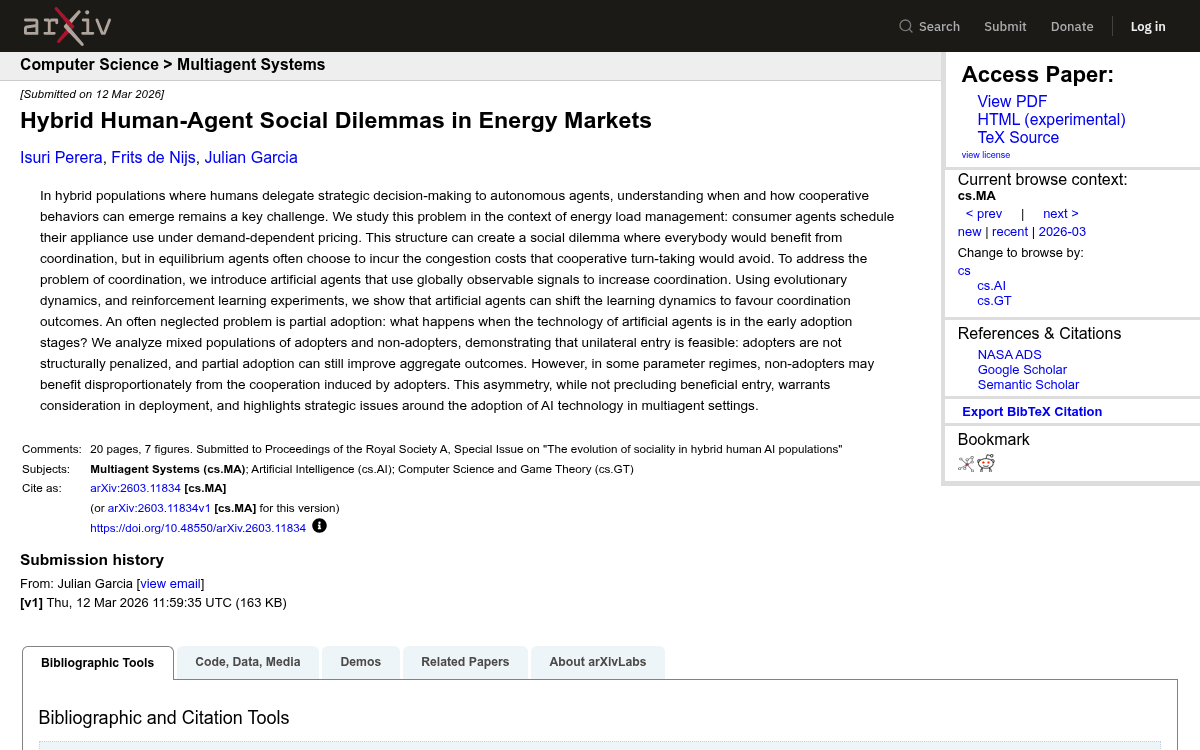
The paper by Perera, de Nijs, and García studies what happens in hybrid populations where humans hand strategic decisions to algorithms. Consumer agents schedule their appliance use under demand-dependent pricing, a structure that can create a social dilemma where everybody would benefit from coordination, but in equilibrium agents often choose to incur the congestion costs that cooperative turn-taking would avoid. Their fix is a decentralized reward-shaping trick that only requires publicly available signals, and their headline finding is that partial adoption still improves the grid.
Why selfish schedulers wreck the grid
Electricity is unusual in that its unit price rises with aggregate demand as more expensive generators are dispatched. If enough consumers all try to shift usage into a cheap window, they trigger the activation of more expensive generators and raise overall costs. Addressing this requires coordination among consumers.
The authors first quantify how badly this breaks under naive learning. Using a centralized MiniZinc solver as a benchmark and a decentralized policy-gradient RL setup as the counterfactual, they show the maximum decentralized cost for a population of 6 agents is more than double the maximum centrally optimal cost. Selfish reward-maximizing agents converge on the Nash equilibrium where everyone crowds their Preferred Start Time, even though a turn-taking arrangement would save money for everyone.
A minimal game that exposes the dilemma
To get theoretical traction, the authors strip DSLM down to a two-player, two-action stage game (stick to your Preferred Start Time, or move Away and pay an inconvenience cost p) and analyze the infinitely repeated version with discount factor δ. Restricting attention to memory-1 strategies yields three Nash equilibria: two non-cooperative ones where both agents always play PST, and two cooperative turn-taking equilibria (labeled PPA and APA) where the agents alternate.
The catch is that turn-taking is only supportable when p < δ, meaning agents must be patient enough that future savings outweigh today's inconvenience. Using two-population replicator dynamics, they run 1000 Monte Carlo simulations and show that at δ = 0.51 the population overwhelmingly falls into the non-cooperative basin, while at δ = 0.95 most trajectories converge to turn-taking. Real consumers, of course, are not infinitely patient.
Reward shaping from public signals only
The core contribution is a payoff-shaping scheme designed for delegated agents that avoids any preference sharing or central coordinator. An agent receives an intrinsic reward bonus only when three conditions hold simultaneously:
- The focal agent actually cooperated (deviated in a way that lowered the price for others)
- The focal agent's own cost is below its running average
- The population's cost is below its running average
The bonus is scaled by a "cost of cooperation" term, defined as the gap between the agent's current cost and what it would have earned by best-responding to everyone else's schedule. Critically, computing this only requires aggregate demand and prices, both of which are broadcast anyway. There is no opponent modeling, no private preference exchange, and no utility-side signaling of the sort used in existing demand-response schemes like CityLearn.
With this shaping term added, the replicator dynamics tell a different story: even at δ = 0.51, the populations reliably converge to the cooperative PPA/APA equilibria. In the full DSLM environment with four appliances per agent, the shaped agents also find the socially optimal Nash equilibrium more consistently, cutting costs by roughly 25% in the p = 0.5 regime.
The free-rider problem, quantified
The more interesting result concerns mixed populations. What happens if only some households install these shaped agents while others stick with vanilla reward maximization? The authors run the two-population replicator dynamics with asymmetric payoff matrices and find:
- Adopters are never structurally penalized. Even a single adopter facing a non-adopter ends up better off than both agents would in the all-selfish baseline.
- Non-adopters, however, capture a disproportionate share of the gains at low discount factors, because the shaped agent is the one paying the inconvenience cost of moving Away.
- Aggregate outcomes still improve with partial adoption, so unilateral entry is viable without waiting for universal rollout.
This is a real strategic insight for anyone deploying delegated agents into a live market. Adopters are not structurally penalized, and if a substantial proportion of market entries consist of such adopters, there is the potential for improved outcomes even for non-adopters. Free-riding is real but it does not kill the deployment case.
Caveats worth knowing
The analysis is deliberately small-scale. The theoretical results rely on a two-player abstraction, and the RL validation is run with 2 agents holding 1 to 4 appliances each. Scaling behavior with hundreds of heterogeneous households, staggered learning phases, and richer appliance mixes is left to future work. The authors also note that their agents do not actively try to teach opponents to cooperate, which is a natural next step. Code and simulation data are available from the authors upon request rather than in a public repo, so reproducing the experiments will take a direct message.
The broader takeaway matters beyond electricity. Any market where humans delegate scheduling or bidding to algorithms, including traffic routing, cloud compute spot markets, and airline pricing, faces the same hybrid-population dynamics. Showing that a decentralized, entry-resilient reward-shaping scheme can shift the evolutionary basin toward cooperation gives designers a concrete tool rather than another impossibility result.