
MojiKit Turns Real Animal Videos Into a Design Language for Social Robots
A CHI 2026 paper turns hours of human-pet video into a design toolkit that lets non-coders script emotional robot behaviors.
 Pro
Takeaways
- MojiKit is a CHI 2026 toolkit for designing pet-inspired affective robot behaviors, grounded in coded video data.
- The paper combines reference cards, a zoomorphic robot MomoBot, and a code-free behavior studio.
- Reference cards were built from 65 human-pet interaction videos, 24 ethology papers, and 5 owner interviews.
- MomoBot uses ESP32 plus Arduino MEGA 2560 with servo-driven ears, head, limbs, and tail.
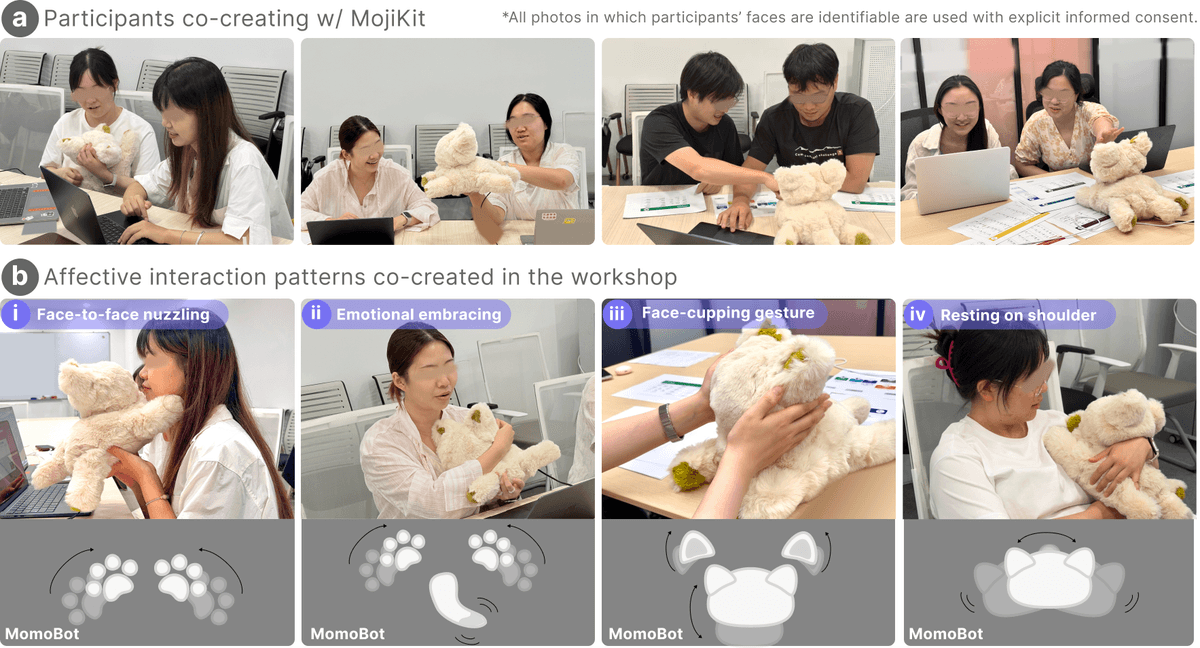
- In workshops with 18 participants, MojiKit produced 35 novel affective interaction patterns beyond personal pet experience.
- Published at CHI '26 with ACM DOI; no public code release yet.
Building a social robot that feels alive is mostly guesswork. Designers watch their own cat, remember how a childhood dog behaved, and hand-code a few tail wags. A new toolkit called MojiKit, presented at CHI 2026, tries to replace that intuition with something closer to a design language, grounded in coded video data of real animals interacting with real humans.
The paper, From Pets to Robots, argues that designing affective behaviors for animal-inspired social robots often relies on intuition and personal experience, leading to fragmented outcomes. The result is a market full of zoomorphic robots (think Aibo, Moflin, various therapy seals) whose behaviors feel narrow because every team reinvents the emotional vocabulary from scratch.
Turning cat videos into a design space
The researchers built their reference material in three stages before writing any robot code. They coded human-pet interaction videos, cross-checked what they saw against ethology papers, then validated the resulting taxonomy with interviews.

That pipeline produced structured reference cards splitting the interaction space into two halves: a human-centric side (why the person is initiating contact, whether it is a request, play, care, or just walking past the animal) and an animal-centric side (how the pet responds physically and emotionally). It is essentially a controlled vocabulary for affective human-robot interaction, similar in spirit to design pattern catalogs in software.
MomoBot and a no-code studio
The hardware side of the toolkit is MomoBot, a small zoomorphic robot with articulated ears, head, limbs, and a tail, driven by servomotors on an Arduino MEGA 2560 talking to an ESP32 for wireless control. It is deliberately generic, more of a movable canvas than a specific animal, so workshop participants can map their designs onto it without being locked into dog-versus-cat semantics.

Sitting on top of the hardware is a Behavior Control Studio, a code-free interface with a preset action library. Instead of writing servo timing loops, a designer composes behaviors by sequencing named actions and emotional beats, then triggering them live on MomoBot. This is the piece that turns the reference cards from a document into something you can actually prototype against in an afternoon.
What the workshop produced
The evaluation ran co-creation workshops with 18 participants. MojiKit helped them design 35 affective interaction patterns beyond their own pet experiences, while the code-free studio lowered the technical barrier and enhanced creative agency. The important word there is beyond: participants generated behaviors they had never personally observed in a pet, which is the whole point of having a data-informed reference rather than relying on memory.
Some of the patterns were prototype-ready on MomoBot as-is; others were flagged as prototype-enhanced, meaning they would need additional sensors or actuators the base robot does not have. That split is itself useful, because it gives hardware teams a prioritized list of what to build next.
Where this fits, and where it does not
If you are working on social robotics, emotional agents, or even virtual pet characters in games, the reference cards are the reusable artifact here. They give a structured way to answer questions like what should the robot do when a person walks into the room without acknowledging it, or how should it respond to a scripted play invitation versus a spontaneous one.
A few honest limits worth flagging:
- The taxonomy is built from 65 videos and 5 interviews, which is enough for a design vocabulary but not a statistical model of animal behavior.
- MomoBot is a generic zoomorph. Behaviors that depend on species-specific morphology (a cat's slow blink, a dog's specific tail geometry) will lose fidelity.
- The studio is code-free, so anything that needs real-time perception, closed-loop control, or reinforcement learning is out of scope, this is for authoring, not autonomy.
- There is no released code or model in the arXiv listing yet, only the paper and figures on the HTML version.
Why it is more than a workshop paper
The quiet contribution is the framing: affective HRI as a design space you can enumerate, rather than a craft you can only intuit. Most consumer social robots ship with a fixed emotional repertoire that grows through internal iteration. A toolkit that decouples the behavior authoring from the hardware, and grounds both in coded observational data, is the kind of infrastructure that lets small teams and researchers explore that space in parallel rather than each starting from their own dog.