
MoHETS Beats 15 Forecasting Models With 21M Parameters and 12% Lower Error
A new sparse Transformer replaces identical MLP experts with a mix of convolutional and Fourier specialists, cutting long-horizon forecasting error by 12 percent.
 Pro
Takeaways
- MoHETS is an encoder-only Transformer with heterogeneous MoE layers, cutting average MSE by 12 percent versus strong baselines.
- Each MoE layer mixes one shared depthwise-conv expert for trends with routed Fourier experts for local periodicities.
- A multimodal cross-attention module injects exogenous covariates like calendar and weather into endogenous patches.
- Convolutional patch decoder replaces linear heads, cutting parameters 42 percent and stabilizing training on long horizons.
- Wins 72 of 72 horizon-level cells across ETT, Weather, ECL, and Traffic benchmarks against 15 baselines.
- Code and four model sizes (0.3M to 21.4M active params) available at github.com/evortigosa/mohe_forecast.
Sparse Mixture-of-Experts models have been the go-to trick for scaling Transformers without blowing up compute, but when you point them at multivariate time series, something weird happens: every expert is the same MLP. That works fine for language tokens, which are all semantically similar bags of embeddings, but time series are stitched together from very different signals - slow-moving trends, sharp periodicities, and noisy spikes - and treating all of them with identical operators leaves accuracy on the table.
MoHETS, a new encoder-only Transformer, tackles this head-on by giving the router a menu of architecturally different experts to choose from. The result: state-of-the-art performance on seven long-horizon forecasting benchmarks, with an average MSE drop of roughly 12 percent against strong baselines like TimeXer, SOFTS, and iTransformer.
Why identical experts fall short on time series
Recent sparse approaches have introduced Mixture-of-Experts to reduce computational overhead, but they inherit the homogeneous expert design of large language models, where every expert is an identical MLP. That is a poor match for what forecasting data actually looks like. Standard MLP experts lack the inductive bias to efficiently separate global trends from local periodicities, a task for which specialized operators such as Convolutions and Fourier Transforms have been mathematically shown to outperform MLPs.
There is also a covariate problem. Real forecasts depend on external context like holidays, weather, or promotions, and most models bolt these on as extra tokens or a simple concatenation. That fails to model how a dynamic time patch actually interacts with a static piece of context like a calendar flag.
Heterogeneous experts, by design
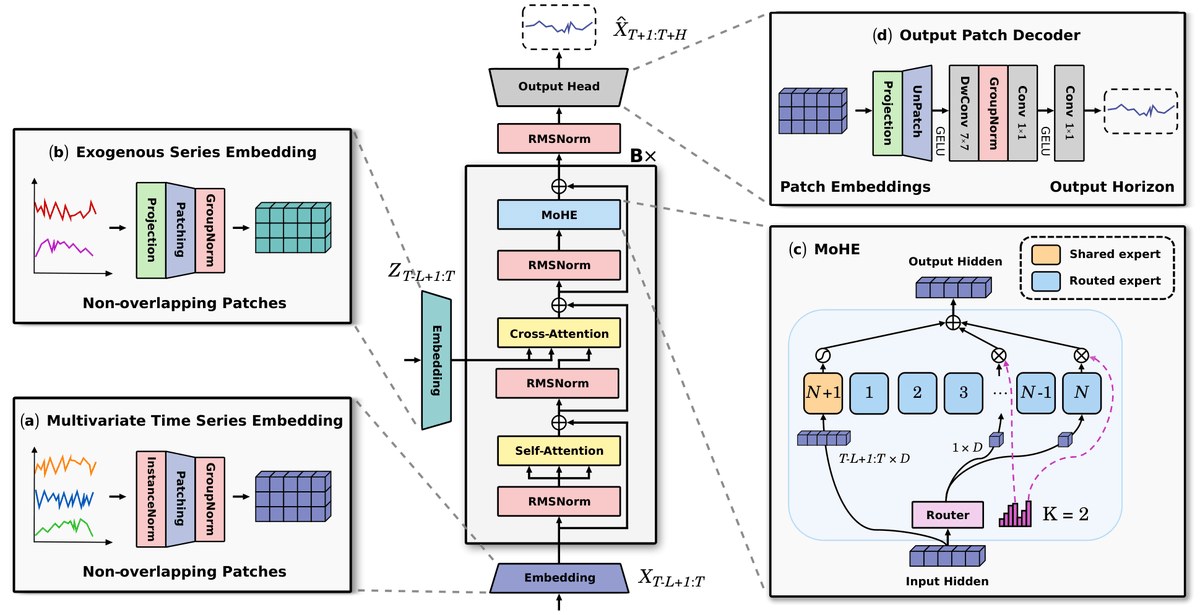
MoHETS replaces the dense feed-forward network inside each Transformer block with what the authors call a Mixture-of-Heterogeneous-Experts (MoHE) layer. Two kinds of expert live inside it:
- One shared depthwise-convolution expert that is always active. It slides across the sequence dimension to preserve continuity and capture long-running trends across patches.
- Multiple routed Fourier-based experts that specialize in frequency-domain analysis. By operating in the spectral domain, these networks isolate high-frequency periodicities within individual patches, a task where standard MLPs often struggle due to spectral bias.
The router picks the top-K experts per patch (K=2 out of 8 in the default config), so most experts stay silent at inference and the compute cost stays modest. The design borrows the trend-seasonality split from classical statistics but learns the decomposition instead of hard-coding it.
How the full pipeline fits together
The encoder-only backbone is built with modern Transformer hygiene: RMSNorm to normalize inputs to each Transformer sub-layer, and Rotary Position Embeddings (RoPE) instead of standard additive positional encodings, so the model can extrapolate to unseen future horizons. Attention uses FlashAttention-2 with grouped-query attention (two query heads share one key/value head) to keep memory in check.
A step-by-step walk through of a forward pass:
- Instance-normalize each variate, then split the look-back window into non-overlapping patches and embed them.
- Run channel-independent self-attention across patches so the model learns dynamics that generalize across variates.
- In a cross-attention block, use the self-attention output as queries and covariate patch embeddings (calendar, weather) as keys and values. This is where semantic context like "this timestamp is a holiday" gets injected.
- Route each patch through the MoHE layer: the shared convolutional expert always fires, plus two selected Fourier experts.
- After B stacked blocks, feed the patch embeddings to a lightweight convolutional decoder that unpatches them back into time points.
That last piece matters more than it sounds. Standard linear heads flatten the patch embeddings, destroying the local temporal structure preserved by the encoder. The parameter count of a linear head scales as O(L times D), leading to parameter explosion and overfitting when the number of variates D increases. Swapping in a ConvNeXt-style convolutional decoder reduced parameters by 42 percent on the Traffic benchmark while improving MSE from 0.418 to 0.406.
Training uses Huber loss (robust to the outliers that routinely destabilize MoE gradients) plus a Switch-Transformer style auxiliary loss to keep experts balanced. Crucially, MoHETS is trained as a one-for-all forecaster: during inference, it employs autoregressive rolling forecasting, predicting a fixed chunk of Ho next steps that gets appended to the input buffer to predict the subsequent chunk. A single trained model handles any horizon in the standard {96, 192, 336, 720} evaluation set.
The numbers
The paper reports results on seven benchmarks - ETTh1, ETTh2, ETTm1, ETTm2, Weather, ECL, and Traffic - against fifteen baselines including iTransformer, PatchTST, TimeXer, TimeMixer, TimesNet, and larger foundation models like Time-MoE, Moirai, and Chronos. MoHETS wins on all 14 dataset-metric cells in the main table, and 72 of 72 in the horizon-level breakdown.
Some standout margins:
- A 12.3 percent MSE reduction relative to TimeXer on ETTh1, 10 percent versus TimeMixer on Weather, and 5.1 percent versus SOFTS on Traffic.
- On the ultra-long 720-step horizon, MoHETS beats TimeXer by 11.7 percent MSE on ETTh1 and 11.2 percent on ETTm1.
- A 15.6 percent reduction in average MSE on Weather compared to Time-MoE-ultra, which weighs in at 2.4 billion parameters versus 21.4 million active parameters for MoHETS-large.
Ablations back up each design choice. Encoder-only beat decoder-only by 8-10 percent MSE. The heterogeneous expert mix outperformed an all-MLP MoE by up to 18.5 percent on Traffic. Cross-attention covariate injection helped most on low-dimensional datasets like ETT where calendar context provides strong non-stationarity signal.
What is actually new
The headline is the 12 percent MSE drop, but the real contribution is architectural: routing is finally doing something a dense model cannot easily replicate, because the experts themselves speak different mathematical languages. A convolution and a Fourier layer have genuinely different inductive biases, so specialization is not just a matter of learning different weights - it is a matter of learning different operators.
Four model sizes are available, ranging from MoHETS-tiny at 0.3M active parameters up to MoHETS-large at 21.4M. All are lighter than current foundation-model baselines and, per the authors, designed for efficient CPU inference. Code is on GitHub.
Where it struggles and what to use it for
The paper is upfront about the limitations. Inference latency grows with d_model and horizon length, especially on high-dimensional datasets rolled out to 720 steps. Long output chunks (Ho=32 and up) can degrade accuracy on coarse-grained hourly data because the model starts overgeneralizing local patterns; the sweet spot the authors landed on is Ho=24. And the model has not been pretrained on a large corpus yet, so foundation models like Time-MoE and Moirai still win on the smallest datasets (ETTh1, ETTh2) where large-scale pretraining regularizes better than in-domain training.
Practically, MoHETS is a strong fit if you have a multivariate forecasting problem with meaningful periodic structure and known future covariates - energy demand with weather forecasts, retail with promotional calendars, traffic with holiday schedules. The single-model any-horizon design also means you do not have to retrain for each prediction length, which is a real workflow win compared with linear-head models that hardcode Ho into their output layer.