
MOGP-MMF Uses Evolution to Beat Hand-Built Protein Prediction Models
Researchers reformulate protein secondary structure prediction as an evolutionary feature-fusion problem, beating deep learning baselines on seven benchmarks including CASP14.
 Pro
Takeaways
- New paper MOGP-MMF reframes protein secondary structure prediction as evolutionary feature-fusion search.
- Combines PSSM, HMM, ProtTrans-T5, and SaProt embeddings across four CNN/RNN extractors as GP inputs.
- Multi-objective GP with knowledge transfer jointly optimizes Q8 accuracy and tree complexity.
- Reports top Q8 and Sov scores across CB6133, CB513, and CASP10 through CASP14.
- Produces a Pareto front, offering lightweight to high-accuracy variants for different deployment budgets.
- Source code released on GitHub for reproducibility.
A new preprint on arXiv proposes a rather unusual take on protein secondary structure prediction: instead of hand-designing another deep network, let genetic programming evolve the fusion formula itself. The method, called MOGP-MMF, is introduced by Yining Qian, Lijie Su, Meiling Xu, and Xianpeng Wang, and it reports state-of-the-art Q8 accuracy across seven benchmark datasets while producing a whole Pareto front of models with different accuracy-complexity trade-offs.
The problem with hand-built pipelines
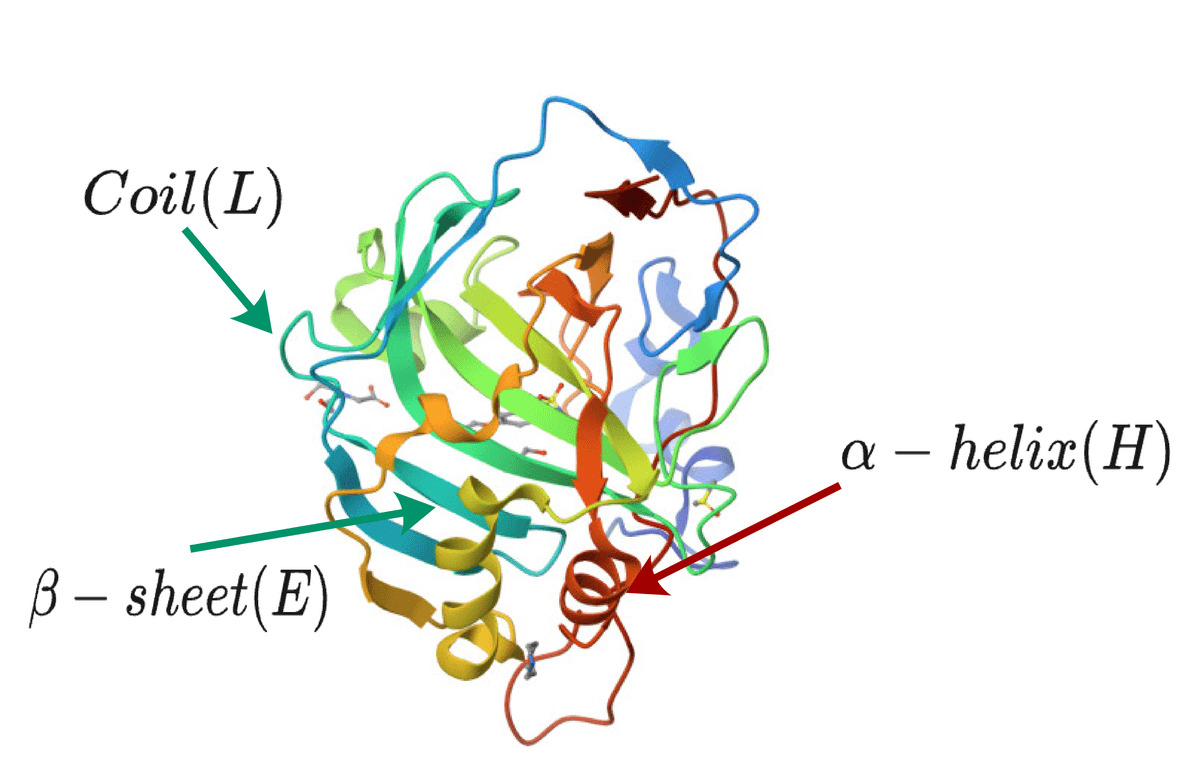
Protein secondary structure prediction (PSSP) assigns each amino acid residue in a sequence to a structural category like alpha-helix, beta-sheet, or coil. Accurate PSSP not only imposes critical constraints for three-dimensional structure modeling but also plays a crucial role in understanding protein function and advancing drug discovery. The eight-state (Q8) version of the task, which distinguishes finer categories like 3_10 helices and beta-bridges, is where most current research focuses.
Recent deep learning approaches range from CNN-RNN hybrids like DeepACLSTM and MUFOLD-SS to transformer-based feature fusers like MFTrans and PSSP-MFFNet. The authors argue these share two weaknesses: most existing models rely on rigid architectures that lack adaptive feature fusion, leading to suboptimal information integration and feature redundancy, and they typically optimize a single accuracy metric while ignoring model complexity, which makes deployment on constrained hardware awkward.
Turning fusion into an evolutionary search
MOGP-MMF reframes PSSP as an automated optimization problem over feature selection and fusion. Genetic programming (GP) is an evolutionary algorithm that evolves programs, typically represented as expression trees, instead of tuning fixed weights. Here, each candidate is a tree that describes how to combine protein features into a prediction.
The framework has three components working together:
- Multi-view multi-level feature extraction (MMF): pulls representations from four sources spanning three views. The evolutionary view uses PSSM and HMM profiles from homologous sequence alignment. The semantic view uses ProtTrans-T5 embeddings. The structure-aware view uses SaProt, which is pre-trained on structure-sequence pairs using the Foldseek structure alphabet, giving it implicit 3D folding information.
- Enriched operator set (EOS): a mix of linear operators (weighted add and subtract) and nonlinear ones like Laplacian of Gaussian filtering, FFT, max pooling, ReLU, and concatenation, which the GP trees can freely compose.
- Multi-objective GP engine: optimizes prediction accuracy and complexity simultaneously using NSGA-II-style non-dominated sorting, producing a Pareto front of solutions instead of one winner.
Each view is fed through four extractors (one or two CNN layers, one or two BiLSTM layers) that end up producing 16 different feature representations before GP takes over.

Knowledge transfer to escape local optima
One recurring headache with multi-objective evolution is that pushing for simplicity can trap the population in low-accuracy basins. The authors address this with a knowledge transfer trick: they first run a single-objective GP (accuracy only) five times, harvest 50 high-performing trees, then inject them into the multi-objective run's crossover pool. A control parameter mu, updated based on how often prior individuals were selected in the previous generation, prevents over-reliance on that prior pool.
During evolution, a least squares classifier stands in for gradient-trained neural heads to keep fitness evaluation cheap, since the heavy lifting already happened in feature extraction.
Numbers on the benchmarks
The team trained on CB6133 and tested on CB513 plus CASP10 through CASP14, comparing against nine baselines including NetSurfP-3.0, AttSec, DeepPredict, and TruMPET. Highlights from the reported Q8 accuracy:
| Dataset | Best baseline | MOGP-MMF |
|---|---|---|
| CB513 | 0.768 (TruMPET) | 0.770 |
| CASP10 | 0.793 (DeepPredict) | 0.805 |
| CASP11 | 0.766 (DeepPredict) | 0.776 |
| CASP14 | 0.692 (NetSurfP-3.0) | 0.690 |
The bigger gain is on Segment Overlap (Sov), which measures whether predicted structural segments line up as continuous chunks rather than scattered correct residues. Ablations show that removing nonlinear operators causes visible bloat, with maximum complexity oscillating between 50 and 60, while EOS keeps trees closer to complexity 40 with better accuracy.
Where it fits and where it hurts
The most practically interesting output is the Pareto front. From the final population of 200 candidates, the authors extract three anchor solutions: a lightweight tree with complexity 15, a balanced knee-point tree at complexity 28, and a heavier tree at complexity 42 that scores best on the hardest CASP12-14 targets. That gives downstream users an actual menu instead of a single black box.
The honest downsides are twofold. The evolutionary process is computationally more intensive than gradient-based training, though the resulting formulas are compact enough to run fast at inference. And performance still leans on the quality of the underlying PLM embeddings, so it inherits any weaknesses of ProtTrans-T5 or SaProt.
The source code is available on GitHub, which is useful if you want to poke at the evolved trees or plug in newer protein language model embeddings as the semantic and structural views.