
MM-Zero Teaches Vision AI to Train Itself With Zero Human Data
MM-Zero trains vision-language models to reason better using zero images, zero labels, and a three-agent loop that writes its own visual curriculum from scratch.
 Pro
Takeaways
- Zero-data VLM training: MM-Zero is the first RL framework to improve vision-language models with no images, labels, or human annotation of any kind.
- Three-agent loop: A Proposer, Coder, and Solver — all from the same base model — co-evolve by generating visual scenes as SVG code and solving reasoning questions over them.
- Consistent benchmark gains: Across Qwen3-VL-4B/8B and MiMo-VL-7B, average accuracy on 10 VLM benchmarks improves by 3-5 points with no external data.
- Reward hacking is the key challenge: Without solvability caps and diversity penalties, agents quickly learn to embed answers in images or collapse to easy visual types like histograms.
- Performance keeps scaling: Accuracy continues to rise past 5 training iterations with no sign of saturation, suggesting room for further self-improvement.
- Open source: Full code, prompts, and training configs are available at github.com/zli12321/MM-Zero.
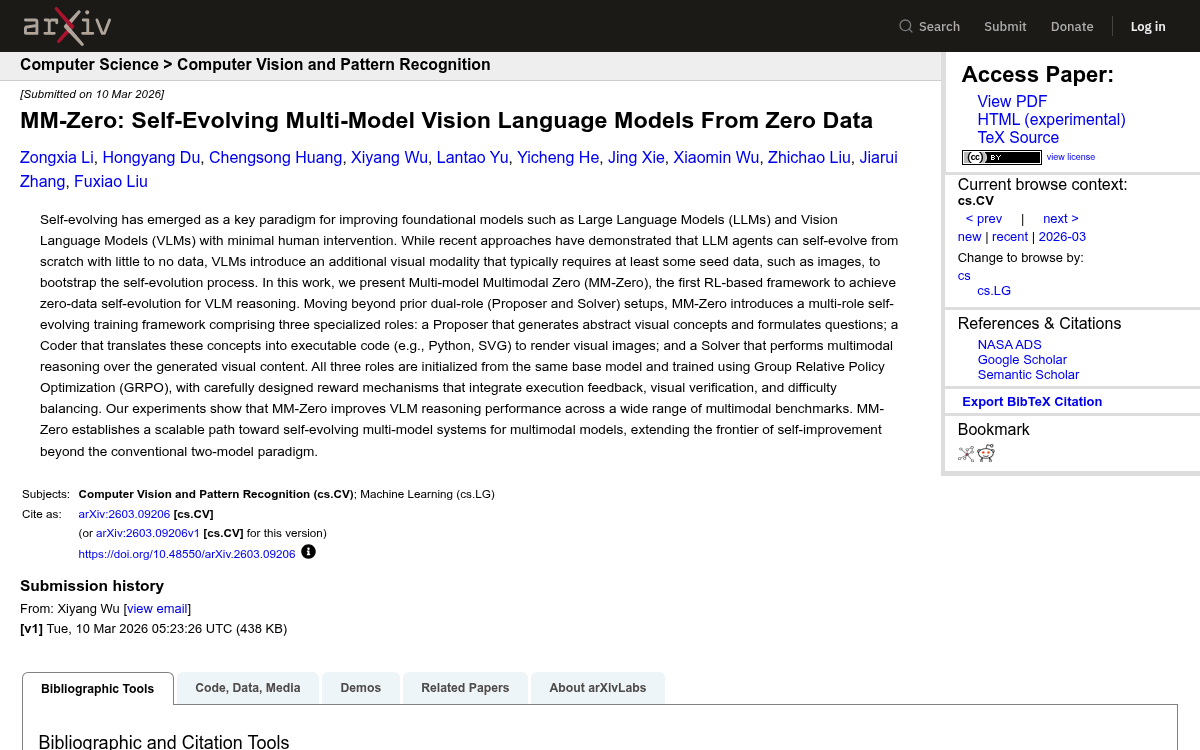
MM-Zero is a new reinforcement learning framework that teaches vision-language models (VLMs) to improve their own reasoning without a single human-labeled image or annotation. Instead of relying on curated datasets, it spins up three specialized agents from the same base model and lets them bootstrap each other, generating progressively harder visual puzzles and solving them in a closed loop.
The wall every VLM self-trainer hits
Self-evolving LLMs have become a serious research direction. Systems like DeepSeek-R1 and related work have shown that language models can generate their own training tasks and improve through reinforcement learning, with no human annotation at all. VLMs introduce an additional visual modality that typically requires at least some seed data, such as images, to bootstrap the self-evolution process.
Existing VLM self-evolution approaches attempt to address this by adapting the proposer-solver pipelines originally designed for LLMs. While this eliminates the need for human-annotated labels, the entire iterative process remains rigidly conditioned on pre-existing, collected static image datasets. That merely shifts the bottleneck from annotation to data collection, which is itself expensive and time-consuming. Approaches like VisPlay and V-Zero still require a corpus of seed images to get started.
Three agents, one base model, no data
MM-Zero is the first zero-data self-evolving reinforcement learning framework that trains VLMs without relying on any external data. Instead of conditioning on existing images, questions, or human labels, MM-Zero enables the model to generate its own visual content, starting from simple scenes and progressively creating more complex ones.
MM-Zero introduces a multi-role self-evolving training framework comprising three specialized roles: a Proposer that generates abstract visual concepts and formulates questions; a Coder that translates these concepts into executable code (e.g., Python, SVG) to render visual images; and a Solver that performs multimodal reasoning over the generated visual content. All three agents are initialized from the same base model checkpoint and trained sequentially using GRPO (Group Relative Policy Optimization), a RL algorithm that ranks multiple candidate responses against each other instead of requiring a separate value network.

How the loop actually works
The pipeline runs in sequential rounds, with each role frozen while the others train. Here is what each agent does:
- Proposer: Given a content-type prompt (charts, geometry, tables, timelines, etc.), it outputs a quadruple: a visual scene description, an easy question with a known answer, and a hard multi-step reasoning question. It is rewarded for generating scenes that are renderable, solvable, and genuinely difficult.
- Coder: Takes the Proposer's scene description and writes SVG markup that renders into a PNG image. It is rewarded for code that executes without errors, produces an image the Solver can actually interpret, and results in a hard-but-not-impossible question.
- Solver: Receives the rendered image and the hard question. Since there is no ground-truth label, it generates multiple reasoning paths and uses majority vote as a pseudo-label (a technique called Test-Time Reinforcement Learning, or TTRL). It is rewarded for agreeing with the consensus answer and for producing a valid chain-of-thought followed by a boxed final answer.
At iteration i, each model evolves from its version at iteration i-1, creating a curriculum that grows in difficulty and diversity over time. The Proposer learns to write richer captions and harder questions. The Coder learns to generate cleaner, more informative SVG. The Solver learns to reason over increasingly complex visuals.
The reward engineering that makes it work
Reward design is where MM-Zero does its most careful engineering. A naive setup quickly degenerates: without constraints, the Coder learns to embed answers directly as visible text in the image, making questions trivially easy and inflating rewards without improving reasoning. The paper addresses this with several interlocking mechanisms:
- Solvability cap: The Proposer's solvability reward is capped at 0.5, so it cannot maximize reward just by generating easy problems. It must also generate hard ones.
- Difficulty score: Peaks when the Solver is maximally uncertain (50/50 on the hard question), incentivizing Goldilocks-level difficulty.
- Easy-Hard penalty: A batch-level penalty fires if the average difficulty score drops below a threshold, preventing the whole batch from collapsing to trivial problems.
- Content diversity penalty: Penalizes over-representation of any single visual type (e.g., histograms) within a batch, using agglomerative clustering on BLEU distances across captions and questions.
The ablation study shows just how critical these are. Without the solvability and difficulty balance factor, the solver improves by only 2.3% over the baseline, compared to 3.9% for MM-Zero. This gap stems from the model disproportionately optimizing for solvability, generating captions that produce easy-to-solve code, while neglecting difficulty. And without diversity rewards, the generated captions and rendered images increasingly converge toward a narrow subset of visual types, such as histograms, which are easy to render and yield higher rendering success rates.
What the numbers show
Results show that across different model sizes, average accuracy on VLM benchmarks steadily improves with additional training iterations. For Qwen3-VL-8B-Instruct, the solver at iteration 3 achieves an average score of 54.1%, compared to 50.7% for the base model, an improvement of 4 percentage points without any data.
The framework was tested on three base models: Qwen3-VL-4B-Instruct, Qwen3-VL-8B-Instruct, and MiMo-VL-7B-SFT. Results across all 10 benchmarks:
| Model | Base Avg. | MM-Zero Best Avg. | Gain |
|---|---|---|---|
| Qwen3-VL-4B-Instruct | 50.2 | 53.5 | +3.3 |
| Qwen3-VL-8B-Instruct | 50.7 | 54.1 | +3.4 |
| MiMo-VL-7B-SFT | 50.9 | 56.1 | +5.2 |
The largest gains are on visual math tasks, which demand more intensive reasoning. These results demonstrate the effectiveness of MM-Zero at improving VLM reasoning without any external data. The 4B model benefits least, which the authors attribute to its weaker base code generation ability: its image rendering success rate starts at only ~40%, compared to ~70% for the 7B and 8B models, meaning it produces fewer valid training samples per iteration.
Crucially, performance does not plateau. Beyond the initial three iterations, continuing training for two additional iterations shows that solver performance does not saturate, with average accuracy continuing to improve. This raises an open question the authors flag directly: how far can a model self-evolve before hitting a ceiling with no human supervision?
What this unlocks, and where it falls short
The practical implication is significant for anyone trying to improve a VLM in a domain where labeled visual data is scarce or expensive. MM-Zero could, in principle, be applied to specialized domains like medical imaging schematics, engineering diagrams, or scientific plots, as long as the Coder can render relevant visual content programmatically. The framework is also model-agnostic: it worked across two different model families without architectural changes.
The limitations are real, though. The primary limitation is that the scaling trend could not be validated on larger VLMs (e.g., 38B parameters) due to prohibitive computational cost, leaving the full scaling behavior of self-evolving training as an important direction for future work. The current Coder only generates SVG, which constrains the visual complexity and realism of training images. Real-world photographs, 3D scenes, and video remain outside the loop. There is also an implicit ceiling set by what SVG can express, meaning the Solver is never exposed to the messy, ambiguous visuals it will encounter in deployment.
Code and models
The code is available at github.com/zli12321/MM-Zero. The repository includes training scripts, prompt templates for all three roles, and the full rendering pipeline. Training was conducted on 8 RTX 6000/Pro 96GB GPUs, with full fine-tuning (no LoRA) across all three agents. The full Qwen3-VL-8B-Instruct setup has approximately 8.77B trainable parameters.