
Mitsubishi Electric's Neural Radio Localizer Hits 0.01 cm Errors Without Giant Databases
A physics-informed neural network doubles as a generative channel model, replacing bulky fingerprinting databases and pushing radio localization below one wavelength.
 Pro
Takeaways
- A physics-informed neural network learns location-to-channel mapping, then acts as a generative database for radio localization.
- Median error drops to 0.01 cm outdoors and 0.06 cm in NLoS indoor scenes at 3.5 GHz.
- Memory shrinks from 485.2 Mb (k-NN dictionary) to 36.4 Mb of network weights, a 13x reduction.
- Bi-level grid search plus circle sampling escapes wavelength-spaced local minima in the loss landscape.
- Works with a single base station and stays robust at 5 dB SNR and sparse training density.
- Limited to static scenes and ray-traced data; real measurements and time-varying environments are future work.
Locating a phone or a robot with radio waves usually forces engineers to pick their poison: pay for accuracy with a giant database of pre-measured channel signatures, or accept meter-scale errors when walls and metal cabinets scatter the signal. A new paper from researchers at Mitsubishi Electric, INSA Rennes, Chalmers University and b<>com sidesteps that trade-off by turning a small neural network into an on-demand replacement for the database itself.
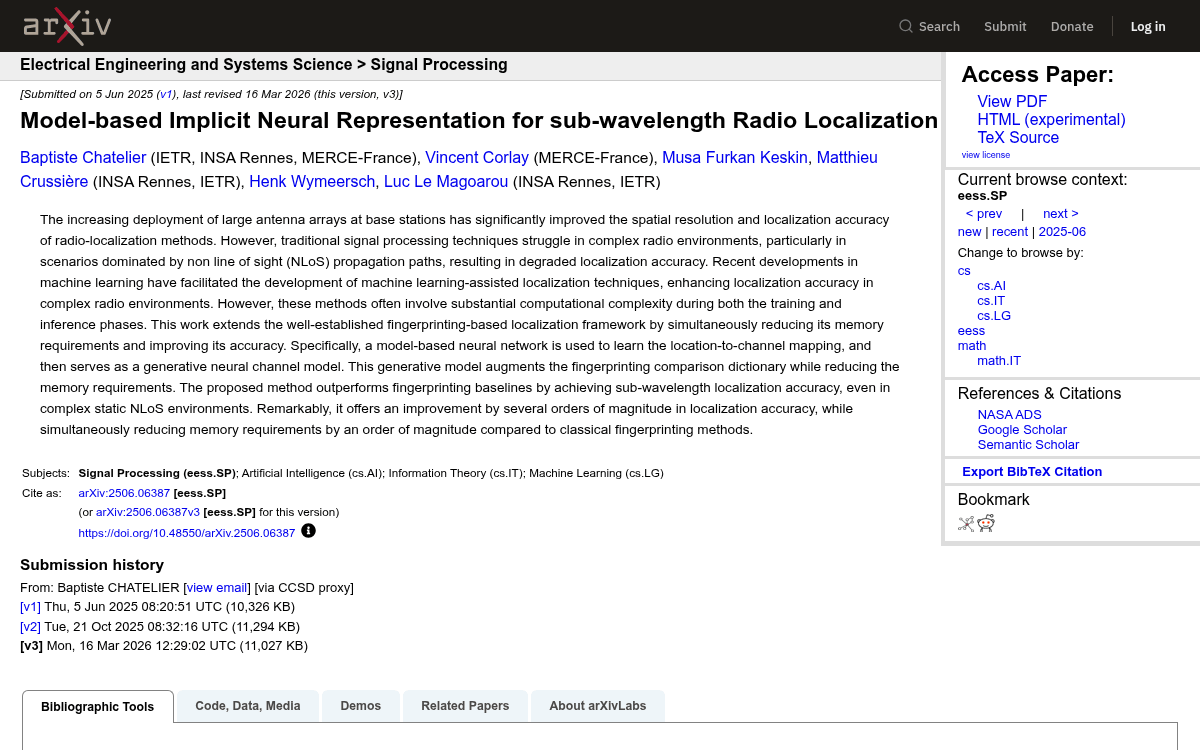
The result, described in Model-based Implicit Neural Representation for sub-wavelength Radio Localization, reaches median errors as low as 0.01 cm at 3.5 GHz, roughly a thousandth of the carrier wavelength, while cutting memory use by an order of magnitude compared with classical fingerprinting.
Why fingerprinting hits a wall
Fingerprinting works by recording the channel between a base station and many known locations, then matching a new measurement against that dictionary. It handles messy multipath environments where geometric methods like angle-of-arrival collapse, but the accuracy is tied to how densely you sample space. Halving the error in a 2D scene means quadrupling the number of stored reference points, so pushing beyond sub-meter accuracy quickly becomes a storage and measurement-campaign nightmare.
Recent deep-learning localizers do better in complex indoor scenes, cutting the 90th percentile error from roughly 15 m to 1-5 m in 3GPP evaluations, but they still lean on channel measurements from multiple base stations and heavy neural architectures during both training and inference.
A neural network that plays channel model
The core trick is to train an implicit neural representation, a coordinate-based MLP variant, to learn the mapping from a location x in the scene to the full uplink channel matrix H(x). The architecture is not a generic MLP: it decomposes the channel into a sparse combination of steering vectors, frequency responses, and planar wavefronts, mirroring the physics of ray propagation. That inductive bias is why the network can interpolate between training points at wavelength resolution instead of memorizing them.
Once trained, the network becomes a generative channel model. Instead of storing a fixed dictionary, the localizer synthesizes a candidate channel at any query location on the fly and searches for the one that best matches the observed measurement. The whole thing runs against a single base station.

Fighting local minima with circles
Naively minimizing the difference between the measured and predicted channel would work if the loss landscape were smooth, but it is not. The authors prove that consecutive minima of the phase-sensitive Frobenius distance are separated by roughly the central wavelength, so gradient descent tends to get stuck one or two wavelengths away from the true position.
Their algorithm sidesteps this in four stages:
- A coarse global grid search picks a starting region, optionally using a phase-insensitive loss that produces a smoother landscape.
- A finer local grid search refines the estimate.
- Gradient descent through the differentiable neural channel model converges to a local minimum.
- Candidate points are sampled on circles of radius
kλ₀ around that minimum; if any beats the current loss, a second gradient descent runs from there.
The circle step is essentially a model-based annealing move, jumping between the periodic basins predicted by the theory rather than searching blindly.

What the numbers look like
Experiments use Sionna ray-tracing across three scenes: an outdoor block of Paris and two indoor rooms with metallic obstacles, one of which has no line of sight for about half its locations. The base station has 64 antennas and 64 subcarriers around 3.5 GHz, giving a central wavelength of about 8.57 cm.
| Method | Median error (outdoor) | Median error (hard NLoS) | Memory |
|---|---|---|---|
| 3-NN fingerprinting | ~10 cm range | sub-meter | 485.2 Mb |
| MLP baseline (22M params) | tens of cm | meters | large |
| Off-grid (PI) proposed | 0.01 cm | ~0.06 cm | 36.4 Mb |
The proposed method beats fingerprinting baselines by two to three orders of magnitude in median localization error while storing only the 9.1 million parameters of the network. It is also robust: at a 5 dB SNR the boxplots barely shift, and training density can drop below one sample per squared wavelength before performance degrades noticeably.
What it is good for, and what it is not
The setup is a strong fit for quasi-static environments like smart factories, where automated guided vehicles need centimeter-scale positioning and the room layout changes rarely. Because the trained network becomes a compact digital twin of the propagation environment, the same model could be used to detect environmental changes by watching for a sudden rise in channel prediction error.
Limitations are honest and well documented:
- The scene is assumed static. Any new obstacle that changes the multipath structure requires retraining or online adaptation.
- Evaluation uses ray-traced channels, not real measurements. The authors flag transfer learning from ray-tracing to measured data as future work.
- Inference is slower than classical k-NN. The optimized off-grid variant averages around 1.75 seconds per location on an A40 GPU, versus 10 ms for 3-NN.
- In heavy NLoS regions the phase-sensitive loss landscape becomes chaotic and the circle trick reaches its limits.
The paper does not currently link a public code release, but it builds on the authors' earlier location-to-channel mapping architecture, which spells out the network design in enough detail to reimplement. For anyone working on 6G integrated sensing and communication, this is a concrete argument that model-based neural networks can replace measurement dictionaries entirely, not just accelerate the search through them.