
MIT Teaches GPT-4o-mini to Predict What Sentences Humans Remember
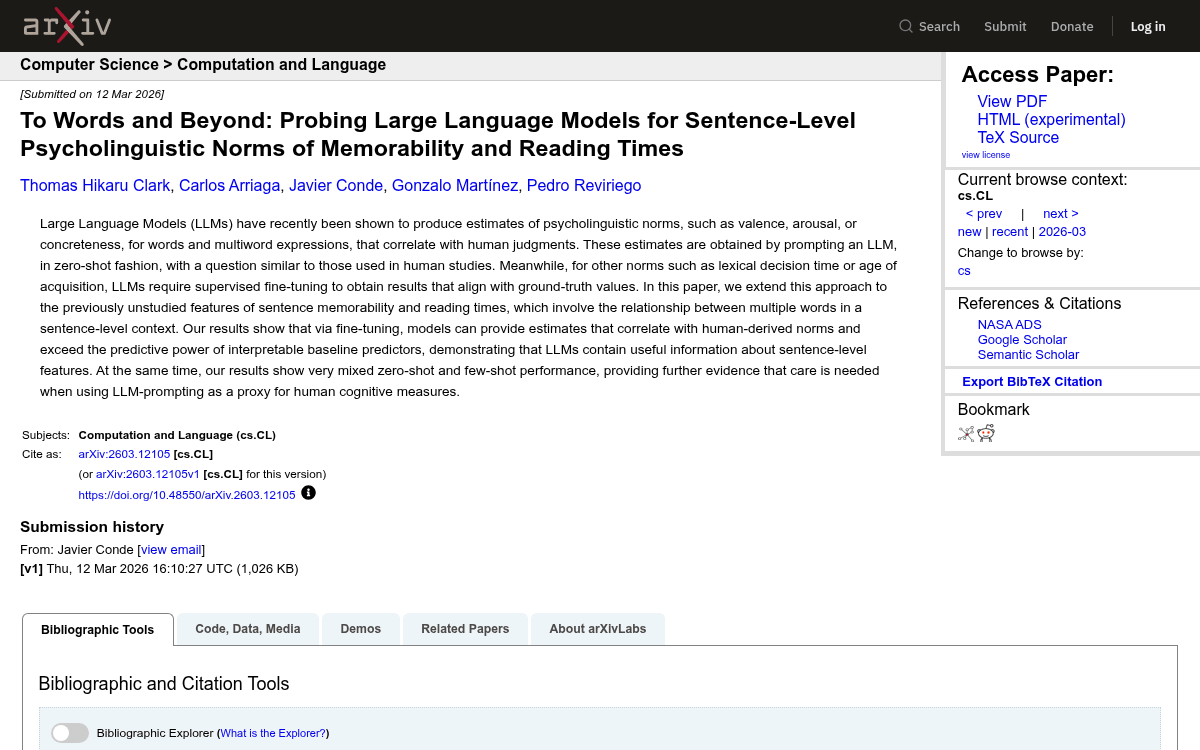
MIT and UPM researchers show fine-tuned LLMs can predict how memorable a sentence is and how long a word takes to read, but zero-shot prompting fails badly on memorability.
 Pro
Takeaways
- Fine-tuned LLMs predict sentence memorability with R-squared 0.45 to 0.49, beating interpretable baselines at 0.32.
- Word memorability fine-tuning hits R-squared 0.53 to 0.59, versus 0.28 for meaning, synonym and frequency baselines.
- Zero-shot prompting fails for memorability entirely but reaches R-squared 0.27 on eye-tracking reading times.
- GPT-4o-mini, Gemma-3-27b, and Qwen3-32b work; Llama-3.1-8b produced unusable output and was dropped.
- Datasets are public: sentence memorability, Natural Stories, OneStop.
- Full paper argues fine-tuning decodes latent knowledge rather than learning norms from scratch.
A new paper from MIT and Universidad Politécnica de Madrid pushes LLMs into psycholinguistic territory that has resisted them until now: predicting properties of whole sentences, not just isolated words. The authors probe two hard-to-collect human measures, sentence memorability and per-word reading times, and find that a few hundred fine-tuning examples can turn GPT-4o-mini and open models into surprisingly strong predictors of human behavior. Zero-shot prompting, on the other hand, mostly falls flat.
Why words were easy and sentences are not
Recent work has shown that if you ask an LLM to rate a word for concreteness, valence, or arousal, the answers line up reasonably well with human norms. Prior work indicates that LLMs are able to predict word-level features such as concreteness or valence, age of acquisition, and lexical decision times, as well as for multi-word expressions. But those norms live at the level of a single token. Sentence memorability and reading times are compositional. As the authors put it, one of the most memorable sentences in a prior study is "Does olive oil work for tanning?"; the memorability of this sentence cannot simply be reduced to the sum of word-level features, but involves the compositional meaning of the words in relation to each other.
There is also a known trust problem with zero-shot prompting for cognitive measures. Some evidence points to a lack of introspection in LLMs, where their responses to prompts are not necessarily consistent with their latent knowledge that can be accessed in other ways, such as by inspecting token log-probabilities rather than directly prompting. That gap is exactly what fine-tuning is supposed to close.
The setup
The team ran three regimes, zero-shot, three-example few-shot, and supervised fine-tuning, across four public datasets:
- Word memorability from Tuckute et al., 2109 English words with empirical memorability scores from a repeat-detection experiment.
- Sentence memorability from Clark et al., 2500 English sentences scored via the same repeat-detection paradigm.
- Self-paced reading times from the Natural Stories Corpus, 433 sentences totalling 10,256 words.
- Eye-tracking gaze durations from the OneStop Corpus, 1,213 sentences with 36,120 words.
Models tested include GPT-4o-mini-2024-07-28, Llama-3.1-8b-Instruct, Gemma-3-27b-it, and Qwen3-32b, with the larger open models loaded in 8-bit for fine-tuning. The other models were fine-tuned locally using LoRA, training only a small number of low-rank adapters rather than the full weights. Fine-tuning used 25% of each dataset for training and the remaining 75% for evaluation, with three epochs. Notably, Llama did not respond consistently to the standard prompts, sometimes writing code or producing other unusable output, and its results were dropped.
What the numbers say
The gap between prompting and fine-tuning is stark. For memorability, zero-shot and few-shot outputs are essentially noise. Fine-tuned models achieve R-squared values of 0.53 to 0.59 on word memorability, exceeding the mean R-squared of 0.28 from the combined baseline predictors of number of meanings, number of synonyms, and frequency. For sentence memorability, fine-tuned models reach R-squared values of 0.45 to 0.49, versus 0.32 for the combined baseline of Sentence-BERT distinctiveness, average word memorability, and average word frequency.
Reading times split into two very different stories. On the Natural Stories self-paced reading data, zero-shot correlations sit at 0.02 to 0.05, and fine-tuned R-squared climbs to 0.15 to 0.21, higher than the 0.08 from combined scalar baselines and roughly on par with a linear model over contextual BERT embeddings. Eye-tracking is where LLMs already know something without training: the zero-shot model reaches R-squared of 0.27, few-shot 0.35, and fine-tuned models span a wide 0.08 to 0.57 range. The authors suspect this is because the features that correlate strongly with reading times are relatively simple, such as length, frequency, and predictability given preceding context, which may be particularly well-aligned with the next-word prediction training objective of LLMs.
The real story: fine-tuning as decoder, not learner
The finding worth internalizing is not that fine-tuning helps, it is what fine-tuning is actually doing. The rich distributed representations of words produced by language models appear to encode sufficient information about a diverse range of psycholinguistic behavioral measures, such that fine-tuning on a small dataset enables reliable decoding of these features from existing model representations, rather than learning the relationship from scratch. A few hundred labeled examples is enough because the model already has the signal internally, it just cannot verbalize it when asked directly.
There is also a domain-specific caveat. The features that make words and sentences memorable may not be obvious or transparent, consistent with findings from the memorability literature showing that humans themselves are poor judges of memorability in domains such as images. So it is not surprising that LLMs, trained largely to mimic surface human judgments, also struggle with memorability in zero-shot mode.
Practical uses and honest limits
The concrete payoff is for anyone building linguistic stimuli or curating text where you want to control for how sticky or hard-to-read it is. The method offers a way to develop predictive models that can estimate psycholinguistic norms for held-out data, useful in settings such as the development of experimental materials, for example ensuring matched control stimuli. It is also plausibly useful for content teams filtering headlines, ad copy, or educational material by predicted memorability without running behavioral studies.
The caveats are worth taking seriously. Results cover English only, Llama-3.1-8b broke on the task entirely, and for Gemma and Qwen on eye-tracking data, predictions from fine-tuning underperform zero-shot and few-shot predictions, indicating a failure of the fine-tuning process to elicit humanlike reading-time predictions. The authors close with a call for caution: practitioners must be wary of trusting the zero-shot predictions of LLMs on psycholinguistic norming tasks, and careful validation against human data is recommended.
All four datasets are public. The word memorability data and sentence memorability data are MIT-licensed on GitHub, the Natural Stories Corpus is on the languageMIT GitHub under CC BY-NC-SA 4.0, and OneStop is on OSF under CC BY 4.0, which is enough to reproduce the pipeline end to end.