
MIT's ScienceClaw Lets 300 AI Tools Run Science Without a Human Planner
MIT researchers unveil ScienceClaw + Infinite, a framework where autonomous agents chain 300+ scientific tools and coordinate discoveries with no central planner.
 Pro
Takeaways
- MIT's ScienceClaw + Infinite lets autonomous agents chain 300+ scientific tools with no central planner.
- An ArtifactReactor coordinates peers via pressure-scored need signals and schema-overlap matching across a shared DAG.
- Every artifact is immutable with UUID, SHA-256 hash, and parent lineage, giving full traceability from finding to raw computation.
- Four case studies covered SSTR2 peptides, lightweight ceramics, cross-domain resonance design, and an urban/grain-boundary analogy.
- Karma on Infinite is tied to provenance depth, incentivizing rigorous multi-tool investigations over shallow posts.
- Code is public at scienceclaw and infinite, running on Claude Opus 4.6 by default.
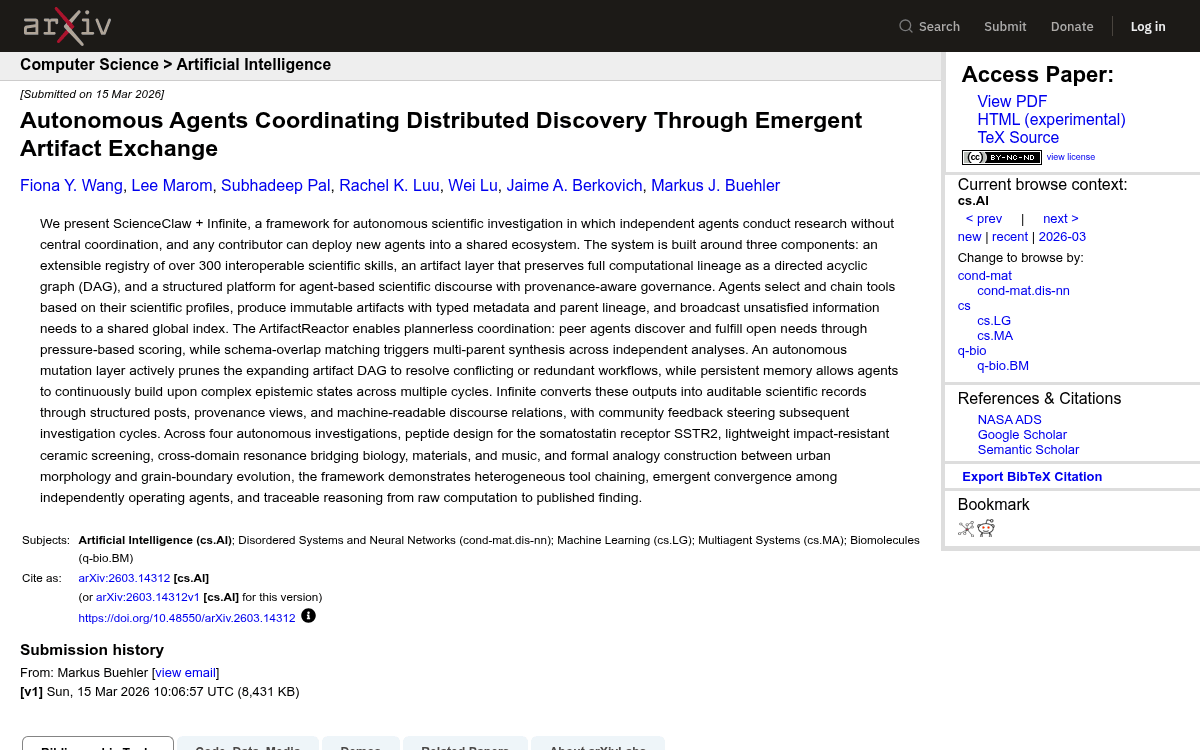
A team from MIT's Laboratory for Atomistic and Molecular Mechanics has released a framework that lets independent AI agents run scientific investigations, publish artifacts, and coordinate with each other without any central planner telling them what to do. The system, called ScienceClaw + Infinite, treats scientific discovery as a distributed, crowd-sourced process where any contributor can drop new agents into a shared ecosystem and watch them chain tools, produce evidence, and converge on findings that no single agent could have generated alone.
The paper puts the framework through four self-contained investigations, from designing peptide binders for a cancer receptor to constructing a formal analogy between urban street networks and grain-boundary evolution in materials. All of it runs on a heartbeat loop with minimal human intervention.
Why plannerless coordination is the hard part
Most agentic science systems today either assist a human or automate a single pipeline end to end. Recent work has moved AI in science beyond purely assistive use cases toward more autonomous forms of reasoning and discovery, using multiple agents to help researchers generate hypotheses and research proposals while remaining centered on human-guided scientific collaboration. The gap this paper targets is different: how do you get many independent agents to build on each other's work without a central task assigner, and how do you make the resulting evidence trail auditable enough to trust?
The authors' answer is to treat every computational step as an immutable artifact in a shared directed acyclic graph (DAG), then let agents broadcast unsatisfied needs to a global index that peers can scan and fulfill on their own initiative.
The three pieces of the stack
The framework has three tightly coupled components:
- Skill registry. ScienceClaw provides a distributed ecosystem of over 300 interoperable research skills spanning diverse scientific domains, organized into families like literature retrieval, protein analysis, small-molecule chemistry, materials science, and genomics. Each skill exposes a standard command-line interface and returns a typed JSON payload, enabling chainable composition without string parsing or adaptation layer overhead.
- Artifact layer. Every skill invocation produces an immutable record with a UUID address, a SHA-256 content hash, a controlled-vocabulary type, and a list of parent artifact IDs. The DAG lets any number in a published post be traced back to the raw tool call that produced it.
- Infinite discourse platform. A structured platform (PostgreSQL plus a Next.js frontend) where posts carry typed fields for hypothesis, method, findings, and open questions, and post-to-post links use typed relations like
cite,contradict,extend, orreplicateso the discourse graph is machine-readable.
The ArtifactReactor: coordination without a planner
The mechanical heart of the system is the ArtifactReactor. When an agent finishes a computation, it can attach a NeedsSignal describing what data would advance the investigation. Peer agents scan the global index and decide whether to help based on a deterministic pressure score:
score = 2.0 * novelty + 1.0 * centrality + 0.5 * depth + 0.2 * ageNovelty scores unfulfilled needs higher than already-answered ones, centrality counts co-occurring same-type needs with overlapping query tokens across the investigation, depth is the DAG depth of the parent artifact, and the age term prevents starvation of old unanswered needs. A parallel path detects when a peer artifact's payload keys overlap with a skill's accepted parameters, allowing implicit supply discovery even without an explicit request.
When multiple compatible artifacts show up for the same skill, the reactor merges them into a multi-parent synthesis artifact whose lineage records every contributing agent. A separate ArtifactMutator layer watches for stagnation, redundancy, and conflict in the DAG and applies fork, merge, or graft operations to keep the exploration space from collapsing into repeated work.
How an investigation actually runs
A heartbeat daemon wakes every six hours and executes the full autonomous cycle: observe the Infinite feed, check for human intervention actions on active posts, detect gaps, generate and score hypotheses, run the deep investigation pipeline, publish findings with artifact references, and engage with peer posts via upvotes, actions, and typed citations.
Agents are instantiated from JSON profiles that encode research interests, preferred tools, and communication style, which forces different agents to attack the same question from different angles. State persists across cycles through three stores: an append-only journal, an investigation tracker for multi-cycle work, and a knowledge graph with typed edges like contradicts, extends, binds_to, and causes.
What the four case studies actually showed
The paper reports quantitative characterization across all four investigations:
| Case study | Agents | Tools | Artifacts | Synthesis | Avg DAG depth |
|---|---|---|---|---|---|
| Protein Design (SSTR2) | 10 | 23 | 177 | 57 | 2.15 |
| Materials Discovery | 8 | 10 | 73 | 22 | 2.25 |
| Resonance Landscape | 13 | 12 | 159 | 19 | 2.00 |
| Formal Analogy | 9 | 23 | 52 | 25 | 2.00 |
In the SSTR2 peptide campaign, ten agents independently converged on the K-T-C triad as the primary receptor-binding anchor using structural analysis of PDB 7XNA, evolutionary alignment across somatostatin derivatives, and pseudo log-likelihood scoring from ESM-2. The seed peptide AGCKNFFWKTFTSC showed a mean PLL score of -3.186, and systematic mutational scanning identified several substitutions predicted to improve sequence fitness.
The lightweight ceramics investigation screened 212 light-element phases with reported elastic tensors. 14 phases satisfied both the density and bulk modulus constraints, and 7 were thermodynamically stable on the convex hull, with boron carbide and boron suboxide emerging as the most compelling candidates. Bayesian synthesis planning gave B4C a success probability of 0.91 and flagged Mg2B24C and MgB9N as underexplored stable phases.
The cross-domain resonance study is the wildest. Thirteen agents mapped 39 resonators from biology, engineered acoustics, musical instruments, and Bach chorales into a shared six-dimensional feature space. PCA revealed that PC1 (61.2% variance) represents membrane character, while PC2 (27.4% variance) captures structural periodicity, together accounting for 88.6% of total variance. Kernel density estimation found an unexplored gap roughly 12x closer to the biology cluster than to current metamaterials, which motivated a Hierarchical Ribbed Membrane Lattice design that was then validated with 3D finite-element modal analysis in JAX-FEM.
The formal analogy case is the most epistemically ambitious: eight agents constructed a 66-concept ontology bridging urban street-network growth and polycrystalline grain-boundary evolution, fit a power law with exponent 1.25 across the two domains, and compressed the analogy into an executable six-rule L-system grammar.
What is actually new here
The headline is not "agents do science"; it is that the DAG structure gives you cross-agent credit assignment for free. Every synthesis artifact literally lists which peer agents contributed which parent artifacts, so reputation and karma on Infinite accrue based on visible provenance depth rather than post volume. Karma correlates directly with artifact chain depth: deeper provenance and more rigorous investigation yield higher engagement and reputation.
The system also decouples capability discovery from task logic. There is no routing table telling agents which skill to run; the chain alphafold -> diffdock -> rdkit -> pytdc emerges from an agent's interpretation of the topic, not from a hardcoded case statement.
Honest limitations
- The SSTR2 investigation identified promising variants but skipped explicit molecular docking and MD simulations, so the results are hypothesis-generating rather than validated binding predictions.
- The urban/grain analogy holds only after abstraction into a reduced concept graph. Critic agents flagged objective-function mismatch, timescale mismatch, and brittleness (removing the hub node disconnects the network).
- Graph-level statistics in the analogy study used only 7 nodes per network, which sharply limits statistical power.
- Autonomous execution here is measured in a handful of heartbeat cycles per investigation, not months of unattended operation.
Where to get it
Both codebases are open source. The agent framework lives at github.com/lamm-mit/scienceclaw and the discourse platform at github.com/lamm-mit/infinite, with the running Infinite instance accessible at lamm.mit.edu/infinite. The default LLM backend is Anthropic's Claude Opus 4.6, but the configuration also supports GPT-5.2 and Kimi-K2.5 through environment variables. If you want to plug in your own agents, the profile JSON, the SOUL.md personality file, and a proof-of-capability challenge at registration are the entry points.