
MIT's RiskMV-DPO Teaches Self-Driving AI to Simulate Dangerous Crashes on Demand
A new pipeline turns collision risk into a controllable input for diffusion video generators, synthesizing rare crash-like scenarios on demand for autonomous driving training.
 Pro
Takeaways
- RiskMV-DPO turns collision risk into a controllable input for multi-view driving video diffusion, generating rare hazards on demand.
- A physics-based per-frame risk score conditions a GENAD trajectory generator via FiLM modulation to synthesize target-risk motions.
- Geometry-Appearance Alignment injects VGGT-derived 3D priors into diffusion training for metric-level cross-view consistency.
- Region-aware DPO with motion-aware masking focuses preference learning on dynamic regions instead of static backgrounds.
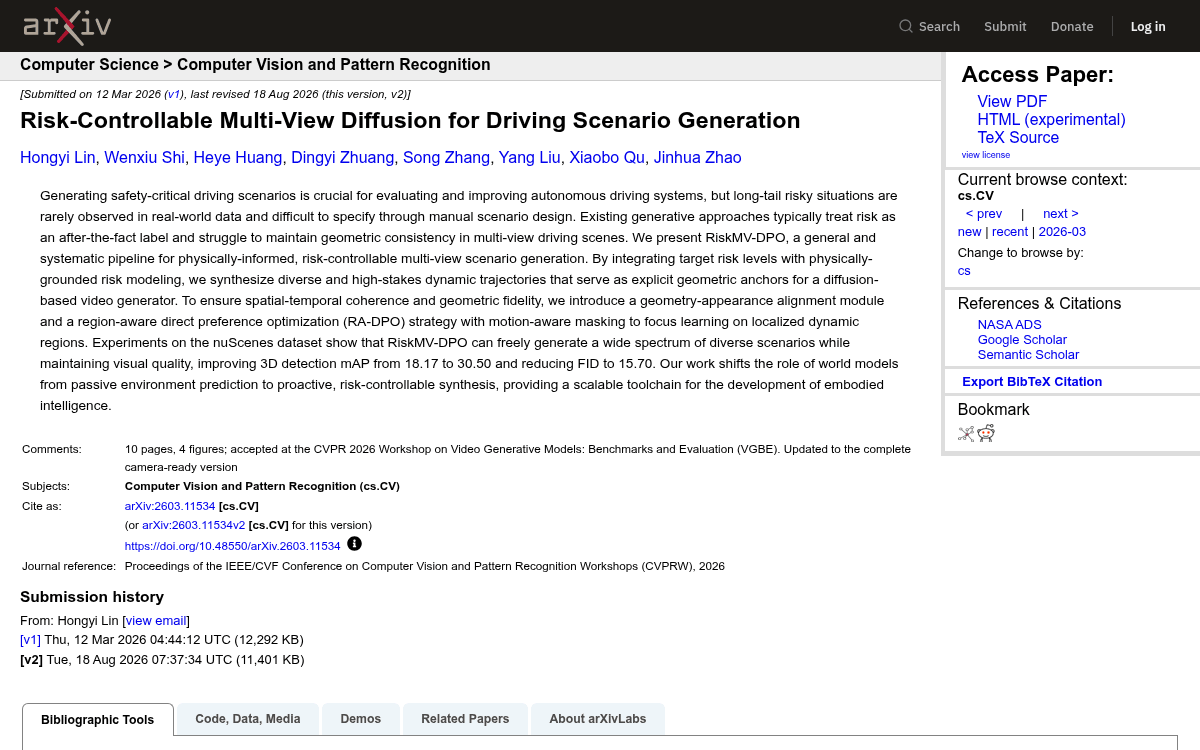
- On nuScenes, it improves 3D detection mAP from 18.17 to 30.50 and cuts FID to 15.70.
- Code and qualitative samples are available on GitHub for the MagicDrive-STDiT3 backbone.
Training self-driving systems on truly dangerous situations is a chicken-and-egg problem. The most valuable data, near-collisions, blind-spot conflicts, aggressive left turns, barely shows up in real driving logs, and hand-authoring these scenarios in a simulator quickly runs into the limits of what a human can imagine. A team from Tsinghua, MIT, and SMART has proposed RiskMV-DPO, a pipeline that treats collision risk itself as a dial you can turn on a multi-view video diffusion model.
The core idea is small but consequential: instead of generating a huge pile of driving clips and filtering for rare hazards afterward, you specify the risk level up front and the system synthesizes trajectories, 3D bounding boxes, and camera video that match that target.
Why long-tail generation keeps breaking
Existing approaches either mine rare events from large generated pools, where truly high-risk situations occur with extremely low probability, or handcraft scenarios by specifying parameters like near-collisions. Both routes bake in human priors and miss the non-intuitive interactions that actually cause crashes. On top of that, driving scenes are multi-camera and outdoors, so any generator has to keep geometry consistent across views under occlusion, fast motion, and changing light, something diffusion models are notoriously fragile at.
The authors argue this needs two fixes at once: making risk controllable for long-tail scenario generation, and making multi-view geometry reliable under outdoor dynamic conditions. RiskMV-DPO tackles both in a single training pipeline.
Turning risk into a control signal
Rather than labeling clips after the fact, the paper defines a per-frame risk score grounded in physics. For each surrounding agent, it combines relative position, whether the ego and the agent are approaching each other, closing speed along the line of sight, a lateral attenuation term, and a category coefficient (a heavy truck is not a pedestrian). The result is a scalar risk value at every timestep that can be summed or maxed across agents.

That scalar becomes the conditioning variable for motion synthesis. The team builds on GENAD, a generative trajectory model, and injects the target risk through feature-wise linear modulation (FiLM), which scales and shifts the bird's-eye-view feature map based on an MLP-encoded risk embedding. The generator produces multiple trajectory hypotheses, and two auxiliary losses push the minimum risk of the batch toward the target while keeping the maximum high enough that the model retains the capacity to produce even more aggressive futures.
The output of this stage is not pixels but structured motion: trajectories and 3D boxes for the ego and every other agent, calibrated to a specific risk level.
Making the diffusion model actually see 3D
Those trajectories and boxes then drive a multi-view video diffusion generator built on the MagicDrive-STDiT3 backbone. Two components do the heavy lifting for geometric realism.
- Geometry-Appearance Alignment (GAM). The system extracts patch-wise features from DGGT and its VGGT backbone, projects them into the diffusion latent dimension, compresses them into 16 learnable geometric tokens via cross-attention, and aligns them with the diffusion model's own appearance features using a cosine-similarity loss. This effectively teaches the generator a compact 3D prior instead of hoping it emerges from image supervision alone.
- Motion-aware masking. Most pixels in a driving clip are static background, so uniform noise wastes capacity. RiskMV-DPO estimates motion magnitude via temporal differencing and combines it with a geometry-consistent mask rendered by projecting sampled 3D points from agent trajectories into each camera. The fused mask concentrates learning on dynamic regions while staying aligned across views.

Region-aware DPO for videos
The alignment step is where things get interesting for anyone who has tried Direct Preference Optimization on video. Global preference signals tend to reward overall visual polish and underweight the moving objects that actually matter for safety. The authors define localized preference pairs by corrupting only the masked (dynamic) region at two different noise levels: the lower-noise version becomes the preferred sample, the higher-noise version the dispreferred one.
They then use a masked flow-matching residual as a proxy for log-probability inside a standard DPO objective, so gradients flow only through motion-dominant pixels. The full training loss combines this RA-DPO term with a supervised flow-matching loss on the masked region and the geometry-appearance alignment loss.
What the numbers show
Experiments run on the nuScenes dataset with 700 training scenes and 150 for evaluation, using 448x840 resolution across six cameras and 16-frame clips. Trainable parameters total about 58M on top of a roughly 2.5B diffusion backbone.
| Method | FID (lower better) | FVD (lower better) | 3D Detection mAP (higher better) |
|---|---|---|---|
| DriveDreamer-2 | 25.00 | 105.10 | - |
| Panacea | 16.96 | 139.00 | - |
| MagicDriveV2 | 20.91 | 94.84 | 18.17 |
| RiskMV-DPO | 15.70 | 87.65 | 30.50 |
The 3D detection mAP jump from 18.17 to 30.50 is the most telling number. It means a detector run on the generated videos recovers 3D bounding boxes almost twice as accurately as on MagicDriveV2 output, evidence that the synthesized scenes actually contain geometrically plausible objects rather than convincing textures.
Ablations confirm each component pulls its weight. Replacing random masks with motion-aware masks improves FID from 20.91 to 19.42 and MV-SSIM from 0.812 to 0.825. Adding the 3D multi-view mask pushes MV-SSIM to 0.841 and reduces Depth AbsRel to 0.228, and the VGGT-based geometry alignment delivers the final gain.
Where it fits, and where it doesn't
This is a useful primitive for building safety test suites, augmenting perception datasets with rare interactions, and stress-testing planners at specific risk levels rather than by lucky sampling. Feeding a target risk profile over a future horizon lets you script when a hazard appears within a clip, which is more precise than the tag-and-filter workflows most teams use today.
The limitations are honest. The authors note that many potential risk patterns in complex real-world environments remain underexplored, and overall performance depends on the quality of trajectories and 3D boxes produced by the risk control module. The physics-based risk score is direction- and speed-aware but does not model driver intent, occluded agents outside sensor range, or complex traffic laws. And nuScenes is a narrow slice of the world; generalizing to different sensor rigs or geographies would require retraining.
Code and additional qualitative samples are available on GitHub. For teams already working with MagicDrive-family generators, the risk-conditioning trick and the region-aware DPO recipe look like drop-in ideas that could sharpen any diffusion-based driving world model.